HOME >> WORLD, LAZY PACK
US won’t try to pick Iraq leaders: Kerry
By AFP – Reuters Source:AFP - Reuters Published: 2014-6-23 0:48:02
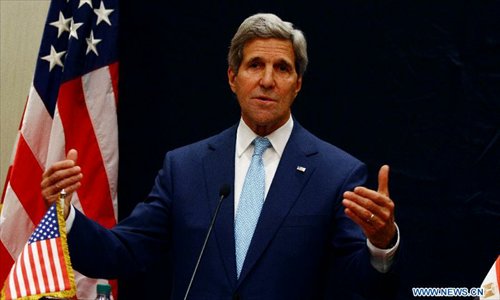
US Secretary of State John Kerry speaks to the media during a press conference in Cairo, Egypt, on June 22, 2014. John Kerry held talks on Sunday with Egyptian newly-elected President Abdel- Fattah al-Sisi in Cairo in the first visit of a high-profile US official to Egypt since Sisi took office earlier this month. Photo: Xinhua
US Secretary of State John Kerry said Sunday that the US will not pick or choose any individual or series of individuals to assume leadership of Iraq.
Kerry's remarks, made during a press conference in Cairo, Egypt, in a regional visit aimed at bridging widening rifts between religious factions, came as Sunni militants advanced through west Iraq after seizing a strategic Syria border crossing.
The latest assaults saw Iraqi security forces making "tactical" withdrawals in the face of an insurgent onslaught that has displaced hundreds of thousands and alarmed the world amid fears Iraq could tear itself apart.
The militants, led by the jihadist Islamic State in Iraq and Syria (ISIS), seized the towns of Rawa and Ana after taking the Al-Qaim border crossing on Saturday, residents said.
The government said its forces had withdrawn from the towns, control of which has allowed militants to open up a strategic route to neighboring Syria, where they also control swathes of countryside along the Euphrates river valley.
Washington wants Arab states to bring pressure on Iraq's leaders to speed up government formation, which has made little headway since elections in April.
While US leaders have stopped short of calling for Prime Minister Nouri al-Maliki to step down, arguing that it is up to the Iraqis to choose their own leaders, they have left little doubt that they feel the Shiite premier has squandered the opportunity to rebuild his country since US troops withdrew in 2011.
"We gave Iraq the chance to have an inclusive democracy. To work across sectarian lines, to provide a better future for their children," US President Barack Obama told CNN Friday.
"Unfortunately what we've seen is a breakdown of trust."
The seizure of Al-Qaim leaves just one of three official border crossings with Syria in the hands of the federal government. The third is controlled by Kurdish forces.
Anti-government fighters already hold areas of the western desert province of Anbar, which abuts the Syrian border, after taking all of one city and parts of another earlier in the year.
Elsewhere, Iraqi government forces, fighting back against the insurgents after initially wilting before their onslaught, Sunday launched an air strike on the militant-held city of Tikrit, killing at least seven people, residents of the city said.
Kerry was also due to visit Amman, Brussels and Paris.
"First and foremost, we are urging countries that have diplomatic dealings with Iraq and that are in the region to take that threat as seriously as we do," a senior State Department official said.
"Second, we are underscoring the need for Iraqi leaders to expedite their government formation process and to come together around a new government that is inclusive."
The official, speaking on condition of anonymity, also noted that "a lot of the funding and support that has over a long period of time fueled extremism inside Iraq has flowed into Iraq from its neighbors."
While Kerry is also expected to travel to Iraq, it was not known when he would do so.
Also on Sunday, Iran's supreme leader condemned US intervention in Iraq.
The statement by Ayatollah Ali Khamenei was the clearest statement of opposition to a US plan to dispatch of up to 300 military advisers in response to pleas from the Iraqi government and runs counter to speculation that old foes Washington and Tehran might cooperate to defend their mutual ally in Baghdad.
"We are strongly opposed to US and other intervention in Iraq," IRNA news agency quoted Khamenei as saying. "We don't approve of it as we believe the Iraqi government, nation and religious authorities are capable of ending the sedition."
"American authorities are trying to portray this as a sectarian war, but what is happening in Iraq is not a war between Shiites and Sunnis," said Khamenei.
Accusing Washington of using Sunni Islamists and followers of ousted Iraqi leader Saddam Hussein, he added: "The US is seeking an Iraq under its hegemony and ruled by its stooges."
Newspaper headline: Iran supreme leader condemns US role as ISIS advances further
Posted in: Mid-East, US, Surrounding countries