How foreigners in Shanghai can communicate with drivers
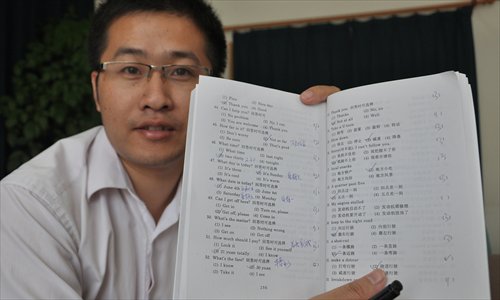
Driver Pu Yongping shows the materials he used to prepare for the advanced five-star taxi exam. Photo: Huang Lanlan/GT
Swiss businessman Boro Petric is very familiar with the Shanghai taxi system. Having lived in the city for eight years, he takes taxis every second day to go to work. He doesn't speak Chinese so this is a constant problem.
"Every time I go somewhere I have to remember the Chinese pronunciation and repeat it several times to make sure it is correct," Petric told the Global Times. He is lucky in having a Chinese wife. She guides him with pronunciation and if he still has trouble communicating with a taxi driver he can call her and ask her to speak directly to the driver. Occasionally she writes his intended address in Chinese on paper or sends it to his mobile phone so that he can just show this to a driver.
Over the years he has had a few problems with taxis - but most of these were caused by his inability to communicate. So when he was asked about English-speaking taxi drivers in Shanghai he almost burst out laughing. "During my eight-year stay in this city, I only met one English-speaking driver and that was in 2012," he said. "I was very surprised - I thought why is he driving a taxi and not teaching English?"
A select group
There are some 100,000 taxi drivers in this big international city but very few speak English. One of this select group is 35-year-old Zhang Lihua. After joining the Dazhong Taxi Company in 2003, he later went and studied English at night school. "I didn't care about getting a diploma," he said. "All I wanted was to learn something useful for my work."
The year before he began his English classes in 2007 Zhang recalled picking up a Russian on Pudong Avenue. The man had just been rejected by several taxi drivers.
"He spoke English, but all the drivers there, including me, didn't understand English," Zhang said. "I felt it would be a disaster if I was missing out on customers just because of a language problem."
These days, with his English classes behind him, Zhang can talk to his passengers and often practices his English with foreigners. More than 50 percent of his regular bookings now are with expats - and another English-speaking driver Pu Yongping, with Dazhong taxi reports a similar figure.
Pu began learning English in 2002, two years after he became a taxi driver. He bought several English language tapes and listened to them while driving. Conversing in English now is not a problem.
Most of Pu's regular expat passengers book his cab through e-mails and instant message applications like WeChat and LINE. He has installed almost all of these apps to stay in touch. "This is a typical message," he said, showing the Global Times his phone. "This Hungarian man asked me to pick him up yesterday from his new apartment."
Pu's reply, though not perfect English, was clear and easy for his client to understand. "Now I going to Pudong Airport. It end will 11:00. Arrive your new home will 11:45."
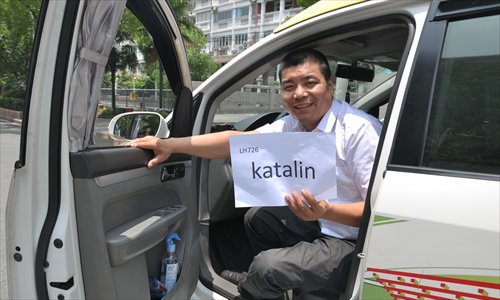
Zhang Lihua gets ready to pick up one of his regular passengers from Pudong International Airport. Photo: Huang Lanlan/GT
Asked for help
Confirming Petric's experience that finding a Shanghai taxi driver who can speak English is incredibly rare, Zhang said over 97 percent of the drivers in his company didn't speak English but many ask Zhang or Pu for help if they had trouble understanding a customer. Usually the queries involve prices and destinations or ascertaining which of the train stations in Shanghai the passenger really needs to get to.
"One day last year I had a call from a colleague because the expat in his car had given him 400 US dollars when the meter showed 400 yuan ($64). "I talked to the passenger and explained what the fare really was."
Zhang and Pu received calls like this almost every day, suggesting there is a need for more English-speaking taxi drivers in the city. However - and most people don't know this - every taxi driver in Shanghai has undergone an English test before getting his or her license.
The Shanghai Municipal Transportation Commission confirmed that the English test, of four or five multiple choice questions, is included in the taxi driver license exam.
"The questions are quite simple, and very easy to answer," said Shen, a staff member at an exam administration department of the commission's transportation test center.
On the Internet an example of a typical question involves the applicants asking whether he should say where, when, why or how to complete the sentence "__ are we going?"
There are advanced examinations for senior taxi drivers to obtain star ratings. This also includes an English test and according to Hu Chuanhua, an instructor at the Jinjiang Taxi Company, this test is much more difficult than the simple multiple choice questions asked in the basic test.
"There is an English comprehension test in the 'three-star' examination," Hu told the Global Times. "For the four- and five-star exams, candidates have a five-minute face-to-face oral test, in which they have to treat the examiner as a foreign passenger and talk to him in English."
Every year more than 1,000 drivers apply to sit the star tests but Hu declined to provide any further details like the pass rates.
Multiple choice
Pu passed the five-star test in 2008 but he said these tests were not enough to guarantee a taxi driver's English was adequate along with the fact that they involved oversimplified multiple choice questions.
Pu and Zhang agreed that looking after foreign clients was never just about learning two or three simple English sentences. These two have learned the bilingual names of the major hotels in the city as well as committing to memory the arrival times and terminals of many of the major international flights.
"And I like to really talk to my passengers, like chatting about Manchester United or Chelsea with British people or NBA teams with Americans," Zhang said. "They are very happy to talk about these things."
Pu talked about one woman, a Hungarian who hailed his cab in Changning district once. Because he spoke English he was able to help her in a way his non-English speaking cabbie colleagues never could. She wanted to be taken to a big supermarket. "I was able to tell her that the Gubei Carrefour was close and was popular with expats. We went there and she was very happy."
Five or six years ago, for the World Expo 2010 in Shanghai, some of the major taxi companies in the city began setting about improving their foreign language services.
"In 2009, we organized once-a-month English classes for our staff," Luo Qitian, a senior official at the Dazhong Taxi Company, told the Global Times. "Nearly 100 taxi drivers took the classes."
The company stopped the classes after the Shanghai Expo. Luo explained they were discontinued because English was not compulsory for drivers and most of them were middle-aged and had difficulty learning another language.
These days it's hard to tell whether the English classes, or a brochure entitled 100 English Sentences for Taxi Drivers produced by another taxi company, were effective at all during the Shanghai Expo.
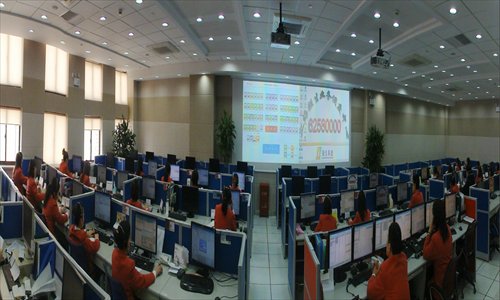
Some of the 100 staff, most of whom speak English, working at the Qiangsheng taxi dispatch center Photo: Courtesy of Qiangsheng Taxi Company
Hot line established
There are other ways of helping solve the problem. In 2006, a nonprofit service hot line, "The Shanghai Call Center" was established to help expats in Shanghai. Foreigners having a problem telling a taxi driver where to go, trying to withdraw money at a bank, giving an ayi instructions or having troubles communicating, can call the 96-2288 hot line where they can access interpreters working in more than 10 languages.
The Shanghai government promoted the hot line as an important service for the Shanghai Expo. "We found that the hot line was very helpful for foreigners taking taxis," said Yue Di, the director of the Shanghai Call Center.
The hot line still works today. "During the Shanghai Expo we were getting more than 500 calls a day but now we only get between 150 and 200," Yue said. Most of the calls involved communication problems with taxi drivers.
At the Shanghai Call Center, some 50 hot line operators are on hand during the day, one third are foreigners but 80 percent of the Chinese staff have studied or lived abroad. "Only people with years of overseas experiences can do this work. Expats often ask about things that are common to them but rarely seen in China's English examinations - like where to buy cream cheese or mozzarella," Yue said.
Some taxi companies also created their own foreign language hot lines. The Qiangsheng Taxi Company has equipped all of its 13,000 taxis with a special radio dispatch translation service. Drivers who can't speak English and need help can push the "translation" button in their cars.
"We have more than 100 staff at the dispatch center and most of them can speak English - three or four speak Japanese," explained Ding Yunping, the director of the dispatch center.
Many translation problems occur over the names of hotels. "For example, the Gran Melia Hotel at Lujiazui was renamed the Kempinski Hotel last year, and that has confused drivers," Ding said. The dispatch center holds training classes for its staff every week, constantly updating the English names for destinations all over the city.
Ding said foreigners can also ask the dispatch center for help by calling 6258-0000, the company's service hot line. Center staffers work as hot line operators.
Operator Ma Hui, 30, has worked there for nearly four years and said she receives calls from foreigners every day, most of them about problems in booking a taxi.
Sometimes there are complaints. Like the young woman who complained two months ago that a taxi driver had charged her an extra 30 yuan on a regular trip. "The driver told me that the shortest route that day was blocked because of serious traffic congestion and so I explained this to the woman."

Operators on duty at the Qiangsheng taxi dispatch center Photo: Courtesy of Qiangsheng Taxi Company
Unpublicized
But do the foreigners in the city actually know about all these useful free translation services? Petric, who has lived here for eight years, said the services haven't worked for him simply because he had never heard of them.
"I often take taxis but I've never seen a translation button. If they have these they should use them. If there is a hot line the number should be in the taxis with signs that clearly explain 'Please call this number and you will be supported with English services.'"
Hot line operator Ma also warns foreigners to only show Chinese addresses to taxi drivers - pinyin is not enough. "There are lots of homophones in Chinese, and many cabbies don't understand pinyin."
Newspaper headline: Taxi talk