HOME >> METRO BEIJING
Visiting the ‘foodseum’
By Li Lin Source:Global Times Published: 2014-7-21 18:38:01
Museums tempt visitors with delicious exhibits
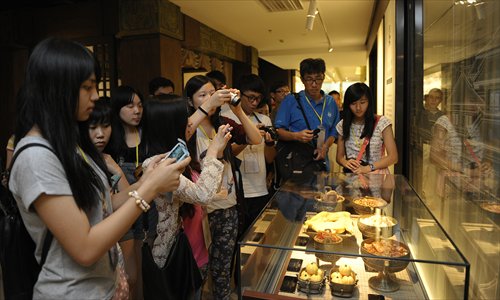
Visitors at the Chinese Royal Gastronomy Museum marvel at ancient imperial dishes. Photo: Courtesy of Chinese Royal Gastronomy Museum
As the cultural heart of China, Beijing ranks second globally for its number of museums with more than 3,000. The Palace Museum and National Museum of China rank among the city's most popular places with their priceless relics, but for a taste of something different it's worth visiting museums dedicated to food.Qi Qing, a 29-year-old self-described "experienced foodie," recently enjoyed the delicious combination of mending roubing (doornail meat pie), Xi'an cold noodles, Taiwan pineapple cake and Hunan-style stinky tofu at the Zhonghua Snacks Museum on Wanfeng Lu, Fengtai district.
"The most impressive food I had today was mending roubing, a traditional fried pie with a beef filling. It is said to have been favored by Empress Dowager Cixi (1835-1908) in the late Qing Dynasty (1636-1912)," said Qi.
Its "doornail" name derives from its small size, with each pie measuring about five centimeters in diameter and three centimeters in thickness.
"I'd never heard of it before. I thought I knew most traditional snacks in Beijing, but I was surprised to learn there are still many unfamiliar ones," added Qi.
The museum opened in 2010. Its ground floor serves as a food court with around 3,000 different traditional snacks from all over the country. Its second floor, covering about half a hectare, is a display area for more than 1,000 antiques steeped in traditional Chinese food culture.
The museum's owner is Hou Jia, president of the Beijing Traditional Snack Association and founder of the Jingshi Jiumen Snack Management Company. Hou said in a November 2012 report by pedaily.cn, an investment news portal, that the museum was established to preserve the culture of traditional Chinese food and counter the unhealthy rise of foreign fast-food.
"Most of our traditional food is healthy and low in fat compared with hamburgers, fried chicken, fries and cola," Hou was quoted in the report as saying. "Every type of food has a profound history and impressive cultural story, which should be remembered by people - that's why the museum was founded."
As Beijing's most famous dish, Peking duck has even inspired its own museum in the capital at a downtown branch of Quanjude, a famous roast duck restaurant chain. The museum opened in July 2014 to coincide with Quanjude's 150th anniversary.
Visitors to the museum learn that ducks have been eaten by Chinese for at least 2,000 years, according to the ancient history chronicle Zuo Zhuan. The history and culture of duck consumption is represented by more than 50 exhibits at the museum, including classic recipes and cooking artifacts.
Perhaps the most interesting exhibit at the Quanjude Museum is a large wooden pail that can hold 150 liters of water, which was used to test whether newly recruited employees at Quanjude were strong enough to work at the restaurant.
For people who appreciate the finer side of dining, the Chinese Royal Gastronomy Museum in Haidian district beckons.
Renowned as an "edible museum," it offers traditional imperial dishes from the renowned Manchu and Han Imperial Feast held over three days during the Qing Dynasty. Additionally, dining rooms at the museum are full-scale replicas of those in the Palace Museum.
Imperial snacks such as rolling donkey (a glutinous rice dessert), fried millet cakes and jujube buns are just some of the offerings visitors can sample at the museum. Gao Wei, a folklore expert, noted that Beijing fulfills an important role in protecting the heritage of food at its museums.
"Although the museums might promote certain restaurants, it is worth commending these companies for operating museums despite the high costs," said Gao.
"Food meets people's basic desire for nourishment, while food museums meet people's higher desire for culture."
Posted in: Intel