Modern moves
Contemporary dance group collaborate with international experts to stage new show
Shanghai-based experimental modern dance studio D.Lab will premiere their original work Invisible Cities at Shanghai Theatre Academy this September.
The show will feature four different pieces, namely A Double Life, Outspoken, Floating Flow Mark, and Deluge, created by both well-known and emerging artists from China and overseas. Each piece is an independent work in which artists will share their own understanding of the theme "invisible cities."
The work got its name from Italian writer Italo Calvino's novel Invisible Cities (1972). In the novel, Italian explorer Marco Polo (1254-1324) tells the Chinese emperor Kublai Khan (1215-94) of the different cities he saw on his expedition to China. The cities Polo describes are perfect, but exist only in his mind.
"Cities, like dreams, are made of desires and fears, even if the thread of their discourse is secret, their rules are absurd, their perspectives deceitful, and everything conceals something else," wrote Calvino.
D.Lab's founder, Duan Jingting, said she chose the theme because she likes the city. "There are all kinds of people in a city who express their different emotions every day. It's full of energy and dynamism," she said.
In 2011, Duan gave her first dancing performance, called Shanghai Jungle, with the city as the main theme.
In her understanding, the city we see may not be what it truly is. "There are numerous stories happening in a city and what we see is only a small part. So many things are actually invisible to us," she said.
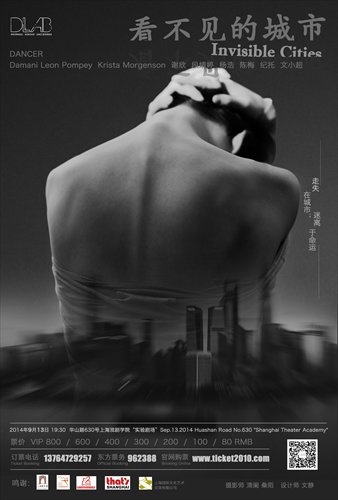
A poster for Invisible Cities Photos: Courtesy of D.Lab
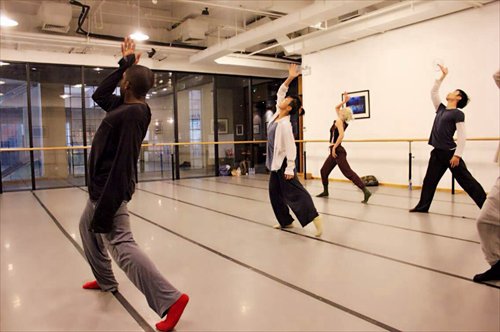
International dancers rehearse in Shanghai.
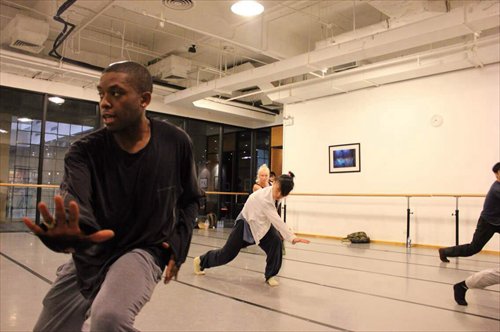
International dancers rehearse in Shanghai.
To Krista Morgenson, a performer in Deluge, the concept of the city is more about the people and the energy they give off, be it frazzled, calm or eccentric. "Without people, a city is just a bunch of buildings; the people are the vitality and creative force," Morgenson said.
"The concept of the 'invisible city' depends on your awareness of the world. When you are not very aware of a city, it's invisible. Only when you're immersed in it can you discover it," said Morgenson, who grew up in a very quiet and easygoing town in Nebraska, the US and had never thought about Shanghai before actually coming here. "The city was pretty invisible to me until I came here. This has been an entire world unto itself, unlike anything I ever experienced. Everything is different and fascinating."
Highlights of the show include simulated rain falling on stage, a poetry reading and live DJ music, all of which take place against the backdrop of an all-white stage. "We hope such design elements can help the audience understand what the artists are trying to express and get them fully immersed in the atmospheric performances," Duan said.
Carol K. Walker, judge of American reality TV show So You Think You Can Dance Las Vegas 2013, serves as art director for the show. With choreographers and dancers from New York, Hong Kong, Beijing and Shanghai all collaborating on the work, she said achieving mutual understanding during rehearsals was a challenge. But they soon found a way of using minimal words and a lot of body language to communicate effectively.
"Dance language is universal. The language barrier they ran into was only an issue on the first day of the rehearsal process when I translated for them, but now they are able to understand each other through body language without translation," said Hua Xia, executive director for international programs at D.Lab.
"Speech comes last and movement comes first. Now we are as acquainted as a family and understand each other through our movement, rather than relying on speech. I found the Chinese dancers relate most to quality. Therefore, it is easy to show how it should feel rather than say how it is done," Damani Pompey, a New York choreographer and dancer, said.
Founded last year by Duan, a preeminent ballerina and a finalist in last year's So You Think You Can Dance China, D.Lab claims to be the city's first private modern dance studio. This is only its second production, eight months after its first, entitled Love, staged to a full house last November.
"Every time we perform, every dance that's born, is really a kind of laboratory experiment," Duan said.
Duan graduated from the Shanghai Dance Academy, worked in the Shanghai Ballet Troupe for seven years and in the Hong Kong Ballet for almost a year. "I prefer modern dance to ballet as it allows for a free expression of real life," she said. "Everyone can get something different from the dance."
"Compared with a film or a modern drama, a dance seems more abstract, easily creating distance between the dancer and the audience. But now more people in China are getting to know the art form, be it ballet, folk dance or modern dance. As long as they want to see a dance performance, it's a good thing for us," Duan said.
"A great modern dance performance has to be fulfilling and innovative, yet pay homage to tradition," Pompey said. "It should be relatable to the public and artistic communities simultaneously. When the dancers move, we can almost witness their story of how they became and how they plan to continue their journey. They have the ability to touch masses by knowledgeably moving their souls on stage."
Date: September 13, 7:30 pm
Venue: Shanghai Theatre Academy
上海戏剧学院
Address: 630 Huashan Road
华山路630号
Tickets: 80 yuan ($12.96) to 800 yuan
Call 137-6472-9257 for details