France requires bold vision in China
New ambassador talks of need to reinvigorate Sino-French relationship
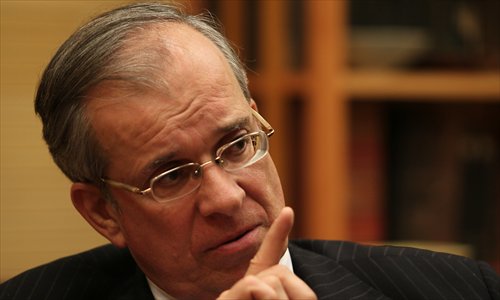
Maurice Gourdault-Montagne, ambassador of France to China, during an exclusive interview with the Global Times Photo: Cui Meng/GT
Editor's Note:
Incoming French Ambassador to China, Mr Maurice Gourdault-Montagne, in his first interview with the Global Times, says the time is ripe for a new boldness in Sino-French relations.
"Let's be bold. The two countries decided in 1964 to make a breakthrough in our relationship. We should be bold enough now to make something we can work together," said Gourdault-Montagne. In the following conversation, the new ambassador presents his views on reinventing ties between the two nations.
GT: What is the priority for your administration?
Gourdault-Montagne: My priority will be reinforcement of our economic ties. But I also would like to give a great emphasis to a flourishing human relationship between our two countries, which means people-to-people exchanges.
We have 35,000 Chinese students in France now, and we've fixed the target of welcoming 80,000 students in 2020. It is important since we rely on these youths to be the partners of our economic ties in the next years.
Tourism is also a way to know each other better. We welcome more tourists to France. That's why we developed the 48-hour visa [approval] system. We had 1.7 million Chinese tourists to France this year. We want them to feel more and more at ease in France.
GT: What has caused France's increasing trade deficit with China during recent years? What measures will be taken by you to promote economic cooperation of the two countries to achieve a "new balance?"
Gourdault-Montagne: It's true that we have had this imbalance because the French economy has weakened in past years. We are now taking measures to revive our competitiveness and overturn the economic downturn.
Let me talk about our major orientations: First of all, we want to lessen state expenditure. Our government pledged to diminish state expenditures by 50 billion euros ($63 billion) in the next three years. Secondly, we want our companies to have margins of profits for investment, for which we will help in diminishing taxes by 40 billion euros for them in the next three years. This will give our companies more competitive potential. We implemented some tools, for instance, research companies won't be compelled to pay their taxes immediately and can be given a tax credit up to a certain amount. It's open to everyone, not only to French companies, also to Chinese companies, so what we want is to create an environment for economic development, investments, foreign investments, and of course Chinese investments. We need investments, not only in real estate, but also in productive industry because we have a good labor force in France, well-qualified. Many Chinese companies who have invested in France have been very satisfied. We want to create a better environment and better conditions for better investment.
GT: Is it possible the two countries can jointly develop third-party markets?
Gourdault-Montagne: I would mention Africa. China is investing in Africa, which is welcomed by Africa. France has strong positions in Africa because of its history with the continent. We know Africa quite well. Wouldn't it be possible for the two countries to work together in Africa, for instance in the field of health against infectious diseases? Or in the fields of logistics, infrastructure, and in agriculture? Africa is the continent of the future, and countries which are committed like China and France can do a lot in Africa for the well-being of Africa. Let's be bold.
GT: What's the potential and advantage in economic and trade cooperation between China and France compared with China-Germany and China-Britain?
Gourdault-Montagne: I think everyone has its own advantages. Britain has great knowledge of finance and Germany is a manufacturing country.
But France is at the crossroads of Europe because we have very close ties to Germany, and we have close ties to southern Europe and Africa. Moreover, France is a country with a lot of experience in dealing with global issues, in dealing with the world. Our country is fully developed and is renewing itself. There is a new edge to France.
GT: President Hollande recently issued a statement that France would suspend the first delivery of two Mistral-class warships to the Russian navy because of Russia's support of breakaway forces in eastern Ukraine. Does it mean that France and its allies start to share the same position on the sanctions against Russia?
Gourdault-Montagne: It's not a sanction, it's only a measure of suspending the decision because what happens in Ukraine is a matter of concern to us. Ukraine is a sovereign and independent country, and we could not recognize the annexation of Crimea.
That's a commercial contract, there is no reason why we should not respect our commercial contract, [but] for the moment there is this situation which has brought us to suspend the delivery of the first vessel.
And I repeat, as our President said, if the situation changes, if peace comes back, if there is settlement to the crisis, there will be the delivery.
GT: France announced reconnaissance flights over Iraq to assist the US against IS a few hours before the crisis meeting in Paris. What's France's consideration on this issue?
Gourdault-Montagne: The word IS, which means Islamic State. But this is not a state, this is a movement which they decided, yes, "we are the state." It's a so-called Islamic state, but they neither are a state, nor do they represent Muslims. They propagate terror.
So we must eradicate this movement, we must destroy it and find a lasting political solution. Hence the conference we organized in Paris last week, where five permanent UN Security Council members, including China, tried to push for a solution. All the stakeholders should be part of the discussion, including in states of the region and even Iran.
GT: Since there is still a divergence between China and developed countries over the responsibilities toward dealing with climate change, what role should China play in curbing climate change?
Gourdault-Montagne: I think it's a major challenge for the whole world. We don't have the same history; we are not at the same step of our industrialization. We don't share the same interests. Every single measure which will be announced [at the 2015 Paris Summit] should not be legally binding, but there must be a prospect on the issue.
Europe is important, but there won't be success without China. China will be a major part of the success, so we are very confident that China's contribution and commitment will be very important.
GT: In your personal video you emphasized "China has changed a lot, but its spirit hasn't changed." Which Chinese spirit in your view hasn't changed?
Gourdault-Montagne: I would like to say longma jingshen (striving to be the best). This longma jingshen has also been worked out in France. The spirit of China is reviving itself all the time, repairing damages, renovating itself. That is the Chinese spirit.