China’s annual consumer inflation at five-year low
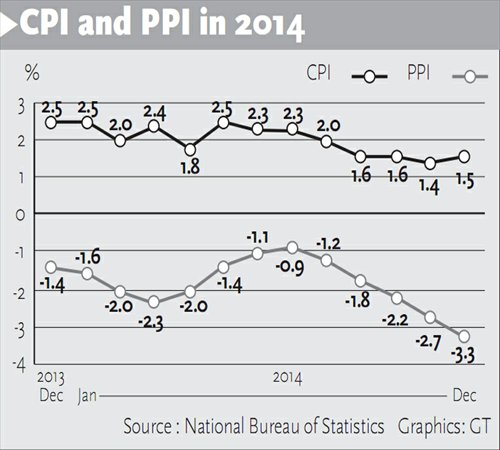
Graphics: GT
China's consumer inflation ticked up slightly in December driven by higher food prices, but leaves the annual inflation at a five-year low, official data showed on Friday, which analysts believe would give policy makers more leeway to prop up the economy.
The consumer price index (CPI), the main gauge of inflation, was released by the National Bureau of Statistics (NBS) on Friday. The figures showed the CPI had nudged up to 1.5 percent year-on-year in December from the previous month's 1.4 percent.
The uptick in December reading was mainly owing to higher food inflation which quickened to 2.9 percent from 2.3 percent in November, while non-food inflation eased to 0.8 percent in December from the previous month's 1.0 percent, said NBS statistics.
Throughout 2014, the CPI was up 2.0 percent on a yearly basis, the lowest level in five years.
Meanwhile, the producer price index (PPI), a measure of inflation at the wholesale level, was announced by the NBS to have fallen further in December, the 34th straight month of decline and the biggest fall in more than two years.
The PPI deflation deepened to 3.3 percent in December from 2.7 percent in November, the NBS data showed.
The worsening PPI was mostly attributed to the continued slide in international oil price, Yu Qiumei, a senior NBS statistician, said in a statement posted on the bureau's website.
The subdued inflation profile triggers speculation about further policy easing to help revive the flagging economy that may miss its annual growth target of around 7.5 percent set for 2014.
"We see intensified downside risks to our 2015 CPI inflation forecast of 2.0 percent, given the further drop in oil and commodity prices in the past week, in addition to softening domestic demand and global outlook," Barclays Capital economists Chang Jian and Zhou Yingke said in a research note e-mailed to the Global Times on Friday.
The Hong Kong-based economists projected two additional cuts in benchmark interest rates in the first half of the year, as well as three cuts in the amount of cash that banks must hold as reserves throughout 2015.
Concerns over near-term growth prospects and disinflationary pressures are likely to lead to the announcements of pro-growth fiscal measures and tweaks in monetary operations, Zhu Haibin, chief China economist at JPMorgan Chase & Co, also wrote in a note e-mailed to the Global Times on Friday.
In particular, the worsening PPI raises the possibility of further monetary loosening in the near future, according to Zhu, who forecast a cut in both interest rates and reserve requirement ratios (RRRs) in the first quarter, followed by another RRR cut during the second quarter.
China will continue to implement a prudent monetary policy while focusing more on the tightness or looseness of monetary policy, making tweaks to the policy in a moderately and timely fashion, the People's Bank of China (PBC), the country's central bank, said in a statement on its website on Friday which outlines its policy stance over 2015.
Among the major tasks for the central bank in 2015 is a continuation of the targeted fine-tuning to guide financial institutions toward furthering liquidity boosts for key areas and weak industries, and increased support for the real economy by further reducing financing costs, according to the statement, hinting at more flexibility around taking policy actions.
China's latest monetary policy fine-tuning came on November 21 when the PBC surprised the markets with an announcement of interest rate cut that reduces borrowing costs for the first time in more than two years.
In anticipation of an additional reduction in benchmark interest rates before the Spring Festival, which falls on February 19 this year, Liu Dongliang, a senior analyst with China Merchants Bank in Shanghai, also warned the markets to be vigilant against the adverse impact of deepening PPI deflation that would intensify the suffering of particularly mining, and raw materials industries.
Despite worries that subdued inflation reflects weak domestic demand, Lu Zhengwei, Shanghai-based chief economist at Industrial Bank Co, said the central bank is still unlikely to deliver deeper interest rate cuts as soon as in the first quarter.
"It would take several months for the interest rate cut [announced in November] to affect the economy, and thereby further monetary policy actions are unexpected until after the first quarter," Lu told the Global Times on Friday.