Sound vision
Teacher aims to enable each student to play an instrument
In Jinshan district's Shanyang town (population 35,000), one in every four residents can play a traditional Chinese musical instrument.
The town was dubbed a Chinese Folk Music Cultural and Arts Town by the Ministry of Culture in 2008. Many of the instrument-playing residents were taught by Wu Yongxiang or one of his students. Wu is a 77-year-old retired teacher who used to work at Shanghai Shanyang Middle School in the district.
Wu was a resident of downtown Shanghai, but on graduation he was assigned to teach math at the school in 1960. Playing various traditional Chinese musical instruments was his hobby. As an undeveloped town in the countryside, very few residents could play musical instruments. So Wu started teaching music to his students for free in his spare time. His class made up a Chinese folk music orchestra.
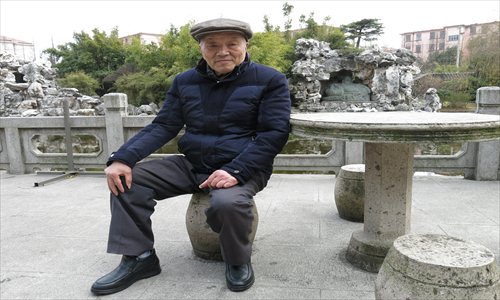
Retired teacher Wu Yongxiong devotes himself to music education in a Shanghai suburb. Photos: Du Qiongfang/GT and from the Internet
"There were no arts or sports activities for countryside children at that time. So they were interested in playing instruments. I also took the students to teahouses to perform. It served as a kind of social activity for them," said Wu.
While many downtown schools had their own orchestras, these were made up of the most talented players with professional training.
Wu's aim was not developing professional-level playing in his students. "I believe art education should be available to every student no matter what level they can reach. Art education can cultivate all-round students and improve their temperament," said Wu. His students would practice during their lunchbreaks.
Although his effort was supported by school leaders and the education authority, many parents were opposed in the beginning. They thought playing instruments was a waste of time and would negatively affect the students' academic performance. But Wu believed that practicing for an hour a day would help the students relax and improve their academic performance.
Before Wu took up his position, the school was among the worst-performing in Jinshan. However, it improved after Wu began teaching music.
In one maths competition, four of the top six winners were Wu's students. His students also got excellent results in their school entrance exams. Four of Wu's students were accepted into the renowned Shanghai High School's senior high school mathematics class, which only recruited 40 students across the city each year.
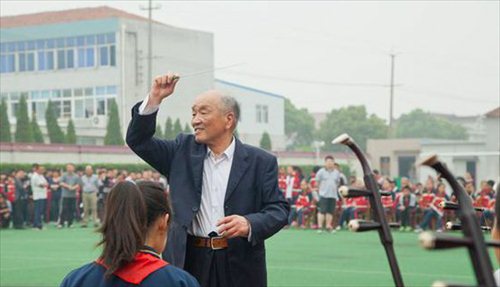
Retired teacher Wu Yongxiong devotes himself to music education in a Shanghai suburb. Photos: Du Qiongfang/GT and from the Internet
Life skills
Wu said that by practicing and rehearsing together, the students learned to be more organized and disciplined and confident. "In art education, I focus on the progress instead of the result. I did not intend to improve their performance level, but rather to improve their study attitude and behavior," he said.
"Their morality was also improved as I also incorporated the school's code of conduct into a Shaoxing opera that I wrote," Wu said. "With these good behaviors and habits, students became more organized in their study. I brought them happiness with music education. So they were fond of me very much. When students like a teacher, they try to focus on the teacher's lesson and learn the teacher's subject well."
Wu believes there are no bad students, but rather students who have been failed by education.
Since Wu's students were so successful, all the parents in the town wanted to send their children to Wu's class.
Wu's last class graduated in 2006, and was made up of 72 students. The school set up a special classroom for the big class. The students' mathematics and English performances in the senior high school entrance exams were the best in Jinshan district, while in Chinese they ranked second and in physics and chemistry ranked fourth in the district.
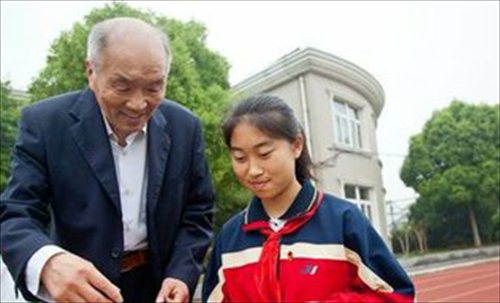
Retired teacher Wu Yongxiong devotes himself to music education in a Shanghai suburb. Photos: Du Qiongfang/GT and from the Internet
To date, Wu has personally taught nearly 1,000 students in the town. In some families, three generations of family members, from grandparents to grandchildren, have all been Wu's students. Some have become music teachers as well. With more and more migrant workers and their children relocating to Shanyang town, Wu's idea of "enabling each village child to play an instrument" has now become "enabling each migrant child to play an instrument."
Wu continued to teach at the school even after he reached retirement age in 2003. He had to step down last year when he lost much of his eyesight due to diabetes. However, he has promised to be available whenever the school and its students need him.