Foreigner security
Observers deny anti-laowai sentiment is brewing in Beijing despite a string of alleged attacks targeting expats
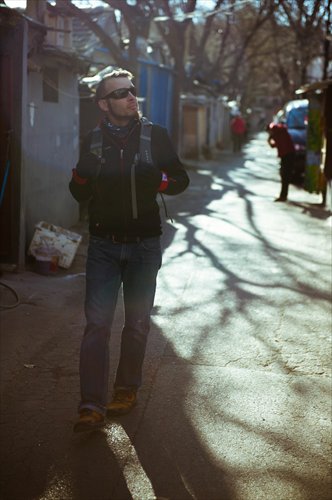
Despite rumors of attacks targeting foreigners, expats Metropolitan spoke to still think of Beijing as a safe and friendly city. Photo: Li Hao/GT
Beijing is often considered a much safer and more tranquil environment for expats compared to other international metropolises such as New York and London.
But as the city has become increasingly diverse after three decades of rapid development, certain problems that used to only worry foreigners living in developed countries have become concerns for Beijing's expat community as well, from living costs, to career opportunities, and most recently, safety.
Several alleged attacks against foreigners last month have caused a stir among Beijing's expat community, with some expats in the online community questioning whether it is a sign of growing anti-foreigner sentiment in the city.
The first of the reported incidents occurred in the early hours of December 14 in the Sanlitun area of Chaoyang district.
The alleged victim of the attack, a 28-year-old born in Nigeria who asked to be identified under the pseudonym "Sunny boy" for fear of retaliation, said he was waiting for taxi with his date, a woman from Mongolia, when a wagon approached, with a group of men wielding metal rods.
"They were shouting at my date and asking if she is Chinese," he said. He tried to explain that he didn't want any trouble, but several of the men jumped out of the vehicle, and after asking him a few "random" questions, started beating him with metal rods. He said he did not fight back because he did not want to escalate the situation. Eventually, he said, they relented for long enough for him and his date to get into a cab. He speculated they may have stopped after finding out that his companion was not Chinese.
"Sunny boy" said that he did not go to police because his injuries were not too severe, and because he did not think he could communicate well enough in Chinese.
Around fortnight later, a similar incident occurred near the campus of the Beijing Language and Culture University in Wudaokou, resulting in the arrest of three men after allegedly attacking an Australian student who has only been identified in media reports by his first name, Michael.
According to expat blog Beijing Cream, Michael was walking back to the university with his South Korean girlfriend at around 3 am on December 21 when the alleged attack occurred. A number of students came to his assistance, subduing the attackers until police arrived on the scene.
A spokesperson with the Beijing Municipal Public Security Bureau confirmed to Metropolitan the arrest of the three men, though he dated the incident to December 31. The spokesperson said two of the men were of Chinese nationality, surnamed Liu and Wang, and that the third was a Chinese-American surnamed Wang. The spokesperson declined to comment on whether the two cases were linked or the possible motive of the attacks as the case was "still under investigation."

Experts have characterized the alleged attacks as isolated incidents, rather than being motivated by wider anti-foreigner sentiment. Photo: Li Hao/GT
Isolated incidents?
Pi Yijun, a criminal psychology professor from China University of Political Science and Law, said that he did not think the rumored attacks were indicative of anti-foreigner sentiment, but were merely isolated incidents of violence. He said any such attacks, regardless of motivation, did not reflect the views of Chinese people toward foreigners as a whole.
"The motive behind the attacks is not clear yet," said Pi. "It could be that there was a personal grudge between the victims and the attackers, or the attackers were hired by people who had personal grudges against the victims."
At the time of going to press, Beijing police did not respond to questions about whether the men arrested knew the victim prior to the attack.
Lu Huajie, a sociology professor from Peking University, also rejected the idea that there was any popular anti-foreigner sentiment in Beijing, although he admitted Chinese attitudes toward foreigners had changed in the past few decades.
"Twenty or 30 years ago, when there were very few expats living and working in Beijing, foreigners were deified," said Lu. "It was like the old Chinese saying, 'Foreign monks give better sermons.'" With the influx of foreigners to China's cities in recent years, and Chinese people's greater exposure to Western systems of knowledge through studying or working abroad, "Chinese people were now more likely to see foreigners as their equals, rather than as being superior," Lu said.
This greater exposure to the foreigners also meant that Chinese people were less inclined to view expats as being all the same, whether positively or negatively, said Lu.
Popular sentiment toward foreigners was tarnished in two widely publicized incidents in May 2012, when a British man was arrested for allegedly sexually assaulting a Chinese girl in the street in Dongcheng district, and a Russian cellist was caught on video verbally abusing a middle-aged Chinese passenger in a train from Shenyang to Beijing.
But in November last year, when an expat cyclist willfully blocked a car that was illegally driving in a bicycle lane in Chaoyang district, his behavior was widely praised among China's social media community.
"These were just individual cases, but they have given locals a clearer and more objective view toward foreigners," said Lu. "Chinese people now see foreigners are human beings like themselves: Some are good, some are not." Lu said that the changes in how foreigners are viewed is a normal process in a city's development. "It doesn't mean there is an anti-foreign sentiment brewing among the locals."
He added that some employees in service industries, such as taxi drivers or restaurant wait staff, might feel awkward or uncomfortable attending to foreign customers because of the language barrier, but this did not mean they were hostile toward foreigners. Incidents of violence between foreigners and Chinese people were not racially motivated, but a simple consequence of there being more expats in China, said Lu.
"The simple fact is that there are more foreigners now [in Beijing], and sometimes, there will be conflicts between a foreigner and a Chinese person, [just as there are between Chinese people]," Lu said. "Overall, Beijing is a safe and friendly city for foreigners."
Voices from the expat community
Foreigners Metropolitan spoke to were also measured in their response to the alleged attacks.
"I think they are just isolated incidents. We have to be careful to generalize Beijing as a foreigner unfriendly city based on these isolated incidents," said Jim Boyce, a wine consultant from Canada who has lived in Beijing for a decade.
Boyce said that he was not scared by the incidents, and that it was important to put things into perspective.
"Violent accidents happen in every city around the world," said Boyce. "[Before coming to Beijing], I stayed in Seoul, South Korea for three years. There were also some men who got upset and violent when they saw a foreign man with a South Korean woman. Even in my hometown in Canada, a country of immigrants, there are also people who don't like foreigners."
Boyce said that one thing that did alarm him was the fact that the alleged attacks seemed to be unprovoked.
"This isn't about some argument in a club or on the street which escalated into violence. It's about attacks on people who are minding their own business," said Boyce. "[But] from my experience in Beijing, it's a safe and friendly city in general."
Stephannie Tebow, a counselor at Harrow International School, said she considered Beijing to be the safest city she had lived in. Originally from the US, Tebow has lived in cities around the world including New York, Los Angeles and Amsterdam. "In New York, I had to carry a gun when I walked through some streets. In Amsterdam, I was told not to sleep in my bed in case there was a gun fight in midnight," said Tebow, who has lived in Beijing for more than 10 years. "In Beijing, I never have to worry about being attacked."
Speaking directly about the alleged attacks, Tebow said that some of her Chinese friends had expressed dissatisfaction about Chinese women marrying foreign men, but it was important to put it into context.
"Sometimes the locals don't like me, but that only makes the city human, because everyone is entitled to their prejudices," she said. "The city has over 20 million people, you can't expect everyone to like you and say hello to you like in your hometown where you grew up…As a visitor to the city, it's our responsibility to adapt to the city we are in, not to provoke the locals."
In general, said Tebow, she found Beijing to be a friendly city. She said on one occasion, when her mother who was visiting from the US tripped and fell to the ground on a busy street, passersby were quick to help. Another time, Tebow said, she was unable to pay for a taxi ride, but the taxi driver did not kick up a fuss.
As for "Sunny boy," he said while he was shaken up by the alleged incident, he was also keen to put it into perspective. "I have only been here for six months, so I am not in a position to say Beijing is unsafe and unfriendly based on the incident."
"The incident scares me a little, but I will not leave Beijing because of that. It's the only city around the world where I could get six job offers within a month and rent a house within one day. It's a great city and it changes and improves every day," he said. "It's natural to have few bad eggs among millions."