HOME >> BUSINESS
US property investment calls for careful planning
By Liu Tian Source:Global Times Published: 2015-1-27 17:43:02
Following the pack could backfire for foreign buyers
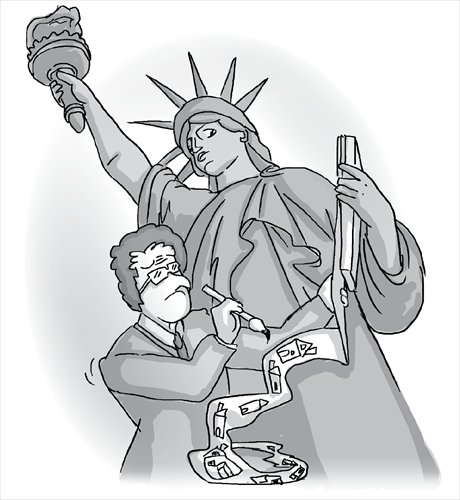
Illustration: Lu Ting/GT
According to recent media reports, more and more overseas investors are piling into the US real estate market, an area which for decades has been dominated by local tycoons, pension funds and private-equity firms.
According to statistics from market researcher Real Capital Analytics, foreign investors spent $45 billion on US commercial properties last year. A substantial number of developers can be found among this group, including many big-name Asian firms.
For example, Japan's Mitsui Fudosan Co spent $259 million last month on a 92 percent stake in 55 Hudson Yards, a land parcel in Manhattan where a new office building is slated for construction.
Chinese property developers have also been out in force. China Vanke Co reportedly invested $175 million in February 2013 on a high-end residential project which it will co-develop with Tishman Speyer. Peer Greenland Group has also invested some $6 billion on development projects in New York City and Los Angeles. Other Chinese developer, including Wanda and Gemdale, have also been extending their reach into the US market.
But with so many Asian developers making inroads into the US market, we cannot rule out the possibility that many are just blindly following the crowd. Investors should do a complete and thorough investigation of the US property market before spending any of their funds. Those who are merely pulled along by the herd could face risks in the future.
Currently, it seems that many investors are trying to enter the US market at a low point as the country's economic recovery gathers momentum. Mark Zandi, chief economist at Moody's Analytics, said recently that new- and existing-home sales are expected to increase by as much as 20 percent in 2015. For Chinese developers specifically, the relatively stable policy environment and lack of intervention from local authorities make the US real estate market particularly attractive.
But as developers grasp for opportunities, they must not ignore the potential risks. Looking back at history, many hotheaded Japanese investors got burnt by an overheated US property some two decades ago.
Aside from market volatility, several other factors are worthy of investors' attention. It's not unheard of for foreign investors - particularly Chinese investors - to run afoul of complicated and unfamiliar property regulations in the US.
Federal, state and local laws frequently differ; as do tax, labor and environmental policies. For those who don't know better, violations of zoning and building code laws could lead to expensive and time-consuming project delays. Even major US businesses are not immune to legal or regulatory roadblocks.
What's more, some overseas buyers have purchased land at seemingly bargain rates, only to be stymied by subdivision approval procedures which could take months - or even years in some cases - to complete. Such long waiting and approval periods could seriously crimp an investor's rate of return.
Financing is another prominent obstacle. US-based property developers can reportedly secure loans at an annual interest rate of 6 percent. Foreign investors rarely qualify for such low rates though, given their lack of credit history in the country or local assets to offer as collateral.
The hazards and pitfalls facing foreign investors in the US are numerous and difficult to navigate. Overseas parties should make careful study of local conditions and risks before putting their money into the US market. They should also seek out the advice and knowledge of reputable local professionals who can help them navigate in unfamiliar waters.
The author is a reporter with the Global Times. bizopinion@globaltimes.com.cn
Posted in: Comments