HOME >> BUSINESS
India should be mindful of risks of inflating GDP
By Xie Jun Source:Global Times Published: 2015-2-15 17:33:04
Statistical tinkering raises growth rate, suspicions
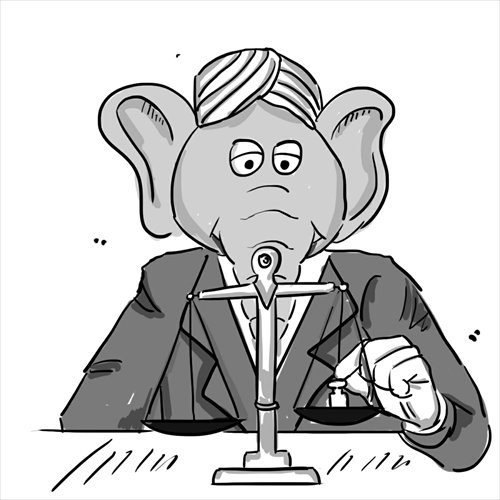
Illustration: Chen Xia/GT
Statistical authorities in India have adopted a new GDP calculation method, one that has led to substantial revisions in the pace of the local economic growth. Under the new calculation regime, the country's GDP growth rate during its 2013 fiscal year was revised from 4.5 percent to 5.1 percent. Similarly, growth in fiscal 2014 was marked up from 4.7 percent to 6.9 percent. Even more impressive results are expected for fiscal 2015, when India's economy could grow by as much as 7.4 percent.
According to recent reports citing Pronab Sen, the head of India's National Statistical Commission, the new regime is designed to "include more sectors" and "better reflect the economy." Among specific changes, Indian statistical authorities now reportedly use data from the 2011-12 period. Previously, GDP data from 2004-05 served as a statistical baseline.
It's not difficult to understand why Indian officials would set up a system that would bolster its rate of GDP growth. As the most important indicator of a country's economic health, a good-looking rate of GDP growth suggests positive development in many aspects of society. Many developing countries often endeavor to achieve the fastest growth rates possible - this includes China, where GDP growth has been a national obsession for decades.
For India's new political leadership, an impressive spike in growth could cement support for the administration of Prime Minister Narendra Modi, who campaigned last year on a platform of reviving the country's flagging economic a top priority.
The real question though is: do these new figures accurately reflect the pace of growth in India? Many, it seems, have their doubts.
"Let's not get carried away - the ground reality is very different," one senior finance ministry official was recently quoted as saying in a report from Reuters published on February 9. Anil Bhardwaj, secretary general of the Federation of Indian Micro and Small & Medium Enterprises, was also quoted on the same day as saying that the feedback he was getting on the ground was not encouraging. "(Small and medium-sized enterprises) are not getting the orders … There's an improvement in business sentiment, in the environment, but unfortunately there is no movement on the ground," Bhardwaj explained in the report.
Suspicions about the accuracy of Indian data might be relatively harmless in and of themselves. Unfortunately, when these figures are used to make important policy decisions, their credibility becomes a matter of national importance. For example, later this month, India's finance minister Arun Jaitley will put forward a budget plan for the 2015-16 fiscal period. By necessity, this plan will have to consider the country's revised growth figures.
Some experts have already voiced caution on the consequences of using the dubious data. Arvind Subramanian, chief economic adviser to the Indian government, has said that the new figures should not be used to make policy choices because they are "misleading."
Looking beyond the country's own borders, the new GDP figures have already elicited considerable comparison between the economies of India and China. As numerous reports have already mentioned, if India's economy were to grow by 7.4 percent, it would indeed outpace China in terms of growth. Although such comparisons are not likely to result in serious competition between the two emerging economic powerhouses, they run counter to the Modi government's strategy to reduce competition between India and China. As Ashish Kuma, director of India's statistical authority, has himself said, "this is not a beauty pageant."
If India's GDP figures were revised merely to make them look more impressive, then the truth will come out soon enough. As China has itself learned, rapid rates of growth don't necessarily lead to higher-quality development.
The author is a reporter with the Global Times. bizopinion@globaltimes.com.cn
Posted in: Comments