Flocking to Nebraska
Experiencing the Great Spring Migration
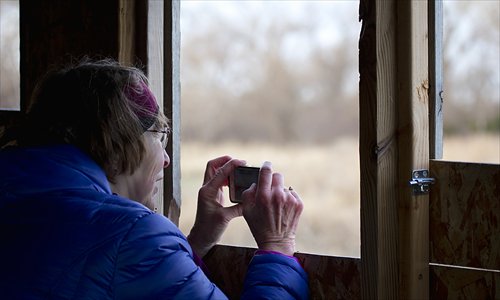
A birder photographs cranes. Photo: Courtesy of Nicola Gordon
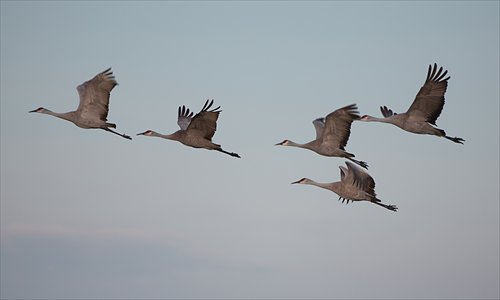
Sandhill cranes in flight Photo: Courtesy of Nicola Gordon
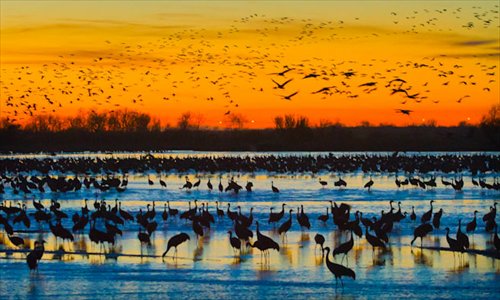
Nesting grounds on the Platte River Photo: Courtesy of Nicola Gordon
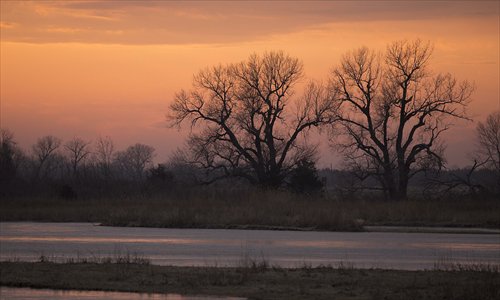
Sunset on the Platte River Photo: Courtesy of the Nebraska Tourism Commission
It's 5 am on a cool March morning and the sun sends shafts of gold across the prairies. Ahhh - the peaceful Nebraska wilderness - savor it while you can! Dark still waters ripple, as winged creatures wake watchful and hungry. A single bird flaps, lifts and soars. Instantly a tranquil scene erupts into the most riotous morning pretty much anywhere across North America. A million beating wings block out the rising sun and bird calls shatter the silence with enough caws and trills and honking to drown out a football stadium.
And where the birds go, so go the birders - flocking in droves to North America's greatest birding spectacle. For five short weeks the shallow braided channels of Nebraska's Platte River Valley host half a million sandhill cranes as they bulk up for the long flight north. Ten million ducks and geese join the hungry throng. And most of the world's 300 endangered whooping cranes swoop down to wade among the reeds and gobble frogs.
Unable to resist Nebraska's Great Spring Migration, my small group of birding types flock to the spectacle. With binoculars, scopes, cameras, field guides and layers and layers of cosy clothes it's clear we're here to holiday birder-style! With no Bingo, no sunny beach, no cocktails by the pool, regular folk may wonder at our sanity. But my birding types know we're in for a spectacular show!
Sandhill cranes at sunrise
Audubon's Rowe Sanctuary, founded in 1974, provides education and bird blind tours in Kearney. Its mission is the conservation of sandhill cranes, whooping cranes and other migratory birds, in a rapidly shrinking habitat along the Platte River Valley. The plight of the cranes is highlighted by Rowe Sanctuary's director, Bill Taddicken. He tells us to "embrace this moment, this river, the birds. Today the habitat for the worlds greatest migration is nearly gone. Today people say "You should have seen the great bison migration." "You should have seen the carrier pigeon migration (where birds numbered in the billions)." And he fears that one day his daughter may say "You should have seen the crane migration."
Rowe Sanctuary is committed to protecting the birds through preservation of 2,800 acres of critically endangered migration habitat. Wetlands are maintained and restored through prescribed grazing, burning and mechanical clearing of sandbars. Rowe Sanctuary also believes they can foster conservation through education. Adult and school-age programs and workshops teach participants what they have and what they may lose if birds and bird habitats are not a priority.
Final words from Rowe Sanctuary's director ensure we all understand some essential birding etiquette. No camera flash, no speaking above a whisper - no actions whatsoever that could disturb thousands of skittish creatures. We walk in silence to a darkened bird blind with only the stars to light our way. Sandhill cranes wake with the first light of dawn and their distinctive karr-r-r-o-o echoes across the sandbars. Our small group shivers in the frosty air - but not one of us would miss this early morning in the Platte River Valley for anything.
American white pelicans
Sandhill crane migration in Nebraska coincides with American white pelican migration. Myself and fellow birders are soon pontooning on the Harlan County Reservoir with pelicans in our sight. Every year their migration route along North America's Central Flyway leads here for several weeks of feeding and resting. At 10 to 20 pounds, these massive birds are known as "B52 Bomber birds" and to illustrate their impressive wingspan, two guides unfurl a sheet of paper. It stretches nine-and-a-half feet and beats the wingspans of whooping cranes, bald eagles, and flamingos.
As one of the largest bodies of water along the Central Flyway, Harlan County Reservoir is a primary stop for millions of migrating birds with over 300 species recorded in the area. My birding group saw a single glaucous gull, golden eagles, a tree full of double-crested cormorants and a flight of skittish killdeer rising from the reeds.
Greater prairie chickens
How do you find a prairie chicken lek? Drive out to the highest pasture, and park your pickup. Now wait. If you've succeeded, the chickens will come. Landowner and naturalist Angus Garey did just that. His search for a lek ended with a group of male prairie chickens performing their mating dance oblivious of his pickup parked in their midst.
Male prairie chickens meet at the same lek year after year to establish territory in areas of 20-50 feet in diameter. The more dominant males establish territory closer to the center of the lek and have a greater chance of attracting a female. And what better way to attract a female than to show off and strut your stuff?
Another early morning on the prairie and I'm sitting in what can only be described as the five-star accommodation of bird blinds. What this re-purposed animal transportation trailer lacks in washrooms it makes up for by providing chairs, blankets and pillows. We sneak in before sunrise, and as morning arrives, the boys come out. Seven males in all, and not a female in sight. Either they know the ladies are watching from the long grass, or they are just happy to get a little practice in first. In the silence of the blind tail feathers unfurling is an audible signal that the dance has begun. Ear feathers come up revealing bright orange air sacs. A dance described as a "stutter-step" is accompanied by deep hooting moans called "booming." These boys are looking for love and they didn't care who knows!
Sunset and more sandhill cranes
Our introduction to The Crane Trust starts with an introduction to the friendly rivalry that exists with Rowe Sanctuary in Kearney. Our Crane Trust guide tells us "Kearney may be the sandhill crane capital of the world, but we have more birds!."
The Crane Trust was established in 1978 with the mission to protect and maintain the Big Bend area of the Platte River as a life support system for whooping cranes and other migratory birds. Efforts to maintain the natural dynamics of the area include acquisition of a herd of bison.
Grazing is rotated by area to naturally reduce vegetation and create nesting habitats. And at the heart of conservation efforts is education of the over 25,000 yearly visitors. Crane Trust quotes African Conservationist Baba Dioum to explain their philosophy:
"In the end, we will conserve only what we love. We will love only what we understand. We understand only what we are taught."
And what better way to teach than to show? Sunset at The Crane Trust is beautiful mayhem. Ten thousand sandhill cranes gather at a nearby field following a full day of feasting.
Someone just can't wait a second longer, spreads his wings, and in one magical moment 10 thousand cranes take flight. From our bird blind we watch as wave after wave washes over the trees and paints a timeless silhouette on the orange sky. The arrival is heralded by the most riotous sound in nature.
I can only imagine that every crane feels compelled to bid good-night to every other crane, for the sound is a tumultuous roar. This is why we are here, and no one said it better than Crane Trust's Karen Krull Robart.
"When you are ready to leave the blind, stop and listen - you will remember that sound forever."
As my bird-filled holiday comes to an end, the long drive to the airport gives me time to ponder. What is it about birding that compels our small group of travelers to go anywhere, get up at 5 am and huddle in blinds on a frosty morning? Appreciation for the diversity? Love of nature? The excuse to be outdoors? While these were all great reasons to get started, there was something that made me cross the line from interested to passionate.
Dawn Hewitt, one of my fellow birders and managing editor of Birdwatchers Digest had the answer "Birding is a life-long scavenger hunt!."
So glad my personal scavenger hunt brought me to Nebraska's Platter River Valley for a the wonderful Great Spring Migration.
Rules of thumb
Birding experiences
Rowe Sanctuary
Phone: (308) 468-5282
Cost: $25/person
Address: Iain Nicolson Audubon Center at Rowe Sanctuary, 44450 Elm Island Rd, Gibbon, NE 68840
Harlan County Reservoir
Email: harlancountytourism@yahoo.com
Phone: 1-800-762-5498
Cost: Free during the White Pelican Homecoming Celebration - March 27-April 4
Address: 70738 Lake View, Republican City, NE 68971
Prairie Chicken Dance Tours
Online: www.prairiechickendancetours.com/book-a-tour
Phone: (308) 345-1200 Ext. 318
Cost: $100/person
Address: Meet up location to be provided prior to the tour
Crane Trust
Online: cranetrust.org/contact/
Phone: (308) 382-1820
Cost: $25/person
Address: 9325 S Alda Rd, Wood River, NE 68883
Where to stay
Best Western Plus Mid-Nebraska Inn & Suites
Book online: book.bestwestern.com
Phone: (308) 234-2541
Cost: $115/night
Address: 224 S 2nd Ave, Kearney, NE 68847
Best Western Plus Grand Island Inn & Suites
Book online: book.bestwestern.com
Phone: (308) 381-8855
Cost: $147/night
Address:2707 S Locust St, Grand Island, NE 68801
Crane Trust VIP Crane Experience
Phone: The Crane Trust at (308) 384-4633 or Sandy Douglas at (402) 651-7033
Cost: $399 per couple - includes one evening and one morning blind viewing, accommodations in the Legacy Cabins, hors d'oeuvres, dinner and a light breakfast
Address: 9325 S Alda Rd, Wood River, NE 68883
Where to eat
The Alley Rose - Famous lunches, renowned dinners and Nebraska-brewed beers
Online: http://www.alleyrose.com/reservations/
Phone: (308) 234-1261
Address: 2013 Central Ave, Kearney, NE 68847
Sin City Grill - Homemade burgers and fresh-cut fries in a Las Vegas style grill
Online: sincitygrillgi.wordpress.com/
Phone: (308) 398-2237
Address: 410 W 3rd St, Grand Island, NE 68801
Getting there
Multiple airlines fly from Beijing to Omaha Nebraska including United Airlines, Air China, Air Canada and Delta.
Flight times are generally 16+ hours, and usually include one layover.
Rental cars can be picked up at Payless Car Rentals at the airport. Reserve a car through http://www.airportrentals.com/
Travel for approximately three hours along the I-80 W to Kearney Nebraska.
Now you're in the heart of Nebraska's birding paradise - enjoy!