Breaking a problem into 700,000 steps
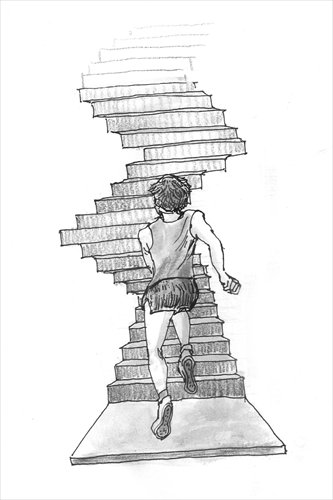
Illustration: Luo Xuan/GT
Atsuyuki Katsuyama does not listen to music during the 12 hours a day he spends running across the United States.
Nor does he imagine how good it will feel when he runs into the Atlantic Ocean in New York City, 80 days after he set out from the Pacific at the Santa Monica Pier.
"When I run, I only think about running," he explained to me. "That's why I can run all those crazy hours."
Katsuyama's pace is not particularly fast, but in a quest to run across the United States by July 13 he is covering 70 kilometers a day - nearly the distance of two marathons.
Earlier this year, the 47-year-old former salaryman for Panasonic met up with me to teach the specialized gait he calls natural running, a style inspired by Mexico's Tarahumara Indians and popularized in the book Born to Run.
After two hours of instruction, I had only touched on the basics. Every motion is carefully considered, from the position of the head to the angle the toes point out to the sides.
I found keeping track of all the fine points difficult, and so does he. When he runs, his mind is always monitoring his body, enjoying the sensations or looking for signs of discomfort, which signal he needs to make adjustments.
"Pain is the fruit of bad running posture," he explains. He runs barefoot or in specialized thin-soled shoes, allowing the body to absorb the shock of each step naturally.
For breathing, he recommends inhaling with two quick breaths, and exhaling the same way. But there is more.
"When I breathe out, it's not just that I throw out the bad air. I try to throw out those bad thoughts, like ego - 'I want to get this, I want to achieve this.' I release them."
Before I met Katsuyama, at a vegan restaurant he runs in Thailand's capital, I assumed I knew how to run, to the extent that I thought about it at all. But I have disliked running all my life, because it hurts my knees. I'm not alone - injuries plague many serious runners.
Athletes like Katsuyama have blown open the sport, showing that with adjustments in technique and equipment, these injuries are not necessary, and tremendous distances can be covered.
Meeting Katsuyama made me wonder how well I understand even the basic things in life. If the way I was putting one foot in front of another was causing me pain, what other fundamentals could use an overhaul?
His advice on running seems apt for tackling any big problem, like learning Chinese or maintaining a marriage. He focuses on each step, and lets the journey unfold on its own.
"Running continental is absolutely pushing ourselves. But we should not push in a single moment, or we will be broken," he said. "If we cannot make a single good step, how can we make 700,000 steps, which we need to run across the United States?"
This article was published on the Global Times Metropolitan section Two Cents page, a space for reader submissions, including opinion, humor and satire. The ideas expressed are those of the author alone, and do not represent the position of the Global Times.