HOME >> BUSINESS
MSCI to announce A-share decision
By Xie Jun Source:Global Times Published: 2015-6-9 23:08:02
Inclusion could bring in up to $68b: expert
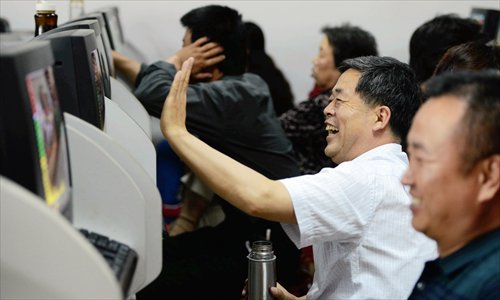
An investor smiles in front of a screen displaying prices of shares at a brokerage in Qingdao, East China's Shandong Province. Photo: CFP
US index provider MSCI Inc is scheduled to announce early Wednesday whether it will include China's A shares in its Emerging Markets Index, with inclusion set to bring funds of up to $68 billion into the A-share markets.
However, some said the inclusion of A shares in the index is unlikely in the short term, because mainland stock markets are still not fully open to overseas investors.
The MSCI Emerging Markets Index is one of the world's most widely recognized measurements for stock performance in emerging markets. The index tracks the performance of more than 800 stocks in 23 economies, more than 70 percent of which are in Asia.
MSCI's decision comes at a particularly strong moment for China's stock markets, which have been on a record-breaking bull run in recent months, even as the country's economy has slowed.
The Shanghai Composite Index reached a seven-year high on Monday, but fell back slightly by 0.36 percent to 5,113.53 points on Tuesday. ChiNext, the country's NASDAQ-style board for high tech and emerging start-ups, climbed 0.03 percent on Tuesday.
Analysts have noted that about $1.7 trillion in global assets are benchmarked to the MSCI Emerging Markets Index, and overseas investors would start buying A shares if they are included in the index. That in turn would cause the A-share markets to see a further strong rise, Shanghai-based news website thepaper.cn reported on Monday.
As much as $68 billion could flow into China's markets if A shares are included in the MSCI Emerging Markets Index, according to a note sent to the Global Times on Tuesday by Zhu Haibin, chief China economist at J.P. Morgan.
"However, A shares are unlikely to be included in the index on Wednesday, mainly due to the restrictions of QFII rules for foreign investment at the current stage," said Zhu.
The Qualified Foreign Institutional Investor (QFII) scheme, which was set up in 2002, places a limit on the amount that foreign institutions can invest in mainland A-share markets.
The standard limit is $1 billion, but the China Securities Regulatory Commission (CSRC) has relaxed QFII rules in recent years, in a bid to encourage foreign investment in China's stock markets.
In 2012, the CSRC lifted the $1 billion cap for certain foreign institutions, including central banks.
According to a report released by the State Administration of Foreign Exchange on May 29, the CSRC had granted QFII licenses to 268 foreign investors as of May 29.
However, the current QFII rules still place restrictions on foreign investors, according to a report by financial website finance.qq.com on Tuesday.
The report noted that a number of foreign investors cannot move their capital freely in and out of the country on a daily basis, also due to QFII requirements.
Zhu said that the QFII program has been a hindrance to the flexibility of cross-border investment in domestic markets, and this could make MSCI reluctant to include A shares in its index.
Zuo Xiaolei, chief economist at China Galaxies Securities, also told the Global Times on Tuesday that because A-share markets are not entirely open to foreign investors, the amount of capital pouring in would be limited, even if A shares are included in the MSCI index.
"However, the mere fact that MSCI is considering including A shares in its index shows that China's economy is growing stably, and has a lot of potential," said Zuo.
Experts have also noted that as the central government has stepped up efforts to open up mainland capital markets, such as launching the Shanghai-Hong Kong Stock Connect program, A shares will eventually be included in the MSCI Emerging Markets Index.
As more international capital flows in, the A-share markets will no longer be dominated by local investors and financial products in mainland stock markets will become more diversified, Zhuo Zhicheng, a partner at PricewaterhouseCoopers, said in a statement sent to the Global Times on Tuesday.
MSCI will publish its final decision on Wednesday at around 5:30 am, Beijing time.
Posted in: Markets