New Xiaomi phone reveals the future of the Sino-Indian economy
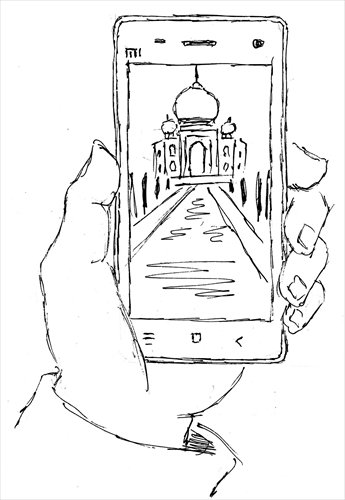
Illustration: A. Saeed
Chinese smartphone giant Xiaomi Corp. launched its first made-in-India handset on August 10. According to Xiaomi, the Redmi 2 Prime is being assembled by Taiwanese contract manufacturer Foxconn, famous for constructing Apple's iPhones. Foxconn has just signed an agreement worth $5 billion to expand its research-and-development facilities in India.
The news about Xiaomi's new smartphone indicates that the company has its eyes on the enormous Indian market and is gearing up to make a real move; in this regard, it is similar to many Chinese companies, and we can expect a strong movement toward Indian sales in the future.
Recent years have seen an increasing number of discussions about the relationship between China and India, raising questions about whether it is a complementary or a competitive one. Xiaomi's recent moves would suggest that bilateral economic relations are learning toward "complementary."
From China's perspective, it faces grave challenges imposed by a rapid rise in manufacturing costs. The existing economic model is no longer suitable for the Chinese economy. Labor-oriented manufacturers are leaving China to pursue cheaper labor costs elsewhere; consequently, industrial transformation is the only way for China to revitalize its economy.
Boasting a massive market and low labor costs, India has become a perfect arena for Chinese companies to transfer excess capacity or maintain low manufacturing costs.
From India's perspective, the emerging economy requires large-scale investments more than ever. From 2013 to the election of current Indian Prime Minister Narendra Modi in May last year, the Indian economy had entered a period of significant decline caused by a drop in investments due to entrepreneurs' lack of confidence in the Indian market.
Modi's response was the introduction of the "Make in India" campaign, designed to holistically enhance India's manufacturing capabilities.
During his inaugural year, Modi made more state visits to other countries than most of his counterparts across the world. Many of these trips were focused on economy and aimed to boost confidence in the Indian market and solicit as much investment as possible.
The Modi administration is also trying to clear obstacles within the country, such as relaxing restrictions over foreign investments and knocking down bureaucratic hurdles. All these efforts have smoothed out the connections between the Chinese companies and the Indian market.
However, in the near future, bilateral economic relations won't be as reciprocal as we might hope.
As economic ties strengthen, frictions will increase. Nonetheless, this is an unavoidable path for an emerging economy hoping to become the factory of the world. China has been there. Now it's India's turn.
As China faces an economic downturn, the question of whether India will replace China as the factory of the world is being debated at length, especially when analysts predict India's economic growth rate will surpass China's in the coming years. The real challenge facing both countries is how to turn away from rivalry and focus on their ability to engage in economic transformation via cooperation rather than competition.
Although geopolitical concerns are causing the Indian government to hesitate toward the China-led "One Belt, One Road" initiative, New Delhi has shown great interest in the economic benefits brought by the program. India plays an active role in both the Asian Infrastructure Investment Bank and the BRICS New Development Bank, both of which are endorsed by China.
India clearly knows that opportunities come only when it is willing to cooperate with China. As the largest emerging economies in the Asia-Pacific region, China and India share the same outlook for economic prosperity.
The author is an associate research fellow at the Institute of Asia-Pacific Studies at the Chinese Academy of Social Sciences. opinion@globaltimes.com.cn