HOME >> METRO SHANGHAI
Clothes encounters
By Huang Lanlan Source:Global Times Published: 2015-8-18 18:23:01
A dozen mannequins wearing newly made Chinese-style outfits stand at the front of a small classroom. Behind them, their designers paste sketches on the wall detailing the process of creating these clothes.
The designers are all participants of the 2015 Chinese Traditional Costume program organized by Donghua University, under the Shanghai Summer School program. Sponsored by the Shanghai government, the program consists of more than 20 sub-programs which offer foreigners in Shanghai free Chinese language and culture lessons.
Dutch student Lieve van de Beek put the finishing touch to her presentation, placing a fluffy toy sheep in the hand of her mannequin. The design van de Beek and her two teammates came up with for the assignment - to make an outfit containing elements of traditional qipao design - is a royal blue dress with a flower-decorated collar.
Including van de Beek, a total of 32 students from 10 overseas universities participated in the costume program, which this year centers around qipao.
"As a symbol of Chinese clothing culture, the graceful qipao has long been loved by people all over the world," said Song Wei, vice dean of Donghua's International Cultural Exchange School. "We hope the participants can learn about the history and characteristics of qipao through the program, which may inspire them in their future designs."
The one-month program consists of clothing design lectures and activities such as visiting a well-known local qipao flagship store. Standing in a circle at the store, watching a craftsman carefully embroidering a handmade silk qipao with a peony, the students were amazed by his skills.
"The Chinese embroidery is so beautiful and I love it," van de Beek said, adding that she will try to learn it herself after returning home.
The right manners
That day, store staff also taught the students some qipao etiquette. "When wearing a qipao, you should be particular about many details in your behavior, like how to walk gracefully, and where to place your legs while sitting," said program director He Qian. "Some students tried on qipao and learned from the staff that day. The qipao looked great on them."
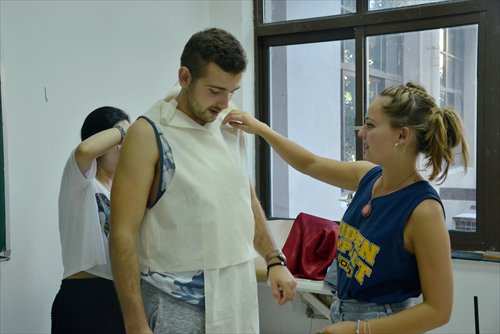
After three weeks of learning and experiencing, the program participants were divided into 11 groups and asked to design and make a suit of clothes with qipao elements within one week.
Van de Beek's group made a dress with a tight, qipao-like collar and a very full skirt.
"Qipao are pretty and elegant, but very tight," she told the Global Times. "They look perfect at formal evening events, but not that great at some other occasions such as shopping and sightseeing."
Van de Beek and her partners gave the dress a full skirt instead of a tight one like a traditional qipao. "We wanted it a bit more girlish and sporty," she said. "Wearing it, you could feel free to go to shops and parks. You can relax and have fun."
Their design won the third prize at the program's group assignment presentation event.
The first-prize winner was made by a group consisting of three students from the US, the UK and South Korea who made a two-piece qipao suit.
This first-place winning work was made up of a traditional-style dark grey qipao and a long-sleeved, light grey and semi-transparent coat decorated with hundreds of beads. The beads formed the shape of the Shanghai International Finance Centre (IFC).
"Making this suit, we were mainly inspired by the skyscrapers we saw at the Bund," said group member Jacob Shindler. "When I visited the Bund for the first time, I saw so many clouds around the IFC building in Pudong New Area, on the other side of the Huangpu River. The building looked so magnificent. It almost touched the sky."
Touching cloth
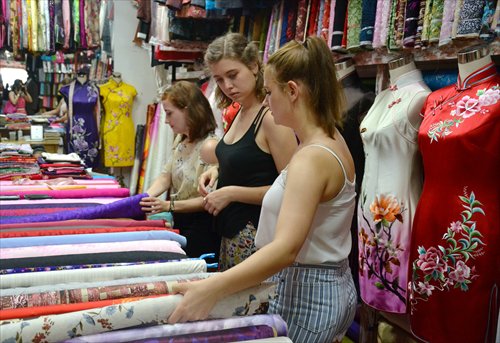
All the groups had to prepare the fabrics and decorations themselves. "To find the perfect materials for our work, we've been to many local fabric markets and stores," said Shindler's partner Karolina Valaityte. "After we bought the suitable materials, we stayed in the program's clothes-making room, busy drafting patterns and cutting cloth."
Another impressive piece was a men's black qipao. "Usually qipao are made for women, but we wanted to design a qipao for men," said Susan Han from South Korea. "We found that a long time ago, many Chinese men wore cheongsam (a body-hugging one-piece dress that originated in the late Qing Dynasty), and we got inspiration from that."
Program director He spoke highly of the participants' designing and making skills. "They were very creative and hardworking, and were good at learning from each other," she said. "During their month in Shanghai, they learned about traditional Chinese clothing culture, and experienced in person how that culture has influenced China's modern fashion trends. I hope the trip will benefit them in their future careers."
Wang Beibei contributed to this story
The designers are all participants of the 2015 Chinese Traditional Costume program organized by Donghua University, under the Shanghai Summer School program. Sponsored by the Shanghai government, the program consists of more than 20 sub-programs which offer foreigners in Shanghai free Chinese language and culture lessons.
Dutch student Lieve van de Beek put the finishing touch to her presentation, placing a fluffy toy sheep in the hand of her mannequin. The design van de Beek and her two teammates came up with for the assignment - to make an outfit containing elements of traditional qipao design - is a royal blue dress with a flower-decorated collar.
Including van de Beek, a total of 32 students from 10 overseas universities participated in the costume program, which this year centers around qipao.
"As a symbol of Chinese clothing culture, the graceful qipao has long been loved by people all over the world," said Song Wei, vice dean of Donghua's International Cultural Exchange School. "We hope the participants can learn about the history and characteristics of qipao through the program, which may inspire them in their future designs."
The one-month program consists of clothing design lectures and activities such as visiting a well-known local qipao flagship store. Standing in a circle at the store, watching a craftsman carefully embroidering a handmade silk qipao with a peony, the students were amazed by his skills.
"The Chinese embroidery is so beautiful and I love it," van de Beek said, adding that she will try to learn it herself after returning home.
The right manners
That day, store staff also taught the students some qipao etiquette. "When wearing a qipao, you should be particular about many details in your behavior, like how to walk gracefully, and where to place your legs while sitting," said program director He Qian. "Some students tried on qipao and learned from the staff that day. The qipao looked great on them."
After three weeks of learning and experiencing, the program participants were divided into 11 groups and asked to design and make a suit of clothes with qipao elements within one week.
Van de Beek's group made a dress with a tight, qipao-like collar and a very full skirt.
"Qipao are pretty and elegant, but very tight," she told the Global Times. "They look perfect at formal evening events, but not that great at some other occasions such as shopping and sightseeing."
Van de Beek and her partners gave the dress a full skirt instead of a tight one like a traditional qipao. "We wanted it a bit more girlish and sporty," she said. "Wearing it, you could feel free to go to shops and parks. You can relax and have fun."
Their design won the third prize at the program's group assignment presentation event.
The first-prize winner was made by a group consisting of three students from the US, the UK and South Korea who made a two-piece qipao suit.
This first-place winning work was made up of a traditional-style dark grey qipao and a long-sleeved, light grey and semi-transparent coat decorated with hundreds of beads. The beads formed the shape of the Shanghai International Finance Centre (IFC).
"Making this suit, we were mainly inspired by the skyscrapers we saw at the Bund," said group member Jacob Shindler. "When I visited the Bund for the first time, I saw so many clouds around the IFC building in Pudong New Area, on the other side of the Huangpu River. The building looked so magnificent. It almost touched the sky."
Touching cloth
All the groups had to prepare the fabrics and decorations themselves. "To find the perfect materials for our work, we've been to many local fabric markets and stores," said Shindler's partner Karolina Valaityte. "After we bought the suitable materials, we stayed in the program's clothes-making room, busy drafting patterns and cutting cloth."
Another impressive piece was a men's black qipao. "Usually qipao are made for women, but we wanted to design a qipao for men," said Susan Han from South Korea. "We found that a long time ago, many Chinese men wore cheongsam (a body-hugging one-piece dress that originated in the late Qing Dynasty), and we got inspiration from that."
Program director He spoke highly of the participants' designing and making skills. "They were very creative and hardworking, and were good at learning from each other," she said. "During their month in Shanghai, they learned about traditional Chinese clothing culture, and experienced in person how that culture has influenced China's modern fashion trends. I hope the trip will benefit them in their future careers."
Wang Beibei contributed to this story
Students of the Chinese Traditional Costume program select materials for use in their coursework.
Program participants make a suit of clothes with qipao elements.
Photos: Courtesy of Donghua University
Posted in: Metro Shanghai