Pen friends
Aspiring writers get master class from established authors during literature program
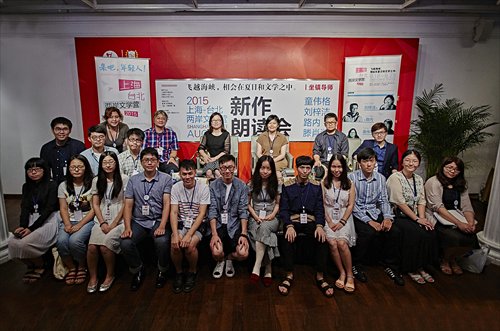
Shanghai's leading literary magazine Mengya and its Taipei counterpart Lianhe Wenxue recently partnered to nurture emerging writers from the Chinese mainland and Taiwan by initiating the Shanghai-Taipei Literature Camp during the Shanghai Book Fair. Tutors and participants of the Shanghai-Taipei Literature Camp pose for a photo at the Shanghai Book Fair. Photos: Courtesy of Yan Han and Zhang Ting
Twenty new talents participated in the seven-day program in Shanghai. Mengya chose 10 emerging writers who have been published in the magazine in the past year, while Lianhe Wenxue picked 10 writers from among those who submitted works in response to a call put out in the magazine and on the Internet.
Four established writers acted as tutors and spent the entire week with the group. They were Lu Nei (Teenager Babylon) and Teng Xiaolan (Beautiful Days, winner of the Lu Xun Literature Award 2014) from the Chinese mainland; and Tong Weige (Wang Kao, winner of the United Daily News Literature Award 2002) and Essay Liu (Seven Days In Heaven, first prizewinner of Lin Rong San Literature Award 2006) from Taiwan.
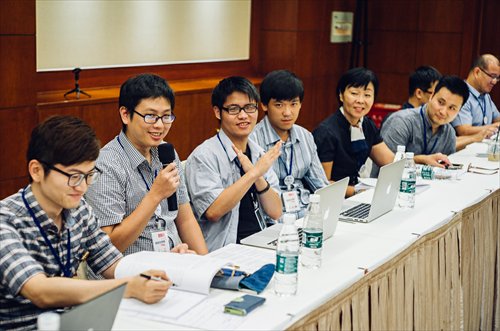
The camp started with a panel discussion by the tutors on the current state of youth literature on the Chinese mainland and in Taiwan.
The highlight was the blind evaluation by the tutors, in which they openly appraised and gave comments on students' works from a professional perspective. They even did a blind evaluation of their own works - according to Mengya, this sparked an unexpectedly heated discussion.
The four participants who the tutors found most impressive shared their works at a public reading at Sinan Mansions at the end of the camp.
Local students from literature groups and communities at the High School Affiliated to Fudan University, Xuhui Middle School and Shibei Middle School made up an independent jury to blind evaluate the works.
Offering a gateway
"Be it in Shanghai or in Taipei, an increasing number of young people are taking up writing," Lianhe Wenxue's publisher Lin Tsai-chueh said. "This is a good opportunity for the young writers from both sides to know each other through literary creations. It is meaningful to discover their similarities and disparities."
Lu Nei pointed out it is difficult for young writers, especially those under 30, to gain recognition. "This camp, alongside some prizes launched by other literary magazines, offers a gateway for them," he said.
Sun Ganlu, the head of Mengya, said exchanges between writers from the Chinese mainland and Taiwan have increased over recent years, but it is new for two literary magazines to establish a platform.
"The camp helps extend the two creative groups' visions and promote mutual studies in hope of producing better writing," Sun said.
Academic approach
While many of the participants are still students, a lot have already built up impressive bodies of work. For example, 23-year-old Lu Junwen of Xiamen University has published nearly 100 articles and stories in newspapers and magazines over the past five years. He worships Chu Tien-wen, particularly her Huangren Shouji (1994).
Hsu Zhen-fu, a 21-year-old undergraduate studying entomology at National Taiwan University, is influenced by the late Beijing novelist Wang Xiaobo and surrealist writer and Franz Kafka Prizewinner Yan Lianke.
Different means
Teng Xiaolan observed that the Taiwan participants appear "highly academic" as they conduct a lot of theoretical studies and background research before they get down to writing. Participants from the Chinese mainland, on the other hand, are more likely to write immediately in answer to their impulses.
While the Taiwan participants expressed their admiration for their mainland counterparts in narrative skill and their wide-ranging subject matter, Lu Nei said the young writers from Taiwan tend to excel in a delicate style and elegant language.
Shui Xiaoyin, a 23-year-old English teacher from Shanghai who took up writing seriously after taking part in the Post-90s-generation Creative Writing Competition in 2013, is one of the four participants that won commendation from the tutors.
Tong Weige made the commendation, saying Shui has a "very good way of storytelling that is fused with a childlike yet not naïve curiosity."
"Within the genre of the coming-of-age story, she proves herself a mature writer already. It would be even better if she rewrote some details more meticulously, and for certain more or less unnecessary descriptions and plots to be removed," Tong said.
Get inspired
Shui told the Global Times that she found Tong's suggestion very useful. "I admire Tong, as well as the Taiwan participants, for they go to lengths to work on the cultural contexts behind their stories and the wording, whilst my way of writing is somewhat unrefined. They inspire me to see that, besides storytelling, I also need to be more prudent with my language."
She added that the thing she had looked forward to most was face-to-face communication with the participants from Taiwan, and was thus glad that they got the chance to have a literary discussion without tutors or any other staff present one night.
All the commended works will be published, in full length, on Mengya.
The magazine's executive editor in chief Fu Xing said the organizers try to make the literature camp an annual event, and that the following edition will take place in Taipei next year.
"I hope more young writers will visit Taiwan next year and keep this literary discussion going, and that there will be more and more similar activities," Shui said.