African firms take to faking Chinese
Plague of counterfeits as locals copy products
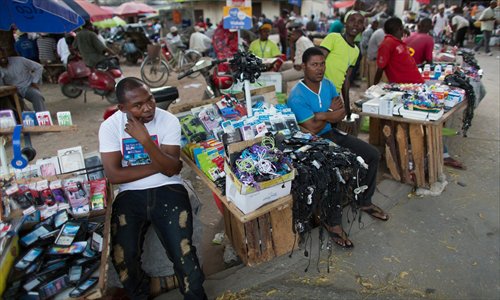
Mobile phone vendors wait for customers in Zanzibar, Tanzania. Photo: IC
A joke has been going round the social media claiming that a primary schoolboy in Uganda was asked by his teacher the opposite of the word "original," and he responded: "China."
As numerous comments on social media showed, one could conclude that Chinese products and businesses in some African countries suffer from the widespread perception of being associated with fake or counterfeit goods.
In East Africa, anything, from electronics, machinery to clothing of sub-standard quality is associated with China in the popular imagination.
Some traders say actual fraud is rare, like Phillip Kiptanui, a Nairobi-based trader dealing with construction and building materials. "I've been importing tiles, roofing materials, carpets as well as paints from China since 2006. I have never experienced a complaint from my customers concerning the quality of these products," said Kiptanui.
He added, "The only problem I have had with the Chinese businesses is the inevitable delays in the delivery of these goods from the source market, China."
To this trader, there is little, if any, difference between products that are made in China and those made in other countries, which are perceived to be of a superior quality.
"It all depends on what one wants and his or her preferences and ability to pay. That is why we have Mercedes, Toyota or Nissan cars. China has managed to segment its markets in a way that people's ability to pay determines what kind of product to supply to them. Fake? Counterfeit? Not from China," argued a quality and standards expert in Nairobi who spoke to reporter in confidence.
'Made in Africa' fakes
But with the emergence of Chinese goods as a major player in the African market, local firms are taking the chance to create counterfeits themselves. "There is a growing number of unscrupulous traders who are coming up with fake or products of inferior quality and then entering the market as if they are from genuine manufacturers from China," he observed.
"Their intention is to make quick money, and injure the consumer loyalty of the genuine products from China."
Police also suspect that at the center of this attack are some local and international firms, which seem to be losing out to the new entrants: The Chinese companies that are thriving in African markets due to their low-pricing strategy.
An anti-counterfeit agency officer in Kenya says they have so far arrested six businessmen purporting to be selling genuine goods from China, yet they had "manufactured" them locally in their premises in the Industrial Area, Nairobi.
"They were a mix of Kenyans, Nigerians and Chinese. In our investigations, we discovered that they were not even paying taxes, and the goods they claimed to have been manufactured in China were being sold to ignorant people in slums and rural areas in Kenya," he said.
According to the officer, in one instance, the goods were "exported" to the Democratic Republic of Congo, Burundi and South Sudan, which, due to political instability, have few controls.
The Kenya Bureau of Standards says the racket could also involve some of its rogue officers, the police and even insiders from the affected Chinese companies. These insiders share the exact formula for manufacturing the goods with the criminals.
There are fears now that if the underground business were not curtailed in time, it could threaten the reputation of Chinese goods and businesses in many African countries.
"We do not want to see a situation where we are denied the opportunity to import goods from China on the back of these dirty tricks," said Waweru Mburu, a mobile phone retailer in Mombasa.
Mburu added that affordable mobile phones from China have allowed almost 70 percent of the populations to connect to the network.
"The mobile phones are [very] popular among Kenyans because they can accommodate two SIM cards, they have radio stereos,Internet access and have long lasting batteries unlike the Nokias or Motorola, among others," said Mburu.
Like other sectors, Mburu says the electronics market has also been infiltrated by "Made in China" fakes. "They are sub-standard and therefore giving China a bad name. These counterfeits are really killing respected brands."
Beatrice Njoroge, a resident of Kajiado, near the Kenya-Tanzania border, said she fell victim to fraudsters after buying a solar panel in Nairobi in July 2014.
But when she reached home, it did not work as expected. "It lost power quite fast. I would therefore only use it continuously for less than three hours, yet I had been told that it was in perfect condition," said Njoroge.
She added that "I took the panel back to the shop where I bought it from, and asked for a replacement which I got. But later, an insider from the company called and told me the solar panels were fake and therefore I should not expect any difference in performance with the initial one."
To curb this challenge, Kiptanui argues China and Kenya, and other African countries need to tighten cooperation against criminal activity. This, he says, can be done by increasing the power of the people charged with ensuring the goods sold in the market meet the set quality standard.
"There should also be hard penalites against those businesses selling fake or counterfeited products," he said.
"Most importantly, Chinese firms exporting goods to Africa should endeavour to review the packaging and sale channels of their products so as to confuse those looking for low hanging fruit."
The author is a journalist on African issues based in Nairobi, Kenya. mkapchanga@gmail.com