HOME >> METRO SHANGHAI
Lobster lobbying
By Yang Lan Source:Global Times Published: 2015-11-18 18:23:01
Imported lobsters have become so popular among the Chinese in recent years that it is now considered a staple dish at Shanghai wedding banquets. As a result of China's growing demand for imported American lobster, exports from the northeastern US state of Maine, famous for its 20-kilogram crustaceans, have surged.
Data from the US Department of Agriculture shows that the US exported 18.9 million pounds of lobsters to China in 2014, up 22-fold from 2009. And yet, despite the abundance of lobster being consumed by middle- and upper-class Chinese, most are unable to distinguish between Maine lobsters and lobsters from other lobster-famous countries.
"A lobster from Australia is a warm-water creature that has a tail but no claws. Maine produces cold-water lobsters that have two claws," Paul R. LePage, the governor of Maine, explained to the Global Times.
LePage was in Shanghai recently, along with a delegation of 21 representatives from Maine, to promote their state's lucrative seafood trade as well as other cultural exports such as education, tourism and business investments.
Second largest export market
China is Maine's second largest export market. Maine sends approximately $184 million in goods to China every year, according to Janine Bisaillon-Cary, president of the Main International Trade Center. Their biggest industry for exports is in fact not seafood, which ranks second, but pulp and paper.
Due to the abundance of forests surrounding the rural state, Maine has historically been considered the country's paper mill capital. However, with the world's declining dependency on paper as a result of the advent of digital technology and eco-friendly initiatives, Main's paper industry has likewise seen a decline. Nonetheless, paper and pulp remain the state's largest export, generating more than $270 million per year in wages to local workers.
Located directly on the Atlantic coastline of North America, the frigid waters of Maine spawn over 125 million pounds of lobster per year. Among this harvest, Maine specializes in two different breeds of lobster: soft-shell lobsters harvested for summer tourists or freeze-processed for overseas exports, and hard-shell lobsters which are sold and shipped alive.
"Shipping lobsters to China has been very important for our industry. Our catch has been growing rapidly over the last 10 years. Finding new markets was incredibly important to the 5,000 lobstermen of the State of Maine as well as local dealers and distributors," said Tom Adams, owner of Maine Coast, an international seafood distributor. Adams' company alone shipped over 1 million pounds of live lobsters into China last year.
Even with their paper industry on the decline, Maine's lobster fisheries are expected to stay in operation for decades to come. Because of this growth, live shipping and frozen processing companies are looking to expand into Asia. Traditionally, Chinese consumers prefer live lobsters to frozen ones due to food safety concerns, but the cost of shipping live lobsters is much higher than shipping frozen lobsters, which makes them an extravagance.
"With flash freezing technology, the quality and taste of frozen lobsters are pretty much the same as the live ones," said LePage, whose business card has the words "OPEN FOR BUSINESS" printed in bold letters, illustrating his desire to seek out a wide range of opportunities to work with Chinese partners.
Educational tourism
Educational tourism is another industry that the State of Maine hopes to promote in China. With a growing number of Chinese university students going to the US to study, LePage would like to see more Chinese students come to Maine in the summer months, combining education with travel.
Maine has a large number of Chinese students enrolled in local high schools, but instead of returning to China between semesters, the state has become a preferred location for overseas Chinese to spend their summer vacations due to its low crime rate, clean environment and unique seashore.
"They may not be totally proficient in English, but they get to learn the language here while experiencing our local culture," said LePage.
In total there are presently over 2,000 Chinese students in Maine, among which 110 study at the University of Maine, which has a study abroad student-and-teacher exchange agreement with Shanghai Ocean University. On this trip, University of Maine provost Jeffrey E. Hecker visited Shanghai Ocean University to discuss an expansion of their programs.
Founded in 1912, Shanghai Ocean University became the first fisheries college in China in 1952. The university consists of schools including fishery, oceanology, food science, economics and trade.
Prior to LePage becoming the governor of Maine, he mentored two Chinese graduate students for the University of Maine. LePage taught them to apply the knowledge they learned in a US university to the global society. After graduation, one was hired by Walmart in Beijing and the other stayed in the US to work in technology.
"Chinese students are much better than American students in their technical studies, but American students have greater critical thinking skills over the Chinese," LePage observed

Data from the US Department of Agriculture shows that the US exported 18.9 million pounds of lobsters to China in 2014, up 22-fold from 2009. And yet, despite the abundance of lobster being consumed by middle- and upper-class Chinese, most are unable to distinguish between Maine lobsters and lobsters from other lobster-famous countries.
"A lobster from Australia is a warm-water creature that has a tail but no claws. Maine produces cold-water lobsters that have two claws," Paul R. LePage, the governor of Maine, explained to the Global Times.
LePage was in Shanghai recently, along with a delegation of 21 representatives from Maine, to promote their state's lucrative seafood trade as well as other cultural exports such as education, tourism and business investments.
Second largest export market
China is Maine's second largest export market. Maine sends approximately $184 million in goods to China every year, according to Janine Bisaillon-Cary, president of the Main International Trade Center. Their biggest industry for exports is in fact not seafood, which ranks second, but pulp and paper.
Due to the abundance of forests surrounding the rural state, Maine has historically been considered the country's paper mill capital. However, with the world's declining dependency on paper as a result of the advent of digital technology and eco-friendly initiatives, Main's paper industry has likewise seen a decline. Nonetheless, paper and pulp remain the state's largest export, generating more than $270 million per year in wages to local workers.
Located directly on the Atlantic coastline of North America, the frigid waters of Maine spawn over 125 million pounds of lobster per year. Among this harvest, Maine specializes in two different breeds of lobster: soft-shell lobsters harvested for summer tourists or freeze-processed for overseas exports, and hard-shell lobsters which are sold and shipped alive.
"Shipping lobsters to China has been very important for our industry. Our catch has been growing rapidly over the last 10 years. Finding new markets was incredibly important to the 5,000 lobstermen of the State of Maine as well as local dealers and distributors," said Tom Adams, owner of Maine Coast, an international seafood distributor. Adams' company alone shipped over 1 million pounds of live lobsters into China last year.
Even with their paper industry on the decline, Maine's lobster fisheries are expected to stay in operation for decades to come. Because of this growth, live shipping and frozen processing companies are looking to expand into Asia. Traditionally, Chinese consumers prefer live lobsters to frozen ones due to food safety concerns, but the cost of shipping live lobsters is much higher than shipping frozen lobsters, which makes them an extravagance.
"With flash freezing technology, the quality and taste of frozen lobsters are pretty much the same as the live ones," said LePage, whose business card has the words "OPEN FOR BUSINESS" printed in bold letters, illustrating his desire to seek out a wide range of opportunities to work with Chinese partners.
Educational tourism
Educational tourism is another industry that the State of Maine hopes to promote in China. With a growing number of Chinese university students going to the US to study, LePage would like to see more Chinese students come to Maine in the summer months, combining education with travel.
Maine has a large number of Chinese students enrolled in local high schools, but instead of returning to China between semesters, the state has become a preferred location for overseas Chinese to spend their summer vacations due to its low crime rate, clean environment and unique seashore.
"They may not be totally proficient in English, but they get to learn the language here while experiencing our local culture," said LePage.
In total there are presently over 2,000 Chinese students in Maine, among which 110 study at the University of Maine, which has a study abroad student-and-teacher exchange agreement with Shanghai Ocean University. On this trip, University of Maine provost Jeffrey E. Hecker visited Shanghai Ocean University to discuss an expansion of their programs.
Founded in 1912, Shanghai Ocean University became the first fisheries college in China in 1952. The university consists of schools including fishery, oceanology, food science, economics and trade.
Prior to LePage becoming the governor of Maine, he mentored two Chinese graduate students for the University of Maine. LePage taught them to apply the knowledge they learned in a US university to the global society. After graduation, one was hired by Walmart in Beijing and the other stayed in the US to work in technology.
"Chinese students are much better than American students in their technical studies, but American students have greater critical thinking skills over the Chinese," LePage observed
Paul R. LePage, the governor of Maine, speaks in Shanghai to promote lobsters and tourism from the state.
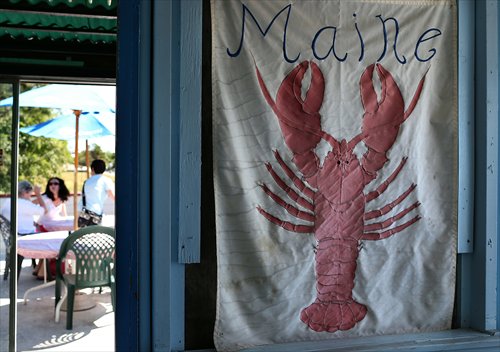
A lobster banner at a restaurant in Maine
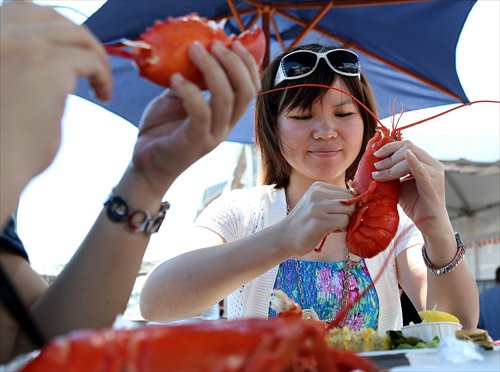
Chinese tourists enjoy lobsters in Maine.
Photos: CFP and Yang Lan/GT
Posted in: Metro Shanghai