Read all about it
Multimedia exhibition pays homage to 10 great magazine pros
Climb up to the second floor of Dr. White, a new bookstore in Xujiahui featuring imported magazines, and you are immediately greeted by the stares of 10 heavyweights of the magazine industry.
These finely illustrated posters bearing quotes include a grinning Terry Jones, the publisher of the i-D, saying "I don't think you need religion." Andy Warhol, who edited the Interview, is accompanied by "I like boring things," while Hong Kong publisher Alan Zie Yongder claims, in Chinese, "I don't do it, be there no money to make."
This is where 10 Cabinets of Magaziners, a petite, multimedia exhibition in honor of some of the best-known names in magazine history, begins.
On display are 10 installations that nine young artists created to express their admiration for these luminaries.
Open drawers
"The word 'magazine' originally comes from the Arabic word 'makhzan,' meaning 'drawer of storage.' From this point, each magazine is an independent drawer, and the 'magaziner' is accordingly the one who fills up the content and pulls up the drawer," wrote Linghu Lei, a high-profile magazine professional and the curator of the exhibition.
For Linghu, the 10 representatives have shifted between various social characters, inspired trends in multiculturalism, and evoked new forms of engagement with life.
The exhibition, he said, aims to invoke memories, generate expectations, and "open up some more drawers."
Artist Fanfan takes two subjects at once - Hugh Hefner, founder of the Playboy, and Alexey Brodovitch, former art director of the US edition of the Harper's Bazaar.
She applies several crafts including pottery and embroidery to build two miniature see-through rooms that cleverly capture the essence of the two magazines.
Mr Bunny features a masculine bunny-headed figure in a red satin robe reading a copy of the Playboy on the sofa. On another sofa sit two Barbies in black skin-tight corsets and stockings, recreating the indulgent, sexy vibe of the magazine.
In Illusional Barformance, several pairs of graceful, feminine hands are found between pieces of erected glass on which torn pages of the Harper's Bazaar are attached.
Meanwhile, Paradox Box, which pays homage to the Rolling Stone's co-founder Jann Wenner, features a black cube marked by a scarlet cardiogram-like pattern and joined to a disc at the bottom, signifying the evolution of the music industry since the magazine was established in 1967.
Zhou Yi, a Beijing-native designer and Central Saint Martins graduate, based her piece on George Lois, who designed 92 covers for the Esquire when he was the magazine's art director.
Zhou admitted she was not familiar with Lois before the project, and she researched Lois' website, the exhibition George Lois: The Esquire Covers at MoMA in 2008, as well as critical essays on him.
"I see him as a brainy advertiser and designer. He has sharp acumen about what would make great covers, and cleverly combines hard news and design," Zhou told the Global Times.
For her project Cover Story, Zhou picked four original Esquire covers from the 1960s and 1970s, and made a mock cover featuring headlines on contemporary China next to each of them. She said she picked covers that she can easily relate to life today.
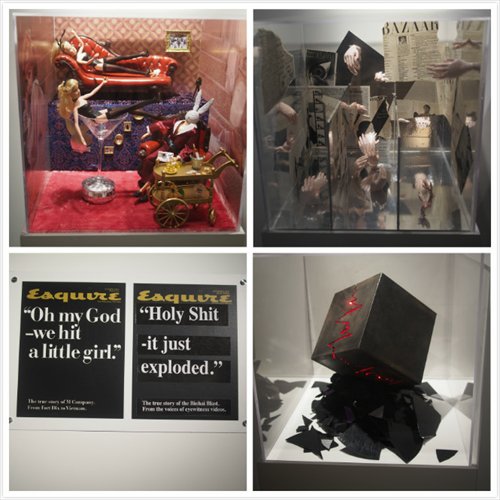
(Clockwise top left) Exhibits Mr Bunny, Illusional Barformance, Paradox Box, and Cover Story on display at 10 Cabinets of Magaziners Photos: Liao Fangzhou/GT
It includes the famous October 1966 edition which bears the words "Oh my God - we hit a little girl" in large white lettering across a navy blue background that referred to a legendary story about a company of American soldiers in New Jersey.
This is accompanied by a September 2015 mock cover reading "Holy Shit - it just exploded," which refers to the deadly Binhai blast that took place in Tianjin this August.
The May 1967 edition featuring a blonde boy having a coke and hamburger while watching TV, on the other hand, is contrasted with a January 2015 mock cover that has a Chinese boy eating a bowl of instant noodles in front of a computer.
"I like to put history and contemporary life together, for similar problems occurred in the past and we can learn from them," Zhou said.
Sound of magazines
Shanghai-based designer and Royal College of Art graduate Jia Huishu takes Tyler Brule, founder of the Wallpaper and the Monocle, as her subject.
Jia re-listened to Monocle 24, the 24-hour radio program derived from the Monocle, and Brule's interviews. "Brule is the epitome of taste - it is not just the fashion items he recommends, but his ideal and concept of lifestyle," Jia said.
During the research, Jia came across Brule saying he considered "luxury" to be having a cup of flat white at his London office in Mayfair.
Since the Monocle mentioned MQ Coffee in its Shanghai feature, Jia decided to go to the coffee shop and record the ambient sounds - whispers, clicking of mugs, the cashier, and the making of milk foam.
Thus, enjoying her exhibit is like "listening" to a page from a magazine. She said she hoped her work would inspire people to think about their lives from a different perspective. Her vision for a traditional magazine would be to approach the audience from a sense rather than from the visual.
"It is especially so with magaziners like Brule, since he is introducing a quality lifestyle. Many brands hire a specific team to research the sounds of their objects. Sound is a very good aspect with which to highlight an object's quality," Jia said.
Date: Until December 29, daily
Venue: Dr. White at The Mix-Place
Address: 880 Hengshan Road
衡山路880号
Admission: Free
Call 5424-0100 for details