HOME >> METRO SHANGHAI
Cultural hybrids
By Wang Han Source:Global Times Published: 2016-1-28 18:38:01
Authors in Shanghai discuss the role foreigners and Chinese are playing to bridge the oceans separating China and the world
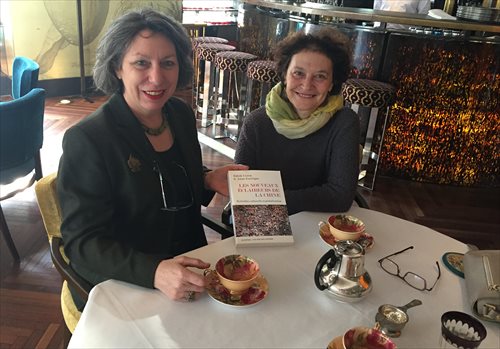
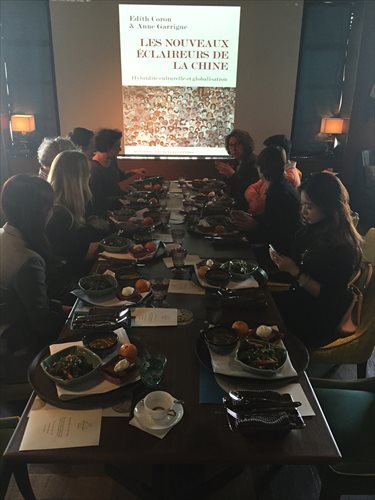
Edith Coron and Anne Garrigue (E&A), coauthors of the new book China Blend: The Cultural Hybrids Bridging the World, recently held a small but intimate literary lunch with a dozen international-minded guests at a restaurant on the Bund.
Coron spent 20 years as a foreign correspondent for several international publications. Her previous book, The Last Exodus, explored the wave of Soviet Jewish immigration to Israel in the 1990s. She has been based in China since 2006.
Garrigue is a French journalist specializing in Asia, where she lived and worked for 20 years until recently moving back to Paris. She has published several books, including a two-volume series on French entrepreneurs in Southeast Asia and in China.
Their latest collaboration focuses on the new breed of internationally minded Chinese and Chinese-influenced foreigners who have transformed modern China into what it is today. Their profiles of these fascinating characters, who range from common factory workers to political attaché, examines the key roles they are playing in China and abroad. The narratives also weave in personal anecdotes that mirror the vast changes in China's warming relations with the outside world.
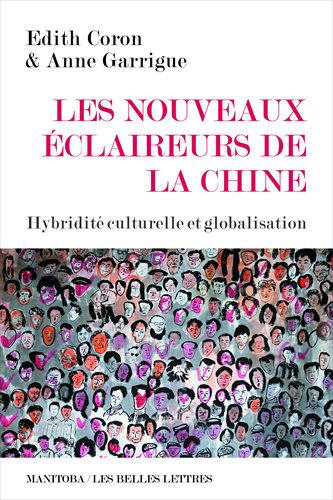
The French version of China Blend was published in October 2015. English and Chinese translated versions have yet to come. Until the time that the Global Times can actually read this book, we asked the authors to speak about the broader themes of their work.
GT: How to define "cultural hybrids?"
E&A: Cultural hybrids are people engaged in a process of transformation, who move between different cultures with ease and familiarity. In so doing, they retain a sense of their authentic self, and to varying degrees claim this cultural complexity as a key component of their identity.
GT: In the book, what issues of cultural hybrids in China are your focuses of discussion?
E&A: Our book has looked both at the journeys these people embarked on, having to resolve what is often seen as a dilemma of loyalty to different cultures (sets of values and behavior) and the impact on the societies in which these hybrids live (what roles they play, what roles they are given or not by their environment).
We interviewed 250 people, Chinese and non-Chinese, who qualify at various degrees as "cultural hybrids." The youngest was an 8-year-old Chinese-American schoolgirl, the oldest was Mao Zedong's translator, Sidney Rittenberg, who is now 94.
GT: You say that never before has anyone written about these cultural hybrids in China, so how did you come up with the idea of writing a book about them?
E&A: We both had been working separately on this topic for many years. Anne is a journalist and an author who lived in Asia for 20 years (Korea, Japan, China, and Singapore) and has written nine books about the region. Edith is a former journalist who lived on four continents over the last 30 years. We met in Beijing and decided to embark on this project, which took us five years from 2010 to 2015.
GT: Can you provide readers with statistics to highlight the trend of cross-cultural exchanges in China?
E&A: Since Deng Xiaoping's opening-up policy, the level of exchanges between China and the world has reached unprecedented levels. Based on our research, around 10 million mainland Chinese live abroad; almost 650,000 foreigners with a residence permit live in China; more than 3 million mainland Chinese have studied abroad since 1978, and about 1.5 million of them have returned to China; nearly 375,000 foreign students from 203 countries are studying in mainland China.
GT: Anne, you lived in Asian countries for two decades, so how did the long sojourn across Asia shape your own cultural hybridity? And are there any contradictions between your authentic identity and your cultural identities?
Anne: I was transformed by my first experience, when I was 27 years old in Japan. Now at 58 I can communicate well with Asians not only because I speak some Asian languages but because I also have common references. I feel comfortable when I emerge myself in an Asian environment. I tested it when I worked on a book on the villages of Huizhou with a Chinese team in 2006. I don't see it as a contradiction. The other way around, I feel enriched.
GT: Edith, your experiences of raising two "third culture" sons on four continents is very special. What challenges has your family encountered in adapting to different cultures?
Edith: It has been an amazingly rich and rewarding experience and obviously with its challenges. The challenge was to be thrown willingly into unknown countries and finding our bearings, as both individuals and as a family, each time. Key to it was learning the languages, diving into the new cultures through encounters, food, history and art and having a purpose. Crossing the boundaries from an outsider to a participant.
GT: Why do you think it is important for Chinese people and expats in China to read this book?
E&A: Because most people do not think in terms of cultural hybridity. We tend to look at our differences, in terms of us/them. We do not emphasize enough the people who are bridging the worlds and who are allowing to think about a future world where complexity is seen as an asset rather than a liability.
Coron spent 20 years as a foreign correspondent for several international publications. Her previous book, The Last Exodus, explored the wave of Soviet Jewish immigration to Israel in the 1990s. She has been based in China since 2006.
Garrigue is a French journalist specializing in Asia, where she lived and worked for 20 years until recently moving back to Paris. She has published several books, including a two-volume series on French entrepreneurs in Southeast Asia and in China.
Their latest collaboration focuses on the new breed of internationally minded Chinese and Chinese-influenced foreigners who have transformed modern China into what it is today. Their profiles of these fascinating characters, who range from common factory workers to political attaché, examines the key roles they are playing in China and abroad. The narratives also weave in personal anecdotes that mirror the vast changes in China's warming relations with the outside world.
The French version of China Blend was published in October 2015. English and Chinese translated versions have yet to come. Until the time that the Global Times can actually read this book, we asked the authors to speak about the broader themes of their work.
GT: How to define "cultural hybrids?"
E&A: Cultural hybrids are people engaged in a process of transformation, who move between different cultures with ease and familiarity. In so doing, they retain a sense of their authentic self, and to varying degrees claim this cultural complexity as a key component of their identity.
GT: In the book, what issues of cultural hybrids in China are your focuses of discussion?
E&A: Our book has looked both at the journeys these people embarked on, having to resolve what is often seen as a dilemma of loyalty to different cultures (sets of values and behavior) and the impact on the societies in which these hybrids live (what roles they play, what roles they are given or not by their environment).
We interviewed 250 people, Chinese and non-Chinese, who qualify at various degrees as "cultural hybrids." The youngest was an 8-year-old Chinese-American schoolgirl, the oldest was Mao Zedong's translator, Sidney Rittenberg, who is now 94.
GT: You say that never before has anyone written about these cultural hybrids in China, so how did you come up with the idea of writing a book about them?
E&A: We both had been working separately on this topic for many years. Anne is a journalist and an author who lived in Asia for 20 years (Korea, Japan, China, and Singapore) and has written nine books about the region. Edith is a former journalist who lived on four continents over the last 30 years. We met in Beijing and decided to embark on this project, which took us five years from 2010 to 2015.
GT: Can you provide readers with statistics to highlight the trend of cross-cultural exchanges in China?
E&A: Since Deng Xiaoping's opening-up policy, the level of exchanges between China and the world has reached unprecedented levels. Based on our research, around 10 million mainland Chinese live abroad; almost 650,000 foreigners with a residence permit live in China; more than 3 million mainland Chinese have studied abroad since 1978, and about 1.5 million of them have returned to China; nearly 375,000 foreign students from 203 countries are studying in mainland China.
GT: Anne, you lived in Asian countries for two decades, so how did the long sojourn across Asia shape your own cultural hybridity? And are there any contradictions between your authentic identity and your cultural identities?
Anne: I was transformed by my first experience, when I was 27 years old in Japan. Now at 58 I can communicate well with Asians not only because I speak some Asian languages but because I also have common references. I feel comfortable when I emerge myself in an Asian environment. I tested it when I worked on a book on the villages of Huizhou with a Chinese team in 2006. I don't see it as a contradiction. The other way around, I feel enriched.
GT: Edith, your experiences of raising two "third culture" sons on four continents is very special. What challenges has your family encountered in adapting to different cultures?
Edith: It has been an amazingly rich and rewarding experience and obviously with its challenges. The challenge was to be thrown willingly into unknown countries and finding our bearings, as both individuals and as a family, each time. Key to it was learning the languages, diving into the new cultures through encounters, food, history and art and having a purpose. Crossing the boundaries from an outsider to a participant.
GT: Why do you think it is important for Chinese people and expats in China to read this book?
E&A: Because most people do not think in terms of cultural hybridity. We tend to look at our differences, in terms of us/them. We do not emphasize enough the people who are bridging the worlds and who are allowing to think about a future world where complexity is seen as an asset rather than a liability.
Edith Coron and Anne Garrigue at the book talk
Participants at the book talk
Cover of China Blend: The Cultural Hybrids Bridging the World
Photos: Wang Han/GT
Posted in: TwoCents, Metro Shanghai, Pulse