China warns against extended sanctions on N.Korea
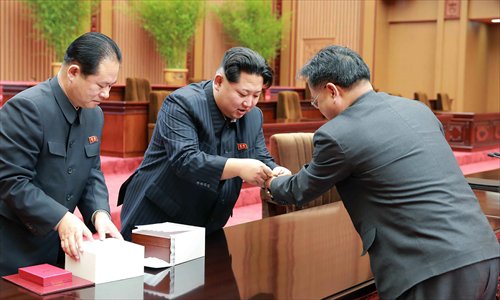
North Korean leader Kim Jong-un (center) gives awards to scientists, technicians, workers and officials who contributed to the launch of the Kwangmyongsong-4 satellite at the Mansudae Assembly Hall on Wednesday morning. Photo: AFP
China warned on Friday that no action directed against North Korea that undermines a "third party's legitimate interests" would help resolve the nuclear issue, in a response to new sanctions imposed by the US against North Korea on Thursday.
"China believes that no hot spot issue can be fundamentally resolved merely through pressure or sanction … It would only complicate the situation," Hong Lei, a spokesman for China's Ministry of Foreign Affairs, told a daily briefing on Friday.
US President Barack Obama on Thursday signed measures passed by Congress, tightening sanctions on anyone importing goods or technology related to weapons of mass destruction into North Korea, or anyone who knowingly engaged in human rights abuses, in a bid to punish the nation for its recent nuclear test and rocket launch, AFP reported on Friday.
"The Korean Peninsula is in a complex and sensitive situation. Relevant parties should remain calm, exercise restraint, and stick to the direction of resolving the issue through dialogues and consultations," Hong said. "We urge relevant parties to act prudently and not to make troubles."
The sanctions targeted not only North Korea, but "secondary sanctions" against those who do business with it, according to Reuters.
Banks and enterprises in China, North Korea's biggest trade partner are likely to fall victim to the sanctions, Japan's Kyodo News Agency reported on Friday.
However, experts said that the measures will not have huge impact on Chinese firms and financial institutions.
"Financial services provided by Chinese banks are unlikely to suffer the brunt of the US sanctions as trade has already diminished after UN sanctions in 2013," Lü Chao, a researcher with the Liaoning Academy of Social Sciences, told the Global Times on Friday.
States are directed to prevent the provision of financial services or the transfer of any financial or other assets or resources, according to strengthened measures levied by the Security Council in 2013.
Lü estimated that only companies which made large-scale investment in North Korea and also do business in US allies like Japan and South Korea will be affected by the sanctions, adding that the number of such firms was limited.
"Besides, since the companies listed for sanctions by the US are based on its intelligence and open reports, those whose business was unknown to the public are unlikely to be involved in the new round of sanctions," Yang Mian, a professor at the Communication University of China, told the Global Times.
He noted that the US has to leave leeway to allow China to maintain interests in North Korea when implementing the measures.
Citing the heightened risk of North Korea instigating terror attacks, the South Korean government sought to push through a sweeping anti-terrorism law, Reuters reported on Thursday.
South Korea's National Intelligence Service said it believed that the North Korean leader had ordered his military to prepare acts against the South, including possibly kidnapping or attacking people or targeting subways or power utilities. The US listed North Korea as a state sponsor of terrorism until 2008.