Educated Chinese women worth more single than married
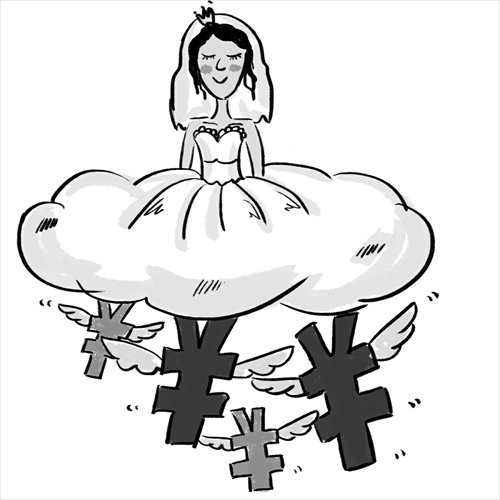
Illustrations: Chen Xia/GT
As a single, 24-year-old Chinese female of what I consider to be just average appearance, I do not think that I can compete with other women in Shanghai's marriage market, historically a home to the most educated, wealthy and attractive women in all of China. But back in my hometown in Wenzhou, Zhejiang Province, I feel I could easily fetch at least 160,000 yuan ($24,469) "bride price."
Bride price is a deeply rooted tradition in Chinese culture, whereby the bridegroom's family must offer betrothal gifts to the woman's family if he wishes to obtain her hand in marriage. In China's poorer times, such gifts were simple housewares such as bedding and furniture. As the economy of the 20th century opened up, so did these gifts, which in the 1980s included "luxurious" electrical appliances like a television or refrigerator.
Today, however, a bride price is usually paid with cold hard cash, which can range as high as a million yuan in metropolises like Shanghai. Each region also has their own methods of determining a woman's bride price, sometimes only according to their appearance or height or, more lately, their education or family background.
For families with a daughter, the bride price is seen as a sort of monetary safety net - and a return on their initial investment of raising and schooling her - for parents who are ostensibly giving away their only child to another family. Married women are often expected to live with and serve their in-laws, leaving their own parents out in the cold.
But because of China's growing gender gap, females are also viewed as valuable commodities by families with a single son, especially in the countryside where many men remain unmarried due to the migratory draw of women to big cities in search of well-paying careers and wealthy spouses.
This places provincial men at a severe economic and geographic disadvantage when it comes time to finding a spouse, but it also reflects a new social phenomenon that has been taking place over the past decade: China's poorest provinces and villages are now demanding the highest bride prices in the country for their daughters.
According to a recent CCTV report, some village families in Shandong Province require real estate and a car on top of an average 120,000 yuan cash bride price. There has also been a growing trend among poor, provincial families with a daughter to stipulate that no dowry will be expected from them, thereby keeping the entire bride price for themselves and placing an additional burden on the husband and his family to pay to furnish their home.
In Wenzhou, however, according to local custom, marrying off one's daughter is a losing transaction, as a girl's family must apply her bride price directly to the dowry in addition to paying an extra 300,000 yuan out of their own pocket.
So even though I might initially be worth a relatively high bride price because I am educated - including a Master's degree from an overseas university - and am not considered "ugly," the large amount of money my parents spent on my education plus the cash they must pay in my dowry means that I am technically worth more to them single than married.
Millions of other Chinese women of my generation also have parents who think this way, which is perhaps one of the reasons why China is seeing a growing number of "leftover women" who stay single and focus on their careers rather than run off and get married right out of college.