Bridging fantasy and reality
Walking around in outer space in a physically interactive VR park
The city's got a lot of tall skyscrapers, but now you can walk on a bridge in space. You could also fall, talk to a giant robot and grab a handrail if you feel a little queasy all the way up there. But down in reality, it's actually a walk-through virtual-reality park.
Star Core VR Park (457 Jumen Road 局门路457号,3335-5416), which calls itself the first of its kind for the country, opened at the beginning of the year in Huangpu district. So far, it's got three out of four chapters in its VR story line, set in space.
In the first, you find yourself walking on a space station's bridge when it breaks. The second part entails a fight with enemy spacecraft, and in the third you retreat to a new planet.
The Global Times recently did the first episode. The venue looks like a narrow corridor with cameras on the ceiling, and in the center of the room is a 10-meter-long yellow bridge with handrails.
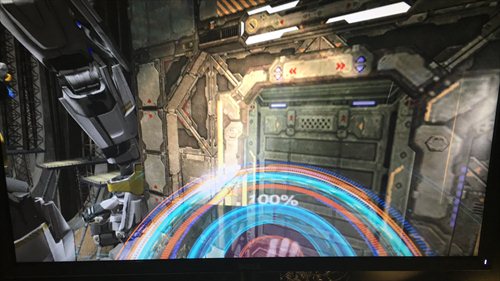
A scene from the first episode from Star Code VR Park
Players walk the bridge wearing futuristic-looking goggles, helmet and glove, trying to make it to the other end of the corridor.
The equipment itself is easy to put on, and the goggles are comfortable, even wearing glasses.
After adjusting some computer settings, the player is transferred to a bridge hanging in a space station, surrounded by vehicles, platforms and anime-style mechas - basically huge machines and robots.
You find yourself standing about 30 meters above ground. Slip, and you fall. On the left is a huge, majestic mecha. You only reach his thigh. You have to lift your head to meet his eyes. To your right you can see an earthlike planet in the dark space.
There are also some stormtrooper-like soldiers on the bridge. You can interact with them with the glove and complete some simple missions.
The effects are so realistic that you immediately leave your friends, the staff, the Earth behind. You totally submerge in the scene.
There's a lot of room for you to walk, move and look around. The texture of the bridge you feel beneath your feet is in sync with the VR. There is almost no delay between your movements and the images you see in the goggles.
The motion-capture system can pinpoint your movements and location accurately and transfer it back immediately to the image.
Xu Lei, the chief operating officer of the VR park told the Global Times that to correlate your body movements to what your eyes see is a big technical problem in the VR industry, not to mention the corresponding potential nausea.
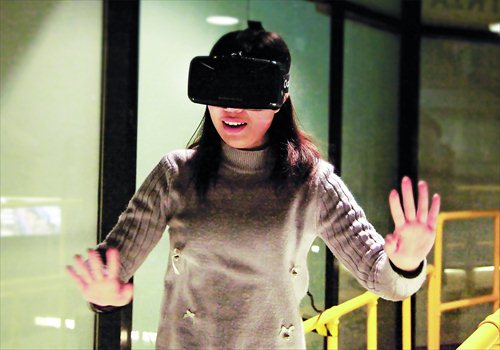
A visitor, through the goggles, walks along a space-station bridge. Photos: Qi Xijia/GT and courtesy of the VR park
"Motion sickness is the biggest problem of the whole industry. When the image you see doesn't coordinate with your movement, you will be dizzy and even want to vomit. But if you see a handrail in the image and you can actually hold it, there will be no motion sickness," Xu said.
The park solved this problem through the cameras and the sensors on the helmet and gloves. The more sensors, the more accurate it can locate position and movement.
"Based on the feedback of thousands of players, 93.6 percent of them didn't feel dizzy when they were playing the game," said Xu.
He said that the walk-through park is the first of its kind in China and the third in the world with a mature VR technology.
"In the existing VR spaces in China many players are confined to a chair. They can't move or walk as the players can do here. And the demos shown are mostly pirated," Xu said.
Globally , the most well-known VR parks are The Void in the US and Zero Latency in Australia. The Void's stories run tomb adventures, while Zero Latency centers on zombies.
As a branch of the film company Mili Pictures, Star Core VR Park has an advantage of original scripts. The space story line that it uses is actually adapted from one of their films, which is due to be released at the end of 2017.
"It will be a 3D humanoid mecha film. We took a story line from the film and developed it into a VR entertainment park," said Xu.
In the future it also plans to open more VR spaces and involve new themes, like elves and dragons. There will also be different seasons.
Xu said that they will leave a cliffhanger at the end of each season and he hoped that people will follow the VR space much like they do with American TV series.