HOME >> BUSINESS
Pakistan power plant lights path to bilateral opportunity
By Li Xuanmin Source:Global Times Published: 2016-6-7 23:13:02
Project part of broader cooperation under ‘One Belt and One Road’ initiative
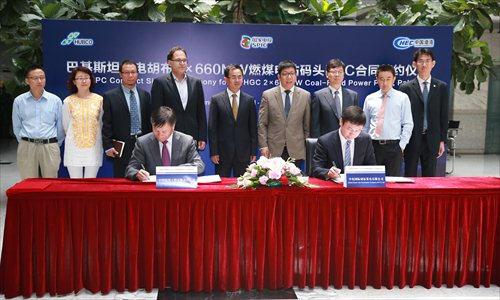
Representatives from China Power International Holding Ltd and China Harbour Engineering Co sign an engineering procurement construction contract in Beijing on Tuesday. Photo: Courtesy of China Harbour Engineering Co
Chinese companies officially signed on Tuesday an engineering procurement construction (EPC) contract for a coal-fired power plant jetty in Baluchistan, Pakistan, and analysts said the deal will create opportunities in both countries.The project is being jointly invested in by China Power International Holding Ltd and the Hub Power Co, and it will be constructed as a whole by China Harbour Engineering Co, a subsidiary of China State Construction Engineering Corp, according to a press release China Harbour sent to Global Times on Tuesday.
The construction of the jetty is expected to be completed by September 2018, with an uploading requirement of 4.4 million tons of coal being met annually.
The port is part of the China-Pakistan Hub 2x660MV coal-fired power plant project located in Baluchistan, Pakistan. It will serve as a transport center and support facility for the power plant.
Pakistan and China agreed to enhance cooperation during President Xi Jinping's official visit to Pakistan in April 2015, Deputy General Manager of China Power Huang Yuntao told the Global Times on Tuesday.
"It was actually one of the priority projects on President Xi's agenda. So we pushed forward the process and signed a joint venture contract with the Pakistani government during that period," he noted.
In line with the China-Pakistan Economic Corridor and the "One Belt and One Road" (B&R) initiative advanced by the Chinese government, the project has received extensive support from both the Pakistani and Chinese governments, China Harbour President Tang Qiaoliang said.
"The Pakistani government helped us with security issues and also assisted us in the land acquisition process," Huang said.
"We also regularly submit reports to the National Energy Administration so that the Chinese government can update our progress and offer corresponding suggestions," he noted.
In recent years, investment from China has moved into Pakistan in sectors such as communications, infrastructure, energy and transportation through various models such as EPC.
Expert noted that capital inflows from China into Pakistan will benefit both sides and strengthen their strategic economic cooperation.
The Hub power plant project sheds light on the promising future offered by closer economic ties along the countries and regions of the B&R initiative.
As the power plant goes into operation, it will become an important part of Pakistan's energy supply chain and ease the country's chronic electricity shortages, Lin Boqiang, director of the China Center for Energy Economics Research at Xiamen University, told the Global Times on Tuesday.
China Power and China Harbour, known for their leading technologies and vast experience, are about to implement the most strict emission standards in the world in the power plant, a practice that will promote Pakistan's sustainable development, Huang noted.
"So in the long term, the project can also help the Pakistani government gradually adjust the nation's energy and electricity structure, optimize the investment environment and facilitate infrastructure construction, which will contribute to the public good," Lin noted.
As the pilot country of the B&R initiative, Pakistan's strategic significance to China is continuing to grow, Lin noted.
Posted in: Companies