HOME >> METRO SHANGHAI
Preschool fervor reflects problems in China’s education system
By Liu Dong Source:Global Times Published: 2016/6/23 18:48:00
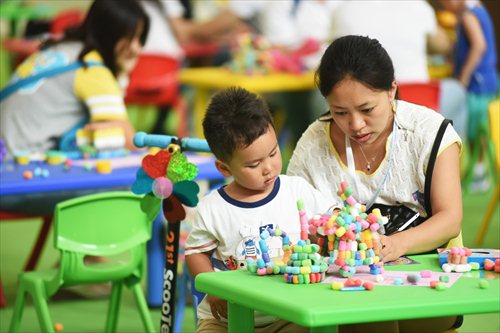
A Chinese mother helps her boy with an art project. Photo: IC
A picture of crowds of adults in Shanghai queuing for up to 40 hours went viral recently. They were all parents trying to enroll their children at Kuno Method, a Japanese-based private preschool institution.
The education group claims that many of its pupils get admitted to prestigious Shanghai elementary schools every year. City media exposed the group for operating without an appropriate business license but this merely served to see a surge in the number of parents wanting to place their children in Kuno Method.
Kuno Method claims to develop children's mental abilities. Since its expansion to Shanghai in 2007, parents have been enthusiastic about its methods and believe that its pupils have a good chance of being accepted by one of the city's leading elementary schools.
For those parents disinclined to wait in line, entrepreneurial scalpers were on hand as queue stand-ins, selling spots in line for up to 5,000 yuan ($760).
"We don't care if the school is an unlicensed agency. We just want it to help our kids get into a top elementary school," one parent told the Global Times.
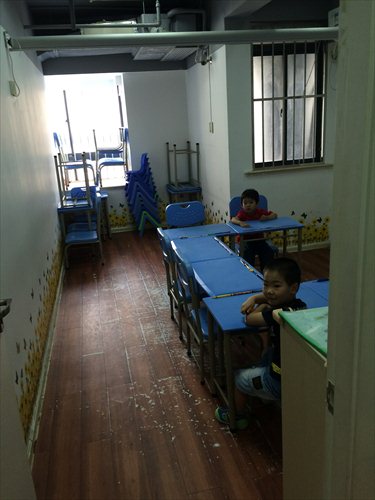
Children in a classroom at Kuno Method. Photo: Liu Dong/GT
Kuno fervor
Although the education authorities have insisted for years that elementary school admissions must not be linked to any prior educational institutions, when the Global Times reporter visited the Kuno Method head office in Xujiahui on Sunday, the entrance was decorated with eye-catching lists of students' names and the corresponding elementary schools where they have been enrolled.
"We are very lucky that our daughter was enrolled just a week ago before the news broke," This was how one couple waiting for their 5-year-old explained their feelings to the Global Times.
According to the mother, who asked to be identified as Ms Wang, the curriculum at Kuno Method is mainly about mind training, memory techniques, math and other mental exercises.
When asked about its role in preparing students for the rigorous standardized tests for school admission, one of the Kuno teachers explained: "We just provide parents with direction and guidance, and we help young students cope with taking an exam. But the results of the tests and interviews depend on the parents and kids themselves."
According to the Xinhua News Agency, which talked to the Kuno Method parent company in Tokyo, the original purpose of the method is to help children learn without resistance when they enter primary school. Being admitted to a prestigious private school is just an "unintended positive outcome."
Yasuyoshi Kuno, the founder of the Kuno preschool education method, has stressed that his early childhood education method was not about teaching children English and math in an early age but it allowed children to grasp concepts of natural shapes, sizes and numbers by connecting different geometries.
In this method preschool education is more involved with hands-on skills, personality training, collective consciousness, traditional culture and customs, outdoor activities and basic manners.
Children in a classroom at Kuno Method. Photo: Liu Dong/GT
Competitive stress
Ms Wang told the Global Times that her child was the last in the class to apply for Kuno. "We have to come here because every other kid in the class had started to learn English, and how could my daughter compete with them if she didn't learn anything?" Zhang said.
Ms Zhang, whose child had just been enrolled at an elementary school, told the Global Times that the logic behind the Kuno fervor was very simple - parents didn't want their children losing the race at the starting line.
"Studying hard in top schools is the way we can change our lives. I earned my life this way and I hope my kids will do the same. We are good at studying and this is what we can teach our kids well," Ms Zhang said.
"For fathers and mothers with little experience in education, why wouldn't you buy quality education resources if you can?" Zhang asked.
Huang Zheng, an expert with the Chinese Preschool Education Research Association, believes that the Kuno fervor highlighted the ignorance and anxieties of many parents in China.
According to a 2016 report published by the China Children and Teenagers' Foundation, 87 percent of parents admitted they were anxious about their children's education.
"It is understandable that parents want their children to receive a good education, but I don't think sending the children to a good school necessarily means their kids will receive a good education," Huang said.
Huang thought it was wrong to put the responsibility for a child's future on a particular institution. "Many parents say they don't know how to teach children - they should learn instead of shifting the responsibility to schools."
Shanghai is one of the cities in China with superior educational resources, but Shanghai parents are still over anxious about education. In some areas there is intense competition for what are perceived as good resources.
A kindergarten teacher from a public school in Xuhui district who asked to be named as just Qiu told the Global Times, there were no convincing statistics to show how many children were enrolled with help from these preschools or with guanxi (knowing key people).
Unequal allocation
On the other hand, the Kuno fervor has also exposed the unequal allocation of educational resources in China.
Li Zixin, the founder of China30s.com, a platform focusing on China's younger generation and the issues they face, thought the big divide on education resources was becoming more serious.
Li said many of China's middle class had become millionaires in the real estate boom in the first decade of the 21st century.
"This has seriously changed the social pricing system. Some things have become more expensive, particularly quality education," the father of two told the Global Times.
Li said that in 2015, of the 1,201 Shanghai students admitted to the two leading universities in Shanghai (Fudan University and Shanghai Jiao Tong University) 70 percent were from 12 "key" high schools.
And in those 12 schools, a majority of the students came from a dozen "key" middle schools.
"So getting your kids into those key schools is vital. You have to be in a good position in the very beginning of this race, which means you need to be enrolled by a 'top' primary school or even kindergarten at the first step so that you have an advantage over the others." Li said.
"For rich people, if money can buy these opportunities, they are very happy to pay for them."
However, in Li's view, this highly concentrated educational framework, which is now polarized by the gap between the rich and poor, cannot be maintained. He thinks alarm bells are already ringing for authorities.
According to jzb.com, one of China's largest education information platform, China now has 180 million children between 0 to 7 years old and the preschool education market was worth 119.8 billion yuan in 2014, with a 21 percent year-on-year increase.
Li said many parents in China today had an international perspective which affected the way they viewed education.
According to jzb.com research, up to 45.7 percent of parents would let their children study abroad.
"Sending their children to study abroad is just like escaping the polluted air and contaminated food in China today, and this has begun to spread across social classes and economic status," Li said.
According to a Caixin media report, more and more local families are using international schools, where they follow the British A-levels or European International Baccalaureate curriculum or take Advanced Placement programs from America as a springboard to getting places in British or US universities.
The number of Chinese students enrolled in foreign universities in 2015 rose by 14 percent to 523,700, the Ministry of Education reported.
Data from the US Institute of International Education last November showed that 124,522 Chinese high-school graduates went to study in colleges in the US during the 2014-2015 school year, up 12.7 percent year-on-year.
Warning signals
The trend of leading students opting to follow an international curriculum is sending warning signals to the Chinese school system.
Li said that with their economic independence and from their own experiences, China's middle-class parents now have a different approach to the Chinese education system.
"Those of us who have been through China's education system, are very aware of its problems. At university, we learn much more outside than inside class. But to get into these universities, we had to go through relentless exam-oriented competitions in primary and secondary schools, and we missed out on a lot of important things we should have learnt."
Li believes more young parents have recognized that it is more important to encourage children to learn to think independently. Unfortunately, China's education system is still very far from adopting this approach. "While the foreign education options are not a panacea, they are attractive options."
Newspaper headline: Kindergarten chaos!
Posted in: Metro Shanghai, City Panorama