HOME >> METRO SHANGHAI
Gone to the dogs
Source:Global Times Published: 2016/7/6 18:18:00
Police bust gang who poisoned animals and sold the meat onto restaurants
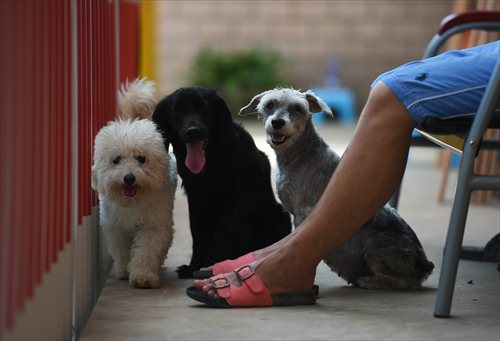
Some dogs were rescued and put in a shelter just before the Yulin Dog Meat Festival. Photo: IC
The controversial Dog Meat Festival in Yulin, Guangxi Zhuang Autonomous Region, though opposed by many people, is a public reflection of the Chinese obsession with dog meat. But some might now be reconsidering their enthusiasm for dog meat. In Rugao, Jiangsu Province, a series of food safety cases triggered by poisoned dog meat are currently being investigated.
Thirty-nine people have been charged by the Rugao People's Procuratorate for selling more than 5,000 kilograms of contaminated dog meat and 110,000 contaminated birds, which contained more than 500 kilograms of cyanide.
The contaminated food was sold in Jiangsu, Anhui, Shanghai, Tianjin and Shandong provinces. Most of it has already been consumed. Twenty-two of those charged have already been sentenced to jail, with terms ranging from eight months to eight years.
The trail to the underground poisoned food gang began to be discovered when a senior citizen surnamed Zhang from Baipu town in Rugao woke from a nap and found his pet dog was missing. Neighbors told him that gangs had been stealing dogs in the area.
He scoured the neighborhood and eventually found the body of his beloved pet in another town. It had been dumped at a center where dog bodies were collected. Angry and distressed, Zhang called the police immediately.
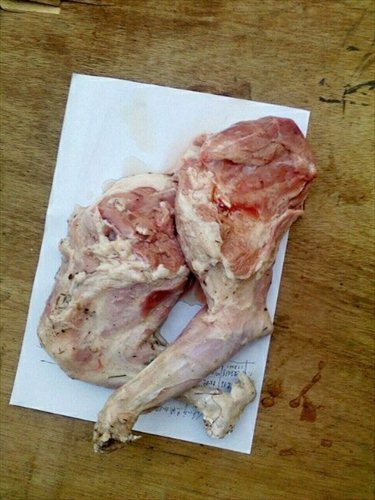
Some of the poisoned dog meat confiscated by police Photo: IC
Rotting meat
When the police arrived at this center, they were confronted by dozens of dog corpses strewn around the floor and the stench of rotting meat. The boss of the collection center, a Mr Gan, protested and said he was running a legitimate business. But he became very nervous when the police asked him to unlock the door to the storage room, the place where the stench was coming from.
There was a large amount of frozen dog meat stored there but the police realized something was wrong. They waited beside the center that night and arrested two men who arrived there later and charged them with dog poisoning. The police also found a notebook which recorded all of Gan's transactions from September 25, 2014. Some of the transactions had the word "live" scrawled beside them.
After being questioned, Gan admitted that his team was part of a well-established dog meat supply chain - the team bought poison, killed the dogs with this and then processed the meat.
Gan admitted buying live dogs as well as poisoned, clubbed and stunned animals. From the dogs that had been clubbed unconscious he extracted their blood to help make the product look fresher. His center was not where the dogs were actually processed. His team just removed internal organs and sold the dead animals with the skin on. Because discolored meat is difficult to sell, the team would freeze any discolored dog meat and try to sell it later in winter when dog meat was in short supply.
Gan made 33,000 yuan ($4,952) from selling half of the 7,000 kilograms of dog meat he had collected in just two months. Some of the meat was sold to costomers like Sun Hailin, who told the police he sold the meat on to restaurants in outer city suburbs in Anhui, Shangdong and Jiangsu provinces.
"Captain Cat"
Gan's poisoned dogs mostly came from Yi Xi, a 52-year-old animal seller from Anhui Province. In Rugao, Yi was known as "Captain Cat" because he had traded in live cats for several years. The cats were not very profitable however, so Yi went into the dog meat business. He had been doing this since 2014 and was very experienced. He used poisoned baits which he would throw to dogs on the street. Within three to five minutes most of the dogs would be dead or unconscious and Yi would grab the bodies. He had sold 300 kilograms of poisoned dog meat to Gan over three months.
Captain Cat's success in the dog meat business increased his notoriety. A lot of local villagers wanted to get into the business and asked Yi for his drugs and poisons as well as learning his techniques. More dogs began to be poisoned and all were being bought by Gan.
Similar methods were used in the poultry business. After questioning Gan and Yi, the police arrested an eight-member gang who had been selling poisoned poultry. More than 110,000 birds had been poisoned this way and sold to restaurants in Shanghai, Zhejiang and Guangdong provinces, where they were cooked for patrons.
Tests revealed that toxic chemicals like cyanide and succinylcholine were present in the dog meat and carbonfuran, a highly toxic pesticide, was found in the poultry.
According to Sun Hailin, the dog poisoners bought the chemicals from a local dealer called Chen Hua. After he was arrested, Chen told police he was just a middleman and his supplier was Ma Hong, who was then arrested by police in Tianjin. Ma told the police that between 2011 and 2013, he had bought 550 kilograms of sodium cyanide three times from a smuggler surnamed Ding from Shandong Province, and resold it for a profit. He admitted he had no qualifications or authorization to buy and sell dangerous chemicals.
The smuggler Zhang Yongnong, who sold the toxic pesticide to kill birds, was also arrested. Zhang said it was easy to get pesticide - a simple click on online shops was all that was needed for large amounts of pesticide to be sent to his home.
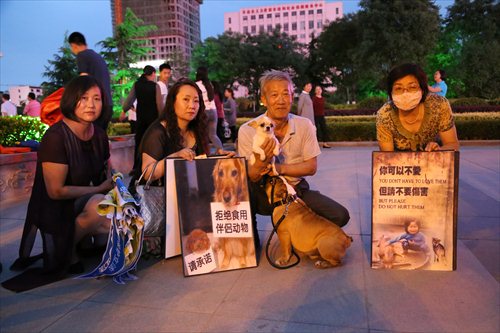
Dog lovers protest over the Yulin Dog Meat Festival. Photo: CFP
Lack of regulations
A procurator from the Rugao People's Procuratorate said the poisoned meat cases reflected a lack of regulation in three areas.
First, compared with ordinary meats like pork and beef, there was little control and regulation of dog and bird meats. Second, the regulations covering dangerous chemicals, like sodium cyanide, were inadequate - there were no controls in the selling and transporting processes, which gave unscrupulous people an advantage.
Third, the administration of the restaurant sector was weak, and improperly-sourced meat could easily find its way onto diners' tables, because the relevant authorities hadn't assumed full responsibility for food quality inspections.
Furthermore, ordinary people were not aware that they should report illegalities like this. The procurator suggested new measures be taken to strengthen the regulations to ensure people could consume food safely.
Compiled by Gu Qianwen based on an article from the Yangtse Evening Post
Posted in: Metro Shanghai, City Panorama