HOME >> METRO SHANGHAI
Leading Chinese researchers explain how new technologies are affecting our lives
By Liu Dong Source:Global Times Published: 2016/7/20 19:03:00
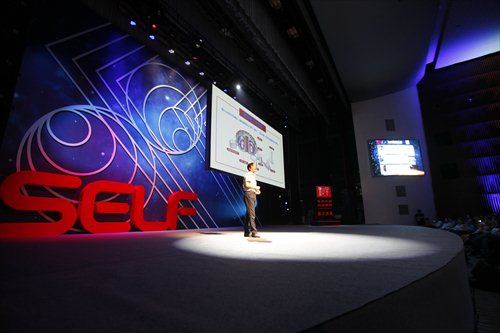
Li Jiangang talks to the audience about artificial suns. Photo: Liu Dong/GT
Technology and science are blasting us into the future. At the Pudong library in Shanghai last weekend, leading Chinese scientists gave special insights into the future as they explained some of the latest developments in their work.
From driverless cars to giant astronomical telescopes, from artificial suns to artificial intelligence, from big data to genome editing - these exciting technologies once were the work of science fiction but now they are part of our daily lives.
In the lecture hall at the library six Chinese scientists spoke to the audience of 500 there and the thousands more watching online. Here are some of the highlights.
An artificial sun
The era of fossil energy will come to an end sooner or later and what will replace this? This has become a pressing problem for every country and especially China.
Li Jiangang, a member of the Chinese Academy of Engineering and a leading expert on nuclear fusion in China told the audience that creating an artificial sun could solve the problem forever.
To create an artificial sun involves simulating the nuclear fusion which occurs at the sun's core in a man-made and controlled reactor. Li said the power it could produce would break mankind's reliance on fossil fuels and offer unlimited clean energy for mankind.
"All current sustainable energies are affected by weather, so nuclear fusion is the best choice. The fuel to maintain the fusion could be deuterium and tritium, the isotopes of hydrogen, and there are infinite reserves of these in the ocean. A cup of seawater can produce energy equal to that created by 300 liters of petrol. But it is much safer and causes barely any pollution," Li told the audience.
For 50 years, scientists around the world have been trying to realize this dream by building such a reactor. But it is not an easy task; the reactor must be able to work and be stable at 100 million Kelvins.
Although Li and his research team used the hardest metal on Earth (tungsten alloy) to build their reactor, they still needed to use the magnetic force produced by a superconductor to suspend the "nuclear fusion fireball" in the middle of the reactor, preventing it from touching the surrounds and melting down.
This reactor was built in Anhui Province, China and was officially known as the Experimental Advanced Superconducting Tokamak (EAST). In February this year, it achieved a breakthrough by heating hydrogen gas to around 50 million Kelvins for 102 seconds. This is the highest temperature and longest time nuclear scientists have achieved to date.
But Li pointed out that this breakthrough only occurred after more than 200,000 experiments and 40,000 failures over 34 years.
Li and his team also participated in an international project, designing and building an experimental fusion reactor: the ITER project in southern France. The ITER nations (China, the European Union, India, Japan, South Korea, Russia and the US) are now engaged in a 35-year collaboration to build and operate the ITER experimental reactor, and bring fusion to the point where a demonstration fusion reactor can be designed.
Although a commercial model will probably not be achievable until 2050 Li said he hoped the first reactor of this type would be built in China.
"I hope I can see an artificial sun being built in my lifetime and see it brightening all the places still in the shadows," Li said.
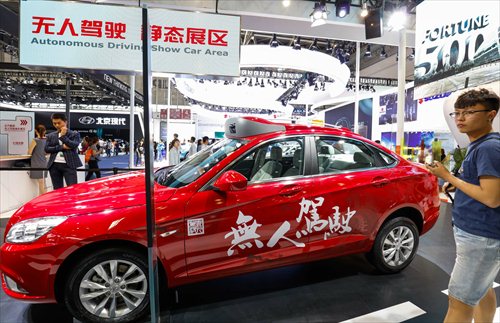
BAIC Motor displays its new driverless car EU 260. Photo: IC
Discovering fire again
"I think the significance of the invention of and the use of the Internet in our daily lives can be only compared to the discovery of fire in human history," Wang Jian, chief technology officer at the Alibaba Group told the audience.
Wang said the Internet has become an indispensable infrastructure for every nation today. "Its presence everywhere makes it transcend any other infrastructure in society," Wang said.
"When we connected every personal computer together, it formed the initial concept of the Internet which we called the Web. When we connected mobile devices, we created "the mobile Internet." Now we are talking about the Internet of things by connecting other devices and data which could not have been connected through networks in the past. Can you imagine in the future, if we could connect everybody's minds, what this would look like? That's the power of Internet," the one-time assistant managing director at Microsoft Research Asia said.
Wang stressed that as human beings we used to only consume natural resources. But now we are creating a new kind of natural resource by our behaviors and this was called "data."
"Data has become a natural resource like land, water and air. This is a change beyond anyone's imagination," Wang said. Wang said the value of the data is realized by computing. And the premise of computing is that the Internet has become the key infrastructure of society.
"The value of data is subsidized instead of being collected on purpose. When you search data with a purpose, its value is restricted by the purpose," he explained.
Wang illustrated his theory with a topical example. "In the past, if we wanted to predict who would become the President of the United States, we needed to carry out street surveys. So what do we do today? We can pretty much figure out the answer by analyzing all the chat data people have posted on social media. And the difference between the two methods is if we have other questions, we don't need to do a survey again, but just reprocess the same data," he said.
"The value of the data is greatly increased because we don't know exactly what it could be used for. And the Internet enables us to have a much deeper understanding of data than before.
"The Internet is the key infrastructure of a modern society, and data is a new means of production like land. You don't know its true value until someone works on it. In the age of the Internet, if you could find valuable information from data by your own means, you would make your fortune," Wang said.
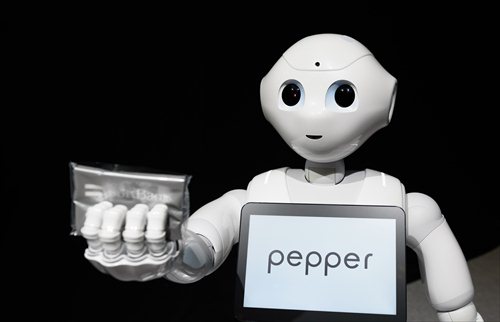
SoftBank Group Corp.'s humanoid robot Pepper is demonstrated at a news conference. Photo: CFP
Focusing on robots
Robotics has become one of the brightest new industries in the world. "With the increasing demands for robots, the key now is to equip robots with a properly functioning visual system," explained Zhang Xiaolin, professor at the Internet of Things System Technology Laboratory of the Shanghai Institute of Microsystem and Information Technology (SIMIT). He has been working on wireless sensor networks and communication systems for robots for decades.
More than 80 percent of the information that the human brain receives is visual. Zhang said if we wanted a robot to have similar capabilities as a human being so it could move freely through streets and avoid obstacles, we had to give it human-like "eyes."
Zhang said building a robot's visual system involved three core functions: positioning, recognition and dimension measurement, which are the areas scientists and engineers are working hard on at present.
International technology and manufacturing giants like Google, Mercedes-Benz and Subaru are striving to develop driverless cars, which involves installing visual systems in the vehicles. These companies are at present generally using a fixed dual camera sensor system. But Zhang believes an object tracking system based on the human neural pathways for a binocular motor system would be a better option.
Zhang believes a binocular system could identify objects better under different circumstance. A "bionic eye" -which is like a human eye - could observe things through coordinated movements of the left and right eyes and maintain a substantial fixed positional relationship. In this way the images the two cameras capture would match to a high degree. This could largely improve the accuracy of computer mapping three-dimensional models and help it identify objects.
Zhang admitted that the service robot technology was far from developed at this stage and most robots today were used for entertainment. However the potential markets are vast. "The birth of eyes sparked an explosion of biological species. And I believe the development of visual systems will spark an explosion of robot species too," Zhang said.
The stem cell surge
For centuries, scientists have believed that human body has the ability to repair itself. From a Chinese medicine perspective the existence of the body's self-healing potential is a constant and exploring this potential is an exciting journey.
Scientists have found this capability in stem cells which can self-renew and self-reproduce.
According to Pei Gang, a cell biology researcher and the president of Tongji University, with people growing more concerned about health stem cells and regenerative medicine have become some of the fastest-growing and most talked-about areas in modern biology.
Considering aging, increased medical expenses and the shortage of transplant organs, stem cell technology could be an effective way to treat some of the most currently incurable diseases. It is a revolution in the medical industry.
Pei Gang shared some of his research on stem cells with the audience. He believes stem cell research is an emerging field with a very promising future. Countries around the world are investing heavily in stem cell research because of its huge impact on social and economic sectors.
But like any other newborn science or technology, Pei said stem cells also had potential problems, particularly with ethical issues.
He talked about human gene editing, which raised global discussions after a group of Chinese scientists announced in 2015 that they had modified a gene linked to a blood disease in human embryos. It was the world's first case involving modified embryos and human reproductive cells and fuelled global debate over the ethics of the research.
"To some extent, it is right to be cautious on big issues like human gene editing, but we should not throw the baby out with the bathwater," Pei said.
"Considering the huge population and medical demands of China, I think this will be an important impetus for China to promote stem cell research," Pei said.
Newspaper headline: Science fact not fiction
Posted in: Metro Shanghai, City Panorama