Nvidia, AMD to pay ‘unprecedented’ 15% of China chip sale revenues to US government: FT
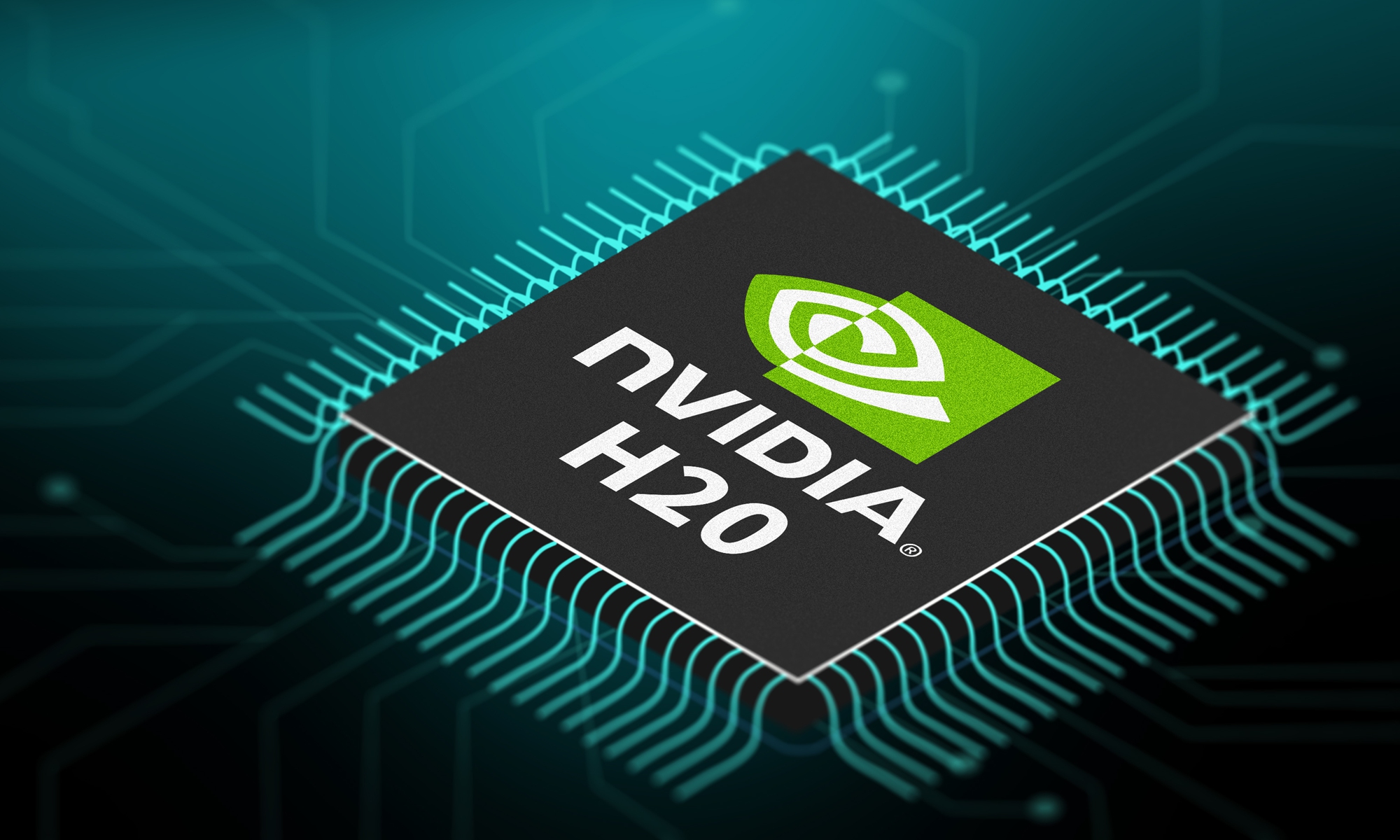
Nvidia H20 chip Photo: VCG
In a rare move, Nvidia and AMD have reportedly agreed to share a portion of their revenue from China sales of certain chips as part of an unusual arrangement with the US administration to obtain export licenses to the Chinese market, the Financial Times (FT) reported on Monday. A Chinese exert said such approach aims to serve only Washington's own interests, which not only undermines the core principles of free trade, but also unbalances the traditional relationship between government and business.
This arrangement is considered "unprecedented," as export control experts have never seen US companies agree to pay a portion of their income to secure export licenses, according to the FT report. According to sources including a US official, Nvidia has agreed to share 15 percent of its revenue from sales of its H20 chips in China, with AMD doing the same for its MI308 chips.
AMD did not respond to a request for comment. Nvidia did not deny that it had agreed to the arrangement. It said: "We follow rules the US government sets for our participation in worldwide markets,"the FT reported.
Washington initially barred chip sales to China in the name of so-called "national security," now according to FT report it pockets a 15 percent sale revenue on Nvidia and AMD's China shipment. If the report is confirmed, it shows the US ban has quietly morphed into a tollbooth: pay up and you may pass, Ma Jihua, a veteran telecom industry observer, told the Global Times on Monday.
This approach means that the US government has repudiated its original security justification to pressure US chip makers to secure export licenses to China through economic leverage. It can be seen that the US permits these exports solely to serve its own interests, with the so-called "national security" invoked merely as a pretext for cracking down on China's semiconductor industry, Ma said.
This tactic not only undermines the core principles of free trade, but also unbalances the traditional relationship between government and business, the expert said.
The H20 chip was developed by Nvidia specifically for the Chinese market following strict export controls imposed by the Biden administration on more advanced chips used in AI. However, the Trump administration later reversed its initial ban on exporting the H20 chip after meetings between Nvidia CEO Jensen Huang and President Trump.
This about-face has been criticized by some US security experts who argue that the H20 chip could aid the Chinese military and undermine US AI capabilities. Nvidia has denied these claims, stating that the allegations are "misleading" and that there is no evidence the H20 chip will be used for military purposes in China.
The decision comes after Nvidia's H20 computing chip has been exposed to have serious security issues, and the company was recently summoned by the Cyberspace Administration of China.
The People's Daily commentary department on August 1 published on its social media accounts WeChat and Sina Weibo an article titled "Nvidia, how can I trust you?" along with a video footage. The article reiterated that "we must never allow 'defective' chips to enter service."
The unusual arrangement highlights the significance of the Chinese market for US chip manufacturers, said Ma.
Global equity research and brokerage firm Bernstein estimated that, based on Nvidia's performance before export restrictions were put in place earlier this year, the company could sell approximately 1.5 million H20 chips in China by 2025, generating about $23 billion in revenue.
However, the revenue deal has sparked concerns among some US officials and experts. Former China expert who served on the National Security Council in the first Trump administration, Lisa Tobin, criticized the decision, suggesting that it turns export licenses into a source of income for Washington and questioning what might come next, according to the FT report on Monday.
The unusual agreement between the chipmakers and the US government underscores the delicate balance between maintaining technological advantages, adhering to export controls, and accessing the lucrative Chinese market, Ma said, adding that it remains to be seen how this rare step will impact the broader US-China tech collaboration and global semiconductor industry dynamics.
RELATED ARTICLES