
HOME >> ARTS
Chinese tourists revive Egypt’s renowned Khan el-Khalili tourist bazaar after recession
Source:Xinhua Published: 2019/12/15 16:48:39
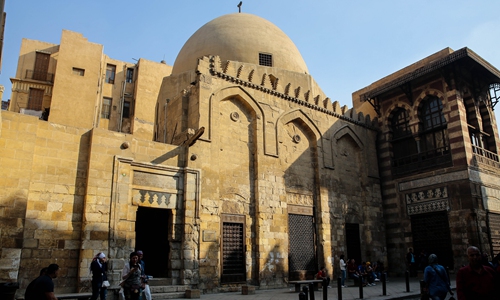
The Khan el-Khalili bazaar in Cairo, Egypt Photo: AFP
The narrow alleys of Egypt's famous Khan el-Khalili bazaar market in the capital Cairo bustled with large numbers of Chinese tourists during a sunny warm winter day."The market attracts thousands of Chinese visitors every day. They have breathed life into the place after years of recession," Mohammed Gamal, owner of an antique shop in the centuries-old marketplace, told the Xinhua News Agency.
Gamal revealed that he was seriously thinking of closing the shop a few months ago due to the acute recession in the tourism industry. However, he said that the recent flow of Chinese tourists have revived business at the famed bazaar once again.
Exploration and shopping
The Tourism sector in Egypt has been suffering from a recession over the past few years due to political turmoil and relevant security challenges that resulted from the ouster of two heads of state in 2011 and 2013.
It further deteriorated after a plane crash in Sinai killed more than 200 people, mostly Russians, in October 2015, and another tragic crash of an Egypt Air flight that killed all 66 people on board, including 15 French nationals, in May 2016.
However, tourism started to recover as Cairo improved its security measures at airports and launched campaigns abroad to promote the vital sector.
In November, Egyptian Tourism Minister Dalia al-Mashat announced Egypt's plans to carry out a tourism promotion campaign to attract more Chinese tourists to the monument-rich Arab country.
Mashat's statements came ahead of her participation in Bloomberg's New Economy Forum which was held on November 20-22 in Beijing.
"I believe the government's efforts to attract Chinese tourists have been working well because the number of the Chinese visitors at the bazaar are notably increasing," Gamal said after she spoke to some tourists in Chinese.
Gamal, whose family has been in the business for decades, noted that Chinese tourists do not only come to the bazaar for historical knowledge, "but also to buy."
"Unlike most of foreign tourists, the Chinese tourists spend well," Gamal said, adding that Chinese tourists have great taste when it comes to Egyptian handmade artifacts and historical monuments.
Khan el-Khalili, which dates back to 1382, is located in the heart of Cairo's old Islamic district and is considered one of the most important tourist attractions in the most populous Arab country.
The market has everything a tourist may need, from antiques to homemade perfume, and even spices of all varieties.
Walking deeper into the bazaar through its tiny alleyways, the glitter of gold and handmade glass items adds beauty to the charming ancient market that catches the eye.
Shops for carpets, belly-dancing costumes and handicrafts dot the pathways of the historical business neighborhood.
Although it has been modernized, the market still maintains its ancient Islamic character with dozens of old structures, ancient mosques and hotels across the commercial district.
In addition to shops, there are coffeehouses, restaurants and street food vendors distributed throughout the market to serve tourists during or after shopping.
"Chinese tourists are frequent visitors of the bazaar's restaurants and coffee shops," Adel Fathy, a worker at a restaurant serving Egyptian food said.
He added that Chinese tourists are eager to know more about Egyptian culture, including food.
"They order several kinds of Egyptian food and they do not negotiate," the middle-aged man said, flashing a smile.
Like Gamal, the antique shop owner, Fathy has also started to learn some Chinese in order to communicate with Chinese tourists.
"A few months ago, none of us spoke Chinese. We only knew words like 'hi' or 'welcome,' but now we can communicate and our Chinese is rapidly improving," he said.
Bright future
To encourage more tourists to visit the country, Egypt has exempted Chinese tourists from visa requirements, allowing for visas-upon-arrival if they are sponsored by a tourist agency and are financially comfortable.
Chinese Cultural Counselor to Egypt Shi Yuewen said in a recent interview with Xinhua that more than half a million Chinese tourists visited Egypt in 2018, and that they are expecting more Chinese tourists to visit the country this year.
Talking about the most popular destinations visited by Chinese tourists, Shi mentioned the Pyramids in Giza, the cities of Luxor, Aswan and Alexandria, as well as the resort cities of Hurghada and Sharm el-Sheikh.
According to the official statistics agency, Egypt's tourism revenues amounted to $12.6 billion in 2018, an increase of 28 percent from $9.8 billion in 2017.
Newspaper headline: Back to life
Posted in: ART,CULTURE & LEISURE