
China's GDP heads for historic downturn in Q1: GT survey
By GT staff reporters Source:Global Times Published: 2020/4/15 22:03:40
Pandemic adds uncertainty to second phase trade talks with US
Editor's note:
The black-swan COVID-19 pandemic has dragged down the world economy and most observers expect China's first-quarter GDP to contract at its worst rate ever. Ahead of first-quarter economic data to be released on Friday, the Global Times Source surveyed 20 Chinese experts. They were asked to gauge the depth of the virus short-circuiting business activity in the Chinese and global markets, as well as its impact on the China-US second phase trade talks. The experts shared their opinions on the role that China, which has effectively contained the virus, can play in helping stabilize global growth for 2020.
Most of the participants expect a historic growth dip for the first-quarter GDP, with a contraction ranging from 3 to 8 percent, but they also foresee a quick rebound starting in the second quarter as the country has basically contained the virus and the impact on domestic economic growth has been brought under control.
The remaining two economists expect the quarterly GDP to gain in the first quarter, since China geared up to resume factory activity in March with strengthened and effective efforts to contain the virus.
Participants included Guan Tao, a former official at the State Administration of Foreign Exchange; Chen Wenling, chief economist at the China Center for International Economic Exchanges (CCIEE); Gao Lingyun, an expert at the Chinese Academy of Social Sciences (CASS); Sheng Songcheng, a counselor to the Shanghai municipal government, and Dong Shaopeng, an adviser to the China Securities Regulatory Commission.
Record slump possible
Domestic supply and demand took a massive hit from the virus in the first quarter — the first two months in particular. Extended holidays and nationwide logistics disruptions hindered factory activity, consumption dried up as people stayed home and corporate investment slowed due to mounting liquidity pressure, the survey found.
As a result, China is likely to record the largest-ever decline in its GDP in the first quarter — the unavoidable price the country paid to control the deadly virus, experts noted.
The total cost may exceed 5 trillion yuan ($709 billion) because of factory shutdowns and the suspension of other activities for more than 40 days due to the virus outbreak, possibly leading to a 3 percent contraction in GDP during the period, said Cao Heping, professor of economics at Peking University.
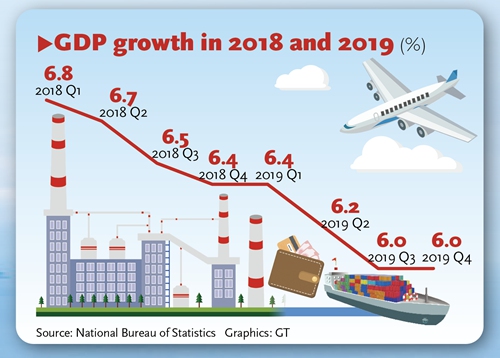
The economy expanded 6.4 percent in the first quarter of 2019.
"Based on China's trade figures in the first two months, first-quarter GDP may have fallen 7 to 9 percent. But as foreign trade saw a rebound in March, the decline may narrow to 5 to 7 percent," said Tian Yun, vice director of the Beijing Economic Operation Association.
In March, China's foreign trade reached 2.45 trillion yuan, down 0.8 percent year-on-year, with the decrease narrowing 8.7 percentage points from the first two months, latest customs data showed.
However, Cong Yi, a professor at the Tianjin University of Finance and Economics, forecast GDP growth in Q1 could expand by 1 to 2 percent.
Economic activity gradually resumed in March with an increased recovery in operational capacity and supply, along with a number of exporters' move to produce medical supplies for shipments to virus-hit countries. These factors probably helped the economy grow slightly during the period, said Cong.
Chen of the CCIEE estimated a gain of 3-4 percent in first-quarter GDP, saying that China's economic fundamentals are stable since the country basically contained the virus in the past two months. It was also able to stabilize production and gradually resume manufacturing and other economic activity.
Slim hope for trade talks
The current challenges for the Chinese economy mainly come from external shocks as the pandemic is sweeping through the European markets and the US, the world's largest economy, the survey found. The number of global confirmed COVID-19 cases exceeded 1.99 million as of press time, with the US reporting more than 600,000, according to Johns Hopkins University.
The US economy may shrink 2.5-3 percent in the first quarter as the COVID-19 outbreak in the US is far from reaching an inflection point. The virus is driving US business activity to a record low which continues to elevate its unemployment, said Hu Qimu, senior fellow at Sinosteel Economic Research Institute.
But Bai Ming, deputy director of the Ministry of Commerce's International Market Research Institute, said that US GDP would probably flat in the first quarter, since economic activity was largely unaffected during the first two months of 2020.
Unlike China, US average households have high debt levels, which means that consumer spending power will be hampered by reduced or suspended income during the coronavirus lockdown, Bai said.
Coronavirus relief funds recently approved by the US Congress will be an effective instrument to aid US households, but it might give rise to long-term fiscal pressure and cause economic bubbles, Bai noted.
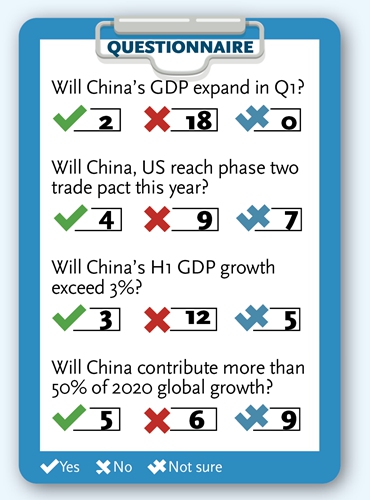
Chinese Ambassador to the US Cui Tiankai recently said that implementation of the China-US phase one trade deal is progressing despite the spread of the pandemic in the US, but 16 out of the 20 experts in the survey said the second phase trade deal has an uncertain future.
"The second phase trade deal is unlikely to be reached by the end of this year," said Gao of CASS, who is close to the trade talks.
Gao said that China is open to further negotiations but the US is not enthusiastic, based on its recent responses, because the pandemic and the upcoming US presidential election have added uncertainty to the second phase trade talks.
Cheng Shi, chief economist at ICBC International, said that because the scope and intensity of the pandemic had gone beyond expectations, the world economy has entered into a painful recession. Thus, the second phase of the trade talks needs to reflect large adjustments to the new environment.
Steady recovery
The latest IMF forecasts suggest that the global economy will contract by 3 percent in 2020, its worst performance since the Great Depression. The US economy will contract by 5.9 percent this year, while China is seen growing by 1.2 percent in 2020, the IMF forecasted.
Both China and the US are large and open economies with huge markets and strong demand. The difference is that the US is a developed economy, which has completed its urbanization and industrialization. However, its economic structure has been too financialized and its manufacturing has been hollowed out, said Hu.
China is promoting new models of urbanization and industrialization driven by the internet-led economy that are rooted in China's great consumer market, Hu said, noting that China has more leeway against external risks than the US.
China's contribution to global GDP growth will increase in 2020 as its rebounding factory sector has sent positive signals to global manufacturers that depend on Chinese imports.
Five of the 20 experts forecast that China's contribution to global economic growth this year will exceed 50 percent. Six said the contribution will range from 30-40 percent. The rest, citing the uncertainty of the pandemic's influence, declined to make a specific forecast.
In 2019, China's contribution to global economic growth was about 30 percent, up from 27.5 percent in 2018, according to the National Bureau of Statistics (NBS).
The NBS is set to release first-quarter economic figures on Friday.
More stimulus moves are expected to be revealed after the NBS announcement, and if the amount is at least 10 trillion yuan and it's mainly used to help enterprises and stimulate consumption, China can still achieve reasonable growth targets for the second quarter and the second half of the year, said Teng Tai, dean of the WANB New Economy Research Institute.
The Chinese economy will be an important stabilizer for the global growth, he said.
The black-swan COVID-19 pandemic has dragged down the world economy and most observers expect China's first-quarter GDP to contract at its worst rate ever. Ahead of first-quarter economic data to be released on Friday, the Global Times Source surveyed 20 Chinese experts. They were asked to gauge the depth of the virus short-circuiting business activity in the Chinese and global markets, as well as its impact on the China-US second phase trade talks. The experts shared their opinions on the role that China, which has effectively contained the virus, can play in helping stabilize global growth for 2020.
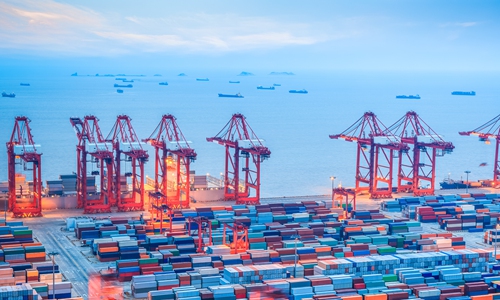
Yangshan deep water port in Shanghai Photo: IC
China's economy is likely to contract in the first quarter as a result of a sweeping halt in activity, the nation's slow recovery of business operations and a sudden slump in global demand because of the COVID-19 pandemic, 18 out of 20 prominent economists said in a Global Times survey.Most of the participants expect a historic growth dip for the first-quarter GDP, with a contraction ranging from 3 to 8 percent, but they also foresee a quick rebound starting in the second quarter as the country has basically contained the virus and the impact on domestic economic growth has been brought under control.
The remaining two economists expect the quarterly GDP to gain in the first quarter, since China geared up to resume factory activity in March with strengthened and effective efforts to contain the virus.
Participants included Guan Tao, a former official at the State Administration of Foreign Exchange; Chen Wenling, chief economist at the China Center for International Economic Exchanges (CCIEE); Gao Lingyun, an expert at the Chinese Academy of Social Sciences (CASS); Sheng Songcheng, a counselor to the Shanghai municipal government, and Dong Shaopeng, an adviser to the China Securities Regulatory Commission.
Record slump possible
Domestic supply and demand took a massive hit from the virus in the first quarter — the first two months in particular. Extended holidays and nationwide logistics disruptions hindered factory activity, consumption dried up as people stayed home and corporate investment slowed due to mounting liquidity pressure, the survey found.
As a result, China is likely to record the largest-ever decline in its GDP in the first quarter — the unavoidable price the country paid to control the deadly virus, experts noted.
The total cost may exceed 5 trillion yuan ($709 billion) because of factory shutdowns and the suspension of other activities for more than 40 days due to the virus outbreak, possibly leading to a 3 percent contraction in GDP during the period, said Cao Heping, professor of economics at Peking University.
The economy expanded 6.4 percent in the first quarter of 2019.
"Based on China's trade figures in the first two months, first-quarter GDP may have fallen 7 to 9 percent. But as foreign trade saw a rebound in March, the decline may narrow to 5 to 7 percent," said Tian Yun, vice director of the Beijing Economic Operation Association.
In March, China's foreign trade reached 2.45 trillion yuan, down 0.8 percent year-on-year, with the decrease narrowing 8.7 percentage points from the first two months, latest customs data showed.
However, Cong Yi, a professor at the Tianjin University of Finance and Economics, forecast GDP growth in Q1 could expand by 1 to 2 percent.
Economic activity gradually resumed in March with an increased recovery in operational capacity and supply, along with a number of exporters' move to produce medical supplies for shipments to virus-hit countries. These factors probably helped the economy grow slightly during the period, said Cong.
Chen of the CCIEE estimated a gain of 3-4 percent in first-quarter GDP, saying that China's economic fundamentals are stable since the country basically contained the virus in the past two months. It was also able to stabilize production and gradually resume manufacturing and other economic activity.
Slim hope for trade talks
The current challenges for the Chinese economy mainly come from external shocks as the pandemic is sweeping through the European markets and the US, the world's largest economy, the survey found. The number of global confirmed COVID-19 cases exceeded 1.99 million as of press time, with the US reporting more than 600,000, according to Johns Hopkins University.
The US economy may shrink 2.5-3 percent in the first quarter as the COVID-19 outbreak in the US is far from reaching an inflection point. The virus is driving US business activity to a record low which continues to elevate its unemployment, said Hu Qimu, senior fellow at Sinosteel Economic Research Institute.
But Bai Ming, deputy director of the Ministry of Commerce's International Market Research Institute, said that US GDP would probably flat in the first quarter, since economic activity was largely unaffected during the first two months of 2020.
Unlike China, US average households have high debt levels, which means that consumer spending power will be hampered by reduced or suspended income during the coronavirus lockdown, Bai said.
Coronavirus relief funds recently approved by the US Congress will be an effective instrument to aid US households, but it might give rise to long-term fiscal pressure and cause economic bubbles, Bai noted.
Chinese Ambassador to the US Cui Tiankai recently said that implementation of the China-US phase one trade deal is progressing despite the spread of the pandemic in the US, but 16 out of the 20 experts in the survey said the second phase trade deal has an uncertain future.
"The second phase trade deal is unlikely to be reached by the end of this year," said Gao of CASS, who is close to the trade talks.
Gao said that China is open to further negotiations but the US is not enthusiastic, based on its recent responses, because the pandemic and the upcoming US presidential election have added uncertainty to the second phase trade talks.
Cheng Shi, chief economist at ICBC International, said that because the scope and intensity of the pandemic had gone beyond expectations, the world economy has entered into a painful recession. Thus, the second phase of the trade talks needs to reflect large adjustments to the new environment.
Graphics: GT
Steady recovery
The latest IMF forecasts suggest that the global economy will contract by 3 percent in 2020, its worst performance since the Great Depression. The US economy will contract by 5.9 percent this year, while China is seen growing by 1.2 percent in 2020, the IMF forecasted.
Both China and the US are large and open economies with huge markets and strong demand. The difference is that the US is a developed economy, which has completed its urbanization and industrialization. However, its economic structure has been too financialized and its manufacturing has been hollowed out, said Hu.
China is promoting new models of urbanization and industrialization driven by the internet-led economy that are rooted in China's great consumer market, Hu said, noting that China has more leeway against external risks than the US.
China's contribution to global GDP growth will increase in 2020 as its rebounding factory sector has sent positive signals to global manufacturers that depend on Chinese imports.
Five of the 20 experts forecast that China's contribution to global economic growth this year will exceed 50 percent. Six said the contribution will range from 30-40 percent. The rest, citing the uncertainty of the pandemic's influence, declined to make a specific forecast.
In 2019, China's contribution to global economic growth was about 30 percent, up from 27.5 percent in 2018, according to the National Bureau of Statistics (NBS).
The NBS is set to release first-quarter economic figures on Friday.
More stimulus moves are expected to be revealed after the NBS announcement, and if the amount is at least 10 trillion yuan and it's mainly used to help enterprises and stimulate consumption, China can still achieve reasonable growth targets for the second quarter and the second half of the year, said Teng Tai, dean of the WANB New Economy Research Institute.
The Chinese economy will be an important stabilizer for the global growth, he said.
Graphics: GT
Posted in: ECONOMY