
Thermal detector industry disorderly, but not for long
By Yin Yeping Source:Global Times Published: 2020/4/21 22:48:40
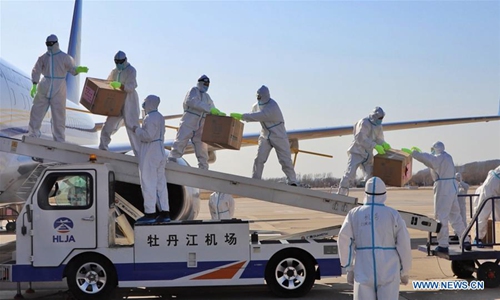
Staff transport medical supplies at the airport in Mudanjiang, northeast China's Heilongjiang Province, April 15, 2020. Hubei has sent medical supplies to the border province of Heilongjiang in northeast China amid the rising pressure of imported COVID-19 cases. (Xinhua)
Increasing global demand for virus prevention and control items such as thermal detectors has disrupted the industry's normal supply-demand balance and led to the emergence of substandard products, causing concern among domestic suppliers over the international reputation of Chinese-made products.
Sally Gao, a sales manager of Wuhan Guide Infrared, told the Global Times on Tuesday that the company puts a lot of effort into products' quality, including controlling the source of raw material production and setting up multiple quality checkpoints along the production line.
However, the reputation of thermal detectors made by some small workshops has had a bad impact on Wuhan Guide's exports.
"Instead of seeking long-term development, some of the workshops are profiteering by cutting production costs at the expense of quality, which disturbs the market order," Gao said, adding that the substandard products yield inaccurate readings.
Although every detection system has its measurement errors, the average error of an entry-level medical infrared thermometer is about 0.5 degree Celsius and that of a high-end model is 0.3 degree. Meanwhile, errors for industrial models exceed 2 degrees.
An employee surnamed Xue of Dali Technology, based in Hangzhou, capital of East China's Zhejiang Province, a thermal detector supplier, told the Global Times that there are cases of some companies using thermal detectors intended for industrial use for medical purposes. The industrial models are cheaper but less accurate.
"Some middlemen buy these kinds of products for export orders without knowing or caring about function or quality … they only think about making profits," he said.
Chen Hongyan, an industry expert, told the Global Times on Tuesday that the biggest cause of these quality problems is middlemen from abroad who — in order to close a deal — help buyers find low prices in a bid to make greater profits.
"The technical threshold for production lines of thermal detectors for medical use is relatively high … and so are the costs," Chen said.
Chen said that a good sensor alone costs more than 80 yuan, but others can be had for only 40 yuan, even though they give inaccurate results and have much shorter service lives. The Global Times learned that the current standard market price for a hand-held thermal detector for medical use is around 300 yuan and large infrared thermal imaging rapid temperature-screening systems cost up to 100,000 yuan, including taxes.
"The price is high because of quality control, and the costs of raw materials for some parts have gone up," said Gao, adding that despite the rising prices, the company is managing to turn out products at a reasonable price.
In order to stop substandard medical materials from being exported, the Chinese customs authorities have launched series of crackdowns.
More than 33 million pieces of medical materials being exported without registration certificates were intercepted by customs. Among them, there were 31.65 million masks, 509,000 sets of protective clothing and 46,000 infrared thermometers, according to China customs on April 13.
Jin Hai, director of the general affairs department of the General Administration of Customs, said at a press briefing on April 13 that China customs will use punitive measures to stop substandard or shoddy goods from being exported through confiscation and fines.
The situation eased after March 31 when new rules requiring exporters to provide Chinese markings in addition to the markings of the destination countries were launched.
"The costs of illegal activities are much higher now and if something is not up to standard, the products will be confiscated and fines will be imposed, so that not only middlemen but those elsewhere on the chains including the manufacturers and buyers will all end up being losers," Chen said.
Posted in: COMPANIES,COVID-19 IDUSTRY DRIVE