
China plans to set up 10 demonstration zones to promote imports
By Yu Xi Source: Global Times Published: 2020/11/4 20:53:40
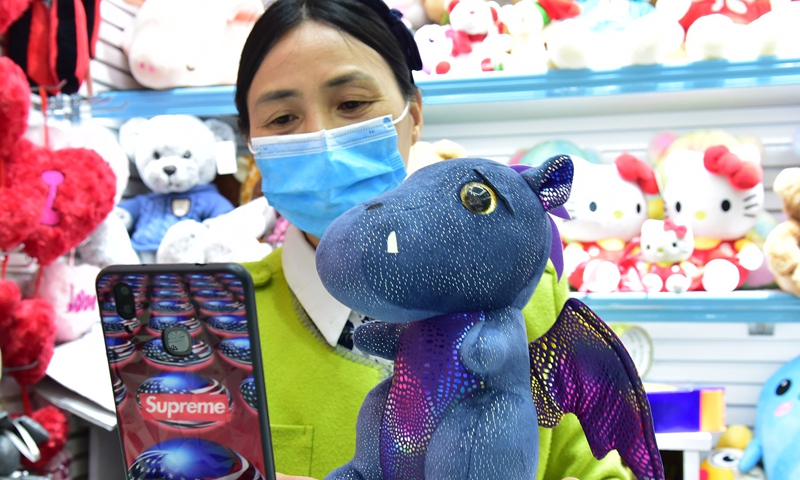
A merchant promotes products via livestreaming at Yiwu international trade city in Yiwu, east China's Zhejiang Province, April 8, 2020. (Photo by Lyu Bin/Xinhua)
China's Ministry of Commerce and eight other authorities announced on Wednesday that the country plans to set up 10 demonstration zones to promote imports by creative means, covering the eastern, central and western regions as well as the old industrial base in Northeast China, ahead of the opening ceremony of the third CIIE.
The demonstration zones include sea, land and air ports, reflecting the impetus and potential of China's import capability, said Li Xingqian, director of the Ministry of Commerce's foreign trade department, during a media interview, according to the MOFCOM on Wednesday.
The 10 demonstration zones include Shanghai Hongqiao Central Business District; Jinpu New Area in Dalian, Northeast China's Liaoning Province; Yiwu, East China's Zhejiang Province; Tianfu New District in Southwest China's Sichuan Province, and Xi'an International Trade and Logistic Park, Northwest China's Shaanxi Province.
The demonstration zones are intended to support imports, industry and consumption, as well as to boost trade innovation in policy, services and models, according to Li.
These regions are expected to play important roles in global trade. For instance, Yiwu has more than 310,000 vendors with an online presence including 140,000 cross-border vendors, according to a document the Yiwu government sent to the Global Times on Wednesday. The city handles daily cross-border parcels exceeding 2.3 million.
During the second CIIE, China promised to develop more demonstration zones to promote imports. The move indicated "the country is fulfilling its commitment" to build more demonstration zones to boost imports, Wei Hao, director of the Department of International Economy and Trade at Beijing Normal University, told the Global Times on Wednesday.
Despite the impact of the COVID-19 pandemic, the third CIIE is being held as scheduled, which has shown "our strong determination" to pursue "high-quality opening-up," Wei said, noting that the new zones not only cover developed regions, but include underdeveloped areas such as the central and western regions, indicating the country is aiming to make new strides in economic development, based on the 14th Five-Year Plan (2021-25).
China has lowered tariffs in a bid to enhance trade during recent years. The Chinese domestic market has huge potential as the size of China's middle class is put at over 400 million people, according to Li.
Li said China is taking practical action to assume its responsibility as a major trading country to boost imports, and China will continue to make policy adjustments to support the import business in innovative ways.
Data from the World Trade Organization show that China's imports accounted for 11.3 percent of the world's total in the first seven months, up 0.8 percentage point year-on-year, hitting a record high share in global trade.
China's merchandise trade stood at 23.12 trillion yuan ($3.44 trillion) in the first three quarters of 2020, up 0.7 percent year-on-year, according to data released by the country's customs authorities in early October.
Posted in: ECONOMY