Making a sporty splash
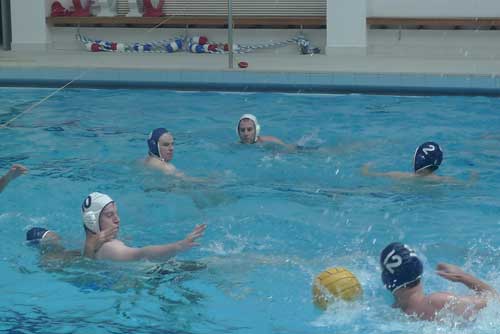
The Shanghai Sea Dragon Water Polo Club scrambles for the ball during a match. Photo: Ye Jun/GT
It's been five years since Elena Escalona last played water polo. The 25-year-old from Florida started competing in the team water sport when she was 14 years old. Her high school team once won a championship four years in a row. Though a dedicated follower of the game, which is known for its toughness and demanding levels of endurance, Escalona had to quit due to a hip injury after her second year at university.
When she recently heard a friend talking about the sheer excitement brought by playing rugby, memories of the fun time playing water polo and her athletic disposition instantly rekindled her passion for her favorite sport. Luckily for Escalona, who moved to Shanghai as a preschool teacher three weeks ago, she soon found a local community of water polo enthusiasts.
Claiming to be a "ragtag crew of former water polo players and swimmers" from all over the world, the Shanghai Sea Dragon Water Polo Club has gathered a group of hobbyists devoted to a sport which, though it remains a fringe pastime in many parts of the world, generates a sense of team camaraderie and serves as enjoyable exercise for the city's hustling urban dwellers.
"Water polo is still a minor sport to a large extent, but people who play it are mostly very passionate about it," John Coughlan, cofounder of the club, told the Global Times.
"I am glad there is a team in Shanghai that I can play with, and I am really surprised at how much I am actually able to do," Escalona said, after playing with members of the Shanghai Sea Dragon Water Polo Club for the first time last Sunday at the Puxi campus of the Shanghai American School. As the only female player in the pool, she said she was "glad that they didn't take it easy on me."
Warriors on water
With its history as a team sport traceable back to county fairs and festivals in England and Scotland in the late 19th century, water polo is also occasionally referred to as "water rugby" and "aquatic football." "I think it combines certain aspects of a lot of sports like soccer, rugby, basketball and swimming. And it's a lot of fun to play," Coughlan said.
Having started playing water polo about 20 years ago, Coughlan, who hails from California where the sport is quite popular, established the Shanghai Sea Dragon Water Polo Club in 2008 together with a few friends who were also missing getting cheeky in the water.
They spread the word to look for like-minded players, and over the years the club has grown into one with over 100 members from all walks of life including students, white-collar workers and many successful professionals, some of whom are or used to be lifeguards or swimming teachers.
Though the majority of members are men, they do have some women players joining them occasionally.
"There is a mix of foreigners and local players, ranging from 16 to 60 years old," Coughlan said, adding that the club is composed of everyone from pure beginners to professional-level players.
According to the 33-year-old who currently works in real estate, they have a fairly experienced core group of former professionals or semi-professional players, including one of the founding members who was the goalkeeper on the 1988 Chinese Olympic team.
Water polo is a rather physically demanding sport. It's common for players to swim a total of 5 kilometers or more during four periods of play, each of which lasts from 5 to 8 minutes.
Therefore, it requires a high level of physical fitness, especially a considerable amount of stamina, to be a good water polo player. "The broader the shoulders are, the better; the faster you can swim, the better; the taller you are, the better," Alex Ahlstrom, one of the club members, told the Global Times, adding that although a good figure is an advantage, one doesn't have to be in perfect shape to be able to play water polo.
"We welcome players who have never played before, but ideally you should have some experience. Otherwise, it's a very difficult sport to learn, particularly if you are not a strong swimmer," Coughlan said.
Apart from basic swimming skills, one would also have to learn special skills like how to play defense, push past opponents, and maneuver strategically in the water. According to Ahlstrom, it takes about 30 minutes to learn the "egg beater," a way of treading water that allows the player to keep a constant position in the water using relatively less energy.

The Men's Water Polo gold medal match is held between Serbia and Italy during the 14th FINA World Championships this July in Shanghai. Photo: CFP
Fringe fun
"Ideally we like to play once a week, but because of scheduling problems, it's not always possible," Coughlan said. He added that apart from their weekly matches when normally around 15 to 20 people show up, they have also traveled all over China and other Asian countries, such as the Philippines and Singapore, to compete in amateur water polo competitions, including the annual Asia Pacific Championship held in Hong Kong.
According to Coughlan, the club used to practice and play at the athletic center in Qingpu district where the professional Shanghai Water Polo Team trains. They have also tried to collaborate with local schools, for example, by inviting the Shanghai American School students to join their games. But, he said that the promotion of water polo has its limitations. "We try to do some promoting, but I don't think it's going to lead to very much."
Shanghai, the city that just hosted the 14th FINA World Championships this summer, is one of the cities leading the development of water sports in China. From 1997 to 2005, the Shanghai Water Polo Team won over 80 percent of all national-level competitions, according to Cao Laiping, also known as Tony, who served on the Shanghai team for four years since the age of 15.
However, despite the glorious results in professional competitions, Cao said there's still a lot local authorities can do to facilitate water polo events and help build a bigger fan base for the sport among the general public. "Shanghai needs more swimming pools suitable for water polo games, and the city needs to cultivate a stronger atmosphere for water polo," said the 30-year-old, who is now a swimming coach at the Shanghai American School.
Coughlan agreed that there is not much amateur water polo in Shanghai. "I think a lot of the retired professionals really appreciate the opportunities to play with us, as they don't really have many chances to play," he said.
A 'biting' bond
Known as an intensively aggressive sport, water polo involves a great amount of holding, pushing and elbowing, especially underwater - actions which are sometimes either unseen or ignored by referees. Top-level water polo players can generate ball speeds between 50 to 90 kilometers per hour.
With swimsuits and caps with ear protectors as the only protective gears for players, injuries, especially those affecting the head and shoulders, do occur during games. However, those who are addicted to the sport tend to disregard the minor injuries they occasionally get. "I have never broken a bone in my life. I think water polo is fairly safe as a sport," Ahlstrom said, disregarding the bruises on his lower right abdominal area and the scratches on his hands.
Ahlstrom, who also plays basketball, football, soccer, and baseball, and who enjoys swimming and scuba diving in his spare time, still considers water polo his favorite sport. The 25-year-old from Texas said that like many other team sports, water polo "teaches people how to work well under pressure and in a team setting."
Ahlstrom said that he likes the fact that while water polo players can get really physical in a fierce competition, they can also enjoy the game in a recreational format, simply regarding it as having a bit of fun in the water.
Coughlan said there is certainly a social side of playing the game, which is developed during the matches as well as afterwards when the teams eat together and socialize. "I think water polo in general attracts a certain type of character. There is certain sense of camaraderie and kinship that we all have," he said, adding that many of his closest friends have been people he met through water polo and that some have even been helpful to his career.
Membership in the club is free, though members need to pay a small amount of money to the lifeguards at the venue. People interested in joining can e-mail Coughlan at john.coughlan@gmail.com.