Defaults, delays and disaster
Subway personnel directs passengers during rush hour. Photos: CFP
On this Monday, trains on Metro Line 2, which links Pudong International Airport to downtown Shanghai, were delayed for an hour because of a signal failure. Thousands of passengers on their way to the airport were affected. It was the fifth metro delay in the past five days.
Since last Thursday, there have been several delays on Metro Line 1, 4 and 8. They have been caused by different reasons and have affected residents citywide.
These incidents have all occurred after the metro operator promised to perfect their services and prevent accidents from happening. The announcement came after a serious train crash, which left 295 people injured on September 27.
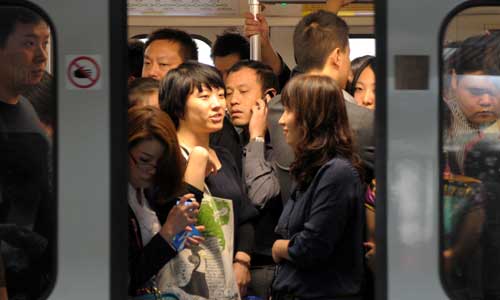
A crowded carriage during rush hour.
The 9/27 accident
On a Tuesday afternoon, Carl Gustafson and hundreds of other passengers, waiting at Metro 10 at Nanjing Road East Station, started to become impatient. After a 30-minute delay, train 1005 finally came into the station, loaded passengers and departed.
The train drove very slowly and stopped from time to time while the conductor made repeated broadcasts over the train's PA system. Although he speaks little Chinese, the 25-year-old Swedish national knew something was wrong.
After the train arrived at the next stop, Yuyuan Garden Station, one of the most bustling tourist sites in Shanghai, many passengers rushed into the train. At the same time, train 1016 had been sitting in the tunnel between Yuyuan Garden Station and Laoximen Station, just in front of 1005, for more than half an hour. Zhu Xuemin, the driver of train 1016, received an order from the Operation Control Center at 2:01 pm to wait 500 meters from Laoximen Station on standby.
At 2:35 pm, train 1005 was allowed to depart from Yuyuan Garden Station towards Laoximen Station. Two minutes later, when the train was traveling at a speed of 54 kilometers per hour, the driver of train 1005, Wang Bin, saw another train straight ahead. Although he immediately put on the emergency brake, 1005 still crashed into 1016.
"I was thrown to the floor along with many other passengers, who were standing. People were panicking after the crash. They were crying, shouting and there were bloody noses everywhere," Gustafson told the Global Times, adding that he saw the train was badly damaged especially between carriages.
According to subway operator, Shanghai Shentong Metro Group Corporation, 295 of the 800 passengers, including seven foreign nationals, on both trains had to be sent to hospital for treatment. No deaths were reported.
Service on Metro Line 10 was suspended until late that night. In an initial report released on September 28, the day after the crash, Shentong Group claimed the collision was due to metro staff reacting incorrectly after a signal system failure caused by power loss.
On October 6, an official report was released by the municipal government after an investigation was undertaken by several parties. The report confirmed the earlier assessment and detailed that the accident was a result of power failure, a lack of communication between dispatchers of the Line 10 Operation Control Center and coordinators at the stations. Twelve metro employees were punished, either by being sacked, demoted or cited for misconduct.
Zhang Lingxiang, deputy general manger of the Shanghai Metro Operation Company, said at a meeting attended by government officials on October 10 that the September 27 accident exposed the company's management loopholes and a lack of emergency response training for employees.
"The average age of our employees working on the first-line of operation such as drivers and dispatchers is under 30. Commonly, they have less than three years of work experience," Zhang said, adding that the company does lack skillful and experienced employees.
When the Global Times reached Bei Yu, the coordinator of Laoximen Station of Metro Line 10, and one of the 12 metro employees reprimanded for the accident, he refused to make any comments about the issue without the consent of his superiors.
Xu Luping, who has been a Metro Line 10 driver since the line opened in April 2010 told the Global Times that usually there are three protection systems in place to prevent collisions from occurring. "They are Automatic Train Operation, Automatic Train Protection and Automatic Train Supervision," said the 24-year-old driver. "The Automatic Train Protection system can automatically detect other trains within a certain distance so drivers can slow down. But the thing is this time all the advanced equipment, both in the control center and the train, stopped working because of the power failure. The drivers and dispatchers had to operate manually."
"When emergency situations occur and manual coordination is necessary, those young dispatchers who are used to relying on computers and automatic machines would of course be nervous," said Zuo Xuejin, director of the Shanghai Academy of Social Sciences.
On the other hand, inadequate coordination and management of the Operation Control Center was also blamed for the accident. "Actually if any of those related employees or managers strictly followed the operation codes, the tragedy could have been avoided," said Li Fenghua, formal general manger of China Eastern Airlines.
A senior engineer of Shanghai Metro Operation Company surnamed Zhou told the Global Times that at least two dispatchers should be positioned in the control center, but often there is only one.
Dai Qi, deputy general-manager of the company and director of the Operation Control Center, who was also one of the 12 employees reprimanded, told the Global Times that whatever the cause was, it is their duty to guarantee metro safety and protect passengers. "We are under great pressure, but we have no excuses and no one to shift the blame to. All we can do is learn from this and try our best to perfect the operation and prevent any future accidents," Dai said.
Lan Tian, press officer of the Shanghai Metro Operation Company, told the Global Times that usually 1,000 new staff members including drivers, dispatchers, coordinators and security personnel are trained before a new line opens.
Expanding subway
Before 2006, there were five major subway lines in Shanghai. By 2010, the number increased to 11, which meant 6,000 staff were hired within only five years.
According to Lan, most new metro employees were recruited from educational institutions and internal departments. The new metro staff were trained at the metro company headquarters to become more familiar with the metro operation system and management codes. After passing the tests, qualified members were sent to four sub-operation companies for practical training. Each trainee had a trainer giving them step-by-step advice for three months. Another series of tests were then taken to ensure their ability to work independently.
However, Ye Huaping, director of the Shanghai Metro Education and Training Center, which was responsible for all general staff training, refused an interview request when contacted by the Global Times. Meanwhile, two major universities that train metro professionals, Tongji University and Shanghai University of Engineering Science, declined to comment on how they train students. Interestingly, two experts in the official investigation team were from those universities.
An HR manager from Shanghai Metro Operation Company surnamed Chen, who was responsible for recruiting and training drivers and dispatchers for Line 2 and Line 11, confirmed with the Global Times that new drivers only had less than three months of training and only around a dozen hours of actual driving experience before they started working independently on the newly-built Metro Line 11, which opened at the end of 2009.
Occupying one of the most developed subway systems in China, Shanghai has the longest subway network in the world, according to the Oriental Morning Post. A new round of citywide subway construction work has started again. The city's subway network is expected to expand from the current 412 kilometers to 525 kilometers with four new lines opening across the city by 2014.
By 2020, a 780-kilometer network containing a total of 455 stations including 109 transfer stations will be built to support half of the city's commuters' daily transportation needs. Authorities said that by that time, people will be able to find a metro station within 900 meters of any downtown location. And residents will be able to travel downtown within 25 minutes.
The increasing amount of metro passengers has put much pressure on public transportation over the past decade. When the first subway line was completed in 1995, the average daily passenger volume was 245,000. By 2010, the number increased to 7 million.
"It took less than half a year for Shanghai to reach what would take other cities a dozen years to reach in terms of passenger volume," Wu Qiang, from the management department of Shanghai Metro Operation Company, was cited as saying in the Oriental Morning Post.
Passengers have complained about safety issues, crowds and the temperature in the trains. In July, it was reported that a train on Line 10 had driven on the wrong tracks. The operator later explained it was caused by a signal failure.
"It is very common to wait for 2 to 3 trains before I am able to get on because it is so crowded," said Li Chuwen, 27, a white-collar worker who lives in Pudong New Area and takes subway to downtown Puxi daily. Complaints about the crowds are especially common on the busiest lines such as Line 1 and 2 as well as some newly-built lines such as 6 and 8, which use smaller carriages.
"Passenger capacity for Line 1 and 2, which run trains at intervals of roughly three minutes apart during peak hour, has already reached their limit," Shao Weizhong, a manager from the Shanghai Subway Operation and Management Center, told local media in July 2010.
Expert opinion
At the 7th China International Rail Transit Technology Exhibition held in August, many experts made comments and suggestions on the future development of the Shanghai subway network with more than 128 billion yuan ($20 billion) expected to be invested.
Fu Deming, consulting chief engineer of the Shanghai Shentong Transportation Research and Consulting Company, said while the fast development of subway systems has benefited the city's residents greatly, more attention should be paid to safety issues. "For example, would those newly-built transfer stations be safe and convenient for commuters? At the old transfer stations, passengers had to walk 5 to 10 minutes from one platform to the other, which left many safety loopholes. The newly-built stations should avoid such problems," Fu said.
Meanwhile, Yin Jingyuan, an official from the Seismological Bureau of Shanghai, said that more needs to be done to ensure the safety of underground subways. "Since the World Expo 2010 in Shanghai, the city has a much more advanced and complicated subway system in terms of total track distance and daily passenger volume," he said. "But this leap ahead has also brought hidden dangers that need to be addressed."
According to Yin, the design and layout of the city's subway network is rather imbalanced and multi-transfer stations like People's Square and Xujiahui, which see massive crowds, increase safety risks during times of crisis. "It is scary to think about what could happen when thousands of frantic commuters rush out all at once," he said. Yin suggested authorities should not pursue the growing trend of developing underground spaces into commercial centers but focus on serving the interests of public transport.
"In Washington D.C. for example, which has an advanced subway system, the stations are designed simply so as not to give people a longing to hang around," he said. "Their subway is strictly used as a means of transferring people from one location to another."
Yin added that a practical rescue plan for underground spaces should be drawn up before it is too late, and said there should be mandatory public fire drills for subways.
The Shanghai subway system can be traced back to as early as 1958, when the municipal government formed a special team to research the possibility of building an underground subway system.
In April 10, 1995, the first subway line in Shanghai, Line 1, with a length of 17 kilometers and containing 11 stations, opened to the public after five years of construction. Sixteen years later, Line 1 has become one of the busiest subway lines in Shanghai with 1.3 million passengers using the line daily. The line has also created one of Shanghai's largest residential areas in Minhang district.
Four major new lines including Line 12, the first phase of Line 13, Line 16 and phase 2 of Line 11 are under construction currently and will open by the end of 2014.