Artists struggle to reinvigorate ancient form
Some of porcelain jugs by Chinese artists seem to be almost tortured. Photos: APPS
When potter Xu Runhui and his Antares Passing Pottery Society (APPS) tried to find a gallery earlier this year in 798 Art District to exhibit their new works, they were disappointed.
"We tried hard to find a place there but failed many times," Xu said,admitting, "I was not that surprised...They just don't think pottery is a fashionable style of art."
Galleries and spaces in places like 798 and other trendy art districts, Xu explained, prefer to display contemporary works – "contemporary" generally meaning avant-garde genres like abstracts, installations and so on.
Pottery, a medium used for thousands of years, is now considered out of touch. "Pottery?" Xu's eyebrows arched . "It's too 'old' a form for these galleries to show it."
Some of porcelain jugs by Chinese artists seem to be almost tortured. Photos: APPS
Pottery is undoubtedly representative of an ancient Chinese genre; some of these works, particularly those from official kilns of the Ming (1368-1644) or Qing (1644-1911) Dynasties, are hotly pursued at international sales, sometimes fetching up to tens of millions of dollars.
Today, in places like Jingde, Jiangxi Province, known as the "Porcelain Capital" because of its thousand year history of producing, there are still plenty of craftsmen devoted to the craft.
Just as in ancient times, these modern artisans mostly paint plum blossoms, orchids, bamboo and chrysanthemum, the so-called "Four Gentlemen" – or junzi – of bird-and-flower paintings, on ceramics such as cups, plates and vases.
Some of porcelain jugs by Chinese artists seem to be almost tortured. Photos: APPS
Even today, people buy them for decoration or utensils with some modern sets fetching handsome prices, although nothing in the region of the genuine antiquities.
So pottery is far from being a field in which it is difficult to "get money," as Shen Li, another member of the APPS, told the Global Times. "You don't worry about selling works as long as you create porcelain."
However, for the seven-member APPS society, most of whom are graduates of the pottery and porcelain department at Tsinghua University, what they are devoted to is not so much selling their wares, as being innovative, hoping to thus include pottery in the field of contemporary avant-garde art.
Their exhibition, Ruo Shui San Qian (The World in a Jug), was finally held in East Beijing, and shows a range of works created by APPS, whose members include Huang Jian, Xu Runhui, Shen Li and Yu Fengbo, among others.
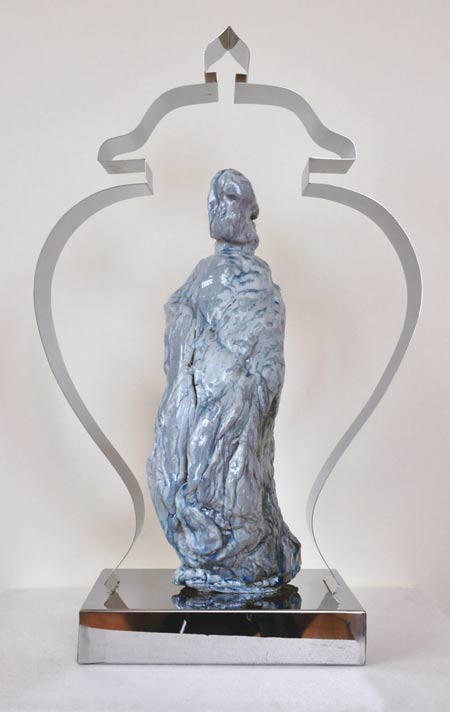
Shen's new series of dishes infuse his spirituality with the fragility of porcelain, he says, featuring an image of the Bodhisattva's head in the center of each.
"Working with clay makes me feel happy and quiet and I often come up with new ideas and sudden reflections on the world," Shen said. "I do think it is a contemporary genre when I infuse my interpretations of the world into my porcelain."
Some of porcelain jugs by Chinese artists seem to be almost tortured. Photos: APPS
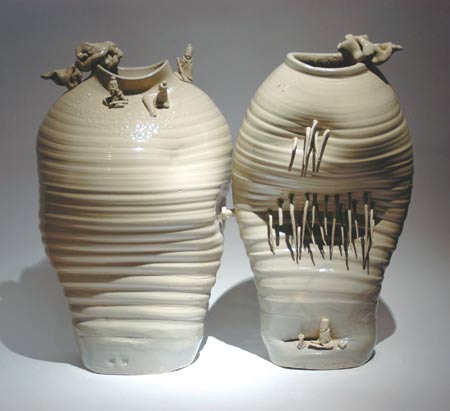
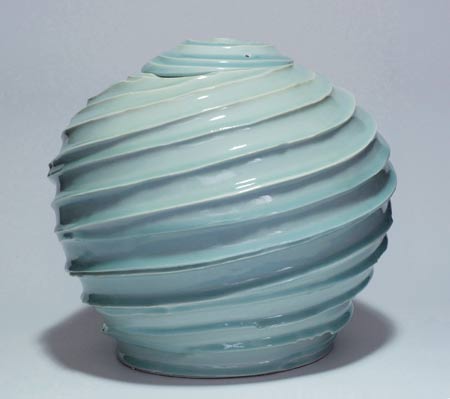
Xu Runhui's porcelain pieces are in the form of jugs (left) which, though just as refined and beautiful as ancient porcelain, are deliberately imperfect-looking – often resembling tortured failings at the wheel.
Like the other six, Xu is trying to infuse tradition with a contemporary concept to make an independent work of art, neither something to solely decorate the house or just be used as tableware.
Although they have each found their own path, "conceptual porcelain" is what they are most devoted to. "Pottery is just a media we are familiar with," Huang told the Global Times. "What we are trying to do is introduce contemporary ideas into the traditional art form."
Luckily, there are some willing to appreciate their struggle: with the backing of one major collector, their exhibition will tour to Shanghai from November 19 to December 11.