The remains of their day
The luxury-villa-turned restaurant on Donghu Road. Photos: Cai Xianmin/GT
The Israeli Consulate in Shanghai is currently searching for stars. Not the young bubbling celebrities of modern films and television but those that appeared in more than 200 photographs taken by Sam Sanzetti, a Jewish photographer, who lived in the city from the 1920s to the 1950s. His pictures show people from all walks of life – babies, newlyweds, ballet dancers and workers.
While the works have triggered an outbreak of nostalgia among old Shanghai residents, they've also introduced the name of this talented Jewish photographer to the public.
In that era, many Jews fled to Shanghai and settled here, some achieving fame by succeeding in business or by writing major works of literature. While Sanzetti's pictures capture the life of times past, there are many residences around the city, where the Jewish influence and those special times can still be felt.
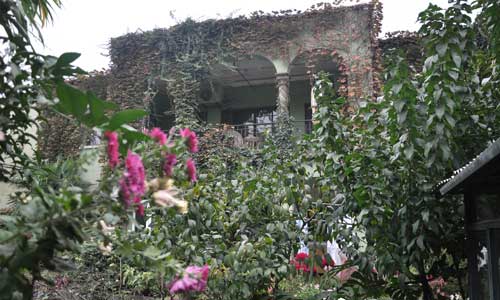
The gardens owned by Jewish businessman Edward Isaac Ezra were turned into a residential compound.
A magnate's mansion
This home is set in a garden at 1209 Huaihai Road Middle. It was built in 1912 with verandahs opening the home to the outside on its two floors. The first floor uses Greek Ionic columns in its construction while the second floor features Corinthian columns. The interior was luxurious, with imperial French Louis XV furniture and a ballroom that could cope with 150 guests or host concerts.
This belonged to Edward Isaac Ezra, who was said to be the wealthiest Jewish businessman in Shanghai then. From British stock, Ezra was born in Shanghai and lived his entire 39 years in the city in the early 20th century. He accumulated his fortune primarily through trading in opium and real estate investment and management. He was important enough to have a road named after him, Ezra Road, which is today's Shashi No.2 Road, close to the Bund. Ezra was the largest stockholder and the managing director of Shanghai Hotels Limited and he controlled major hotels like Astor House (the Pujiang Hotel) by the Bund.
Ezra's personal residence on Huaihai Road Middle once served as the Shanghai headquarters of the People's Armed Police but is now undergoing renovations, and will be developed as a commercial property. You can take Metro Line 1 and get off at the Changshu Road Station for a peek at this former residence of Ezra.
Not far from his wonderful mansion, Ezra owned another golden property in downtown Shanghai, Xinkang Gardens. With its north gate at 1273 Huaihai Road Middle and its south gate at 1360 Fuxing Road Middle, Ezra's private gardens covered around 10,000 square meters. The gardens were equipped with all the luxuries of the day including a tennis court and a swimming pool.
In the early 1930s, the gardens were turned into residential compounds. Zhang Jiesi, who has lived here for half a century from when she was a little girl, said the gardens reflected the virtues of many old people who lived there. "The cedar trees in every courtyard are almost tall enough to reach the sky. Their branches stretch to greet passers-by and share their stories."
In September, 1989, the Xinkang Gardens buildings were listed as protected cultural relics by the municipal government.
The high-end residential compound has been home to many Chinese celebrities, including the film star Zhao Dan, the Shaoxing Opera artist Yuan Xuefen and the oil painter Yan Wenliang. The closest metro station is Changshu Road Station on Metro Line 1.
Literary legacy
If you're a fan of the book Strangers Always, you really should visit the building at 2 Yanqing Road, the former residence of author Rena Krasno. Krasno returned to visit the city in 2007 at the age of 84, recalling with great fondness her early days here. But the visit to Shanghai was the farewell tour for this acclaimed writer and interpreter, who passed away in 2009.
Rena Krasno lived in the building at 2 Yanqing Road with her parents, who came to Shanghai from Russia in the early 1920s. Her father was the editor of Our Life, a trilingual Jewish magazine and her uncle, Gabriel Rabinowitz, designed the Ohel Moshe synagogue, now the Shanghai Jewish Refugees Museum. Krasno's book Strangers Always records life during those chaotic times from the perspective of a young woman in the Jewish community. She shared stories of how people endeavored to find out truth through clandestine radio broadcasts, smuggled information and reading between the lines of the Japanese censors.
As well as writing, Krasno had a special talent for languages. After she left China in the late 1940s, Krasno worked as an interpreter for many international organizations, translating English, French, Russian, German, Hebrew and Spanish.
The closet subway stop to Krasno's former residence in Shanghai is Changshu Road Station on Metro Line 1.
Dining with history
The garden residence at 7 Donghu Road is in a French Renaissance style with Baroque recessed open galleries and a Tashkent columnar porch. The home was built by Ray Joseph, a British Jewish trader, in 1925.
Rumors have it that the villa later became the personal residence of Du Yuesheng, the infamous Shanghai gangster. Inside the decor is set in classically inspired carved wood engraved with delicate patterns. The dining room has two fireplaces facing each other, both under ornate mantelpieces.
Today the villa is called the Donghu Grand Hall, a Shanghai cuisine restaurant and part of the historic Donghu Guest House. Although visitors can view much of the interior for free, dining there will cost about 400 yuan ($63) per person.
"I usually bring out-of-town friends here to enjoy a taste of the luxurious life from the old days in Shanghai. Stepping into the restaurant, the wood floor boards creak, creating a special atmosphere," one regular customer in the restaurant told the Global Times.
The closest subway stations to the place are Changshu Road Station and Shaanxi Road South Station on Metro Line 1.
Nearby attractions
Close by these glamorous former residences, there are several other residences and properties specially built for Jewish people, in the last century. At 20 Fenyang Road, just by Changshu Road Station, there's an auditorium of the Shanghai Conservatory of Music. The colonial-style building was the former Shanghai Jewish Club, and was used for recreation and musical performances in the 1930s.
Walk south along Fenyang Road to No.83, you'll find another Jewish piece of history inside the Eye, Ear, Nose and Throat Hospital of Fudan University. At the rear is the original building of the Shanghai Jewish Hospital, built in 1934.