Perservering believer
Marcelin Loridan-Ivens
Even on his deathbed, Dutch director - and lifelong communist - Joris Ivens was concerned about the fate of his spiritual homeland. In late June, 1989, a period of unrest, the 90-year-old uttered his last words: "How is China now?"
"I couldn't come to China for a decade since," his wife Marceline Loridan-Ivens, now finally visiting Beijing, told the Global Times.
Throughout his life, Ivens produced films about the East, working with luminaries such as Frank Capra - in a US propaganda film about Japan entitled Why We Fight, never distributed due to its depiction of Emperor Hirohito as a war criminal - civil rights activist Paul Robeson and Greta Garbo (their post-war film project was nixed by studios due to Ivens' leftist sympathies).
But his efforts, far from being acclaimed, brought only harsh criticism and further misunderstanding - from both sides.
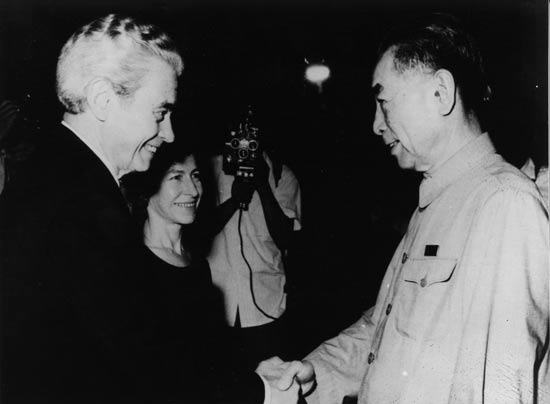
The couple meet Zhou Enlai
Ivens' career changed with an invitation from Zhou Enlai for him and his wife - zealous socialists from the days when communism was a utopian fantasy among European intellectuals - to assist in the making of a promotional documentary, an early example of what would now be called soft power.
The bloated result - a 12-episode, 763-minute epic entitled How Yukong Moved the Mountains - was shot between 1972 and 1974, the height of the Cultural Revolution (1966-1976), to reflect optimism in the face of the chaotic period, which was heavily criticized abroad.
"The whole world was against China at the time," Loridan-Ivens recalled, "calling [them] a bunch of 'blue ants,' deprived of any freedom under communist rule, so we had every reason to deny such rumors and crush their false impressions."
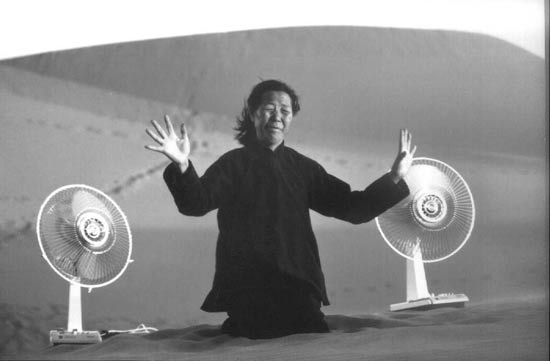
Still from Yukong
After witnessing the destructive behavior of "rebellious" Red Guards being encouraged by leaders, doubt set in about the government but the couple still felt they were telling the West about the "real situation" in China.
Unlike Antonioni's Chung Kuo - Cina (1972), Ivens' film is a grassroots panoramic, interviewing workers, farmers, fishermen, professor, students, soldiers, salesmen, actors, artisans, giving ordinary people a genuine - if deluded - voice.
"We didn't get an answer from the people," Loridan-Ivens admitted.
In 1975, Ivens fled what he once called his "second home" after he was ordered by officials to delete 61 scenes from the final cut. By then, he'd turned down a request by Jiang Qing - Mao's wife and leader of the Gang of Four - for an idolizing documentary about her, and refused to openly criticize Antonioni, whose film had drawn the ire of Mao Zedong himself, leading to a slew of denunciations.
On 30 January 1974, China's official media claimed Antonioni had portrayed the Chinese as "ignorant, isolated, listless people… pulling a long face… an idle crowd, loving to eat and drink without healthy habits."
Despite its length, Yukong was warmly received upon release. Following the arrest of the Gang of Four in 1976, however, Ivens was denounced in Paris as a liar and the propagandist of a false show of peace in China.
The hysteria led to the pair being unable to find new work for nearly a decade, according to Elizabeth D Inandiak, who met the couple in 1983 and later produced Iven's last film, Une Histoire de Vent (A Tale of the Wind, 1988).
But, like a victim of the Cultural Revolution who is later rehabilitated, Ivens was himself later knighted in the year of his death by the Dutch government.
"I didn't really understand Maoism when I met them," Inandiak said. "Ivens was a great poet and Marceline went through so many hardships. Clinging to a dream as idyllic as Chinese painting, they sought to solve people's pains."
A firm believer in popular revolution, Loridan-Ivens said millions in Europe believed those that happened in the Soviet Union and China but that they failed to fulfill their proper role. "After revolution broke out, the realities proved beyond their ideals," she said.
"Nowadays there are still wars for freedom against rulers around the world, such as the Arab (Spring)."
A retrospective of Ivens' work, including The 400 Million (1939), a film about Chinese resistance to the Japanese invasion (the crew featured Sidney Lumet as a reader) later censored by the Kuomintang, Before Spring (1958), capturing Chinese rural life, Yukong and A Tale of the Wind were all screened by the China Film Archive in Beijing last week.
A Tale of the Wind contains fantastical dream sequences, blending documentary footage in a modernist exploration of Chinese mythology, witchcraft and Buddhism in a symbolist manner, rarely seen in Ivens' previous works.
The character of Monkey King provides a running cue throughout the film, before being reincarnated as Ivens, implying his anti-bureaucratic appeal, according to Loridan-Ivens.
A French Jew, Auschwitz-Birkenau internee and Holocaust survivor, on her recent visit to Beijing, Loridan-Ivens showed that she has lost little of her revolutionary zeal, even discussing plans for a new documentary.
"Revolution has brought some changes to people's lives, though not radically," she observed.
"But I didn't realize that materialism would bring the biggest changes of all."
Recalling the Mao-era slogan "Serve the People", she suggested a new motto for the soaring modern economy: "Serve the Renminbi."
Above: Marcelin Loridan-Ivens Inset up: The couple meet Zhou Enlai
Inset: Still from Yukong