The family festival
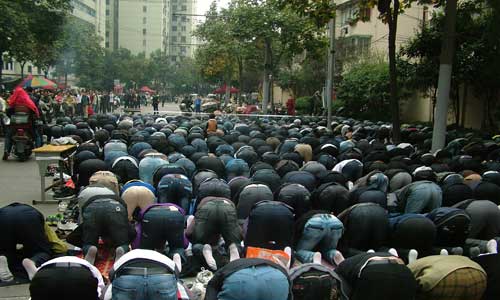
Muslims gather at the Huxi Mosque in Putuo district to celebrate Eid-al-Adha, or the Festival of Sacrifice, which runs from November 7 to 10 this year. Photos: Cai Xianmin/GT and Liu Dong/GT
Shanghai resident Mardan Eysa arose at 5 am on this Monday. He prepared food for the whole day, donned his best suit, and, accompanied by his wife and children, went to the Huxi Mosque in Putuo district. It was a very special day for Eysa and for every other Muslim in the world. It was Eid-al-Adha, or the Festival of Sacrifice, which commemorates Abraham's willingness to sacrifice his son on Allah's order. According to tradition, Allah sent a lamb in the boy's place.
Eid-al-Adha (also known in China as the Corban Festival) is one of the major festivals in the Muslim calendar which this year runs from November 7 to 10. Eysa and his family celebrated the festival along with some of the 200,000 Muslims who live in Shanghai.
Residents living near Huxi Mosque woke in the morning to find the streets filled with white-hatted Muslims greeting each other and choosing foods and apparel. Street vendors were selling roast lamb and other delicacies and the aromas spread throughout the area.
Twenty-year-old Eysa has lived in Shanghai for several years and runs a Muslim restaurant in Pudong. Four years ago he and his wife and two children moved to the city from his hometown thousands of miles away in the Xinjiang Uyghur Autonomous Region.
"I come here each year and it feels like home when I come here," he told the Global Times, while carrying his baby daughter who has just turned 3 months old. "This is like the Spring Festival for us and every Muslim celebrates it wherever he is.
"It is not often for you to see this sort of occasion in Shanghai. For me, as a Muslim, it is one of the happiest and important times of the year. I meet many friends here," he added.
"Usually we go to the mosque first to pray and then we sacrifice the animals. After the religious rites, we go back home to enjoy feasts with mutton, cakes, pears and apples which we share with relatives and guests over the next few days," Eysa said.
This year, nearly some 6,000 Muslims gathered at the Huxi Mosque, the biggest mosque in Shanghai on the first day of the festival, among them Chinese Muslims from the Uyghur people, the Hui people and another 10 minority ethnic groups as well as Muslims from other parts of the world.
Because the mosque can only fit 1,000 people at the most, nearby Changde Road was blocked off for a few hours on Monday morning by the police to make more room so that worshippers could kneel on the ground to pray.
To let the festival proceed smoothly, the city government postponed major construction work nearby in case traffic congestion disturbed the event.
Because the number of Muslims in Shanghai is comparatively small, the atmosphere here is less overwhelming than other places in China. But Eysa said many Muslims like him still follow the religion traditions and come to the mosque to celebrate the festival.
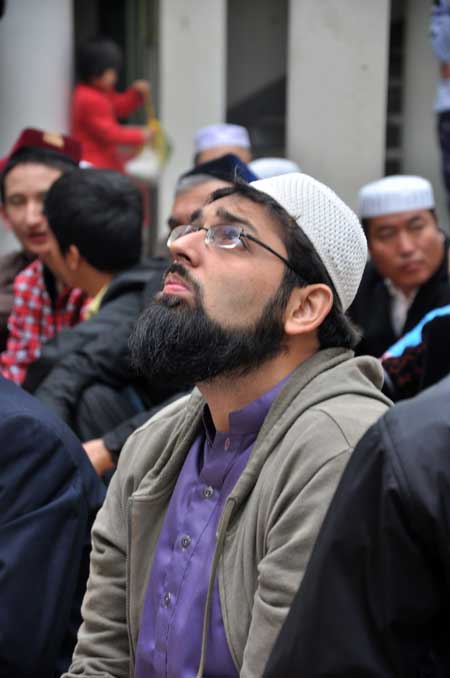
There are more than 200,000 Muslims living in the city but keeping the Islamic faith can be a challenge in a metropolis like Shanghai.
Muslims from abroad
Othman BenAbbes is a 24-year-old Tunisian business student who is studying in Shanghai. Although he had lectures on Monday morning, he came to the mosque first to pray and listen to a sermon.
"I came here to pray just as I did back home," he told the Global Times. "It feels like home and I don't see any difference here in the way we celebrate the festival." Despite the language barrier, BenAbbes has made Chinese and foreign Muslim friends at the mosque.
"For every Muslim, the mosque is our home and we are all brothers and sisters in our faith," he added.
Muhammadilyas Menhas from Pakistan agreed completely with BenAbbes. Menhas is completing a doctorate at Shanghai University and has lived in Shanghai for almost four years. He comes to the mosque every Friday to attend Jumah, the weekly religious prayer session that every adult male Muslim must attend.
"I feel comfortable practicing my religion in Shanghai and have met many new friends through the Muslim community here. They are very nice people," Menhas said.
Kamran Atif, a Pakistani student currently staying at East China Normal University's Minhang campus, told the Global Times that the only problem he has encountered is that there are too few mosques in Shanghai for the Muslim population.
"In my hometown back in Pakistan, this is the most impressive day of the year as everyone celebrates. Wherever they are, in mosques, on the streets or at home, people offer guests the most delicious food they can. It is a bit of a shame that we could not have all of these in Shanghai – it makes me miss home a little bit," he said.
The majesty of mosques
The building of Shanghai's Huxi Mosque started in 1921 but over the years it has been demolished and rebuilt several times. This current mosque was completed in 1992.
The deputy imam of the Huxi Mosque, Chen Peiliang, told the Global Times that Eid-al-Adha was one of the two most important festivals Muslims celebrate every year.
"Each year we have many more Muslims attending the festival than the mosque can hold. We are a big Muslim family here," he said.
Chen said that after prayers and sermons, the tradition was that Muslims would take part in a ceremony where animals were sacrificed and then they would share the meat with each other. But these days, because of space limitations and health regulations, the animals were killed ritually by accredited Muslims in suburban slaughter houses instead of in mosques or homes.
Traditionally, Chen said, the animals are butchered and divided into three parts – a part is for the family, another part is for relatives and friends, and the remainder is for charity.
"In Shanghai, we used to celebrate the festival more quietly compared to other major Muslim communities in places like Xinjiang, Ningxia, Gansu, Qinghai, Yunnan, Shaanxi, Inner Mongolia and Henan. But with the increasing number of Muslims moving here from other provinces in recent years, more and more worshippers are coming to the festival," Chen said.
He said 1,000 Muslims attend the mosque every Friday and one tenth of the congregation were foreigners.
"There are few mosques in Shanghai and they can barely meet the demands of increasing population of Muslims in Shanghai," Chen said.
An imam from the Xiaotaoyuan Mosque near downtown Yuyuan Garden, surnamed Han, told the Global Times that there were challenges and opportunities for the religion in the city.
Han, who was originally from a Muslim family in Shandong Province, came to Shanghai to study in 1990 with the intention of becoming an imam.
After he graduated, he joined the mosque. Han has two children, one at a local university and another in primary school.
At his mosque 400 Muslims attend the prayer service every Friday. The number of Muslims in the city is rising gradually with the high mobility of the religion's adherents.
"To keep the Islamic faith in everyday life is not always easy – especially in a modern city like Shanghai," Han told the Global Times.
"Many Muslims cannot come to the mosque because they are busy at work on Fridays when they are supposed to attend. It is not easy to handle the relationship between work and faith and this is a challenge for every Muslim."
Han said living in a city with diverse cultures is also a little inconvenient when it comes to preserving Islamic customs like only eating halal food. Many Muslims have to compromise with the secular world.
Han said he cooks halal food for his younger child and ensures that the older daughter eats in Islamic restaurants.
"A true Muslim is not born to be a Muslim but chooses to be. A true Muslim prays five times each day and confesses everything he has done or said to Allah," he noted.
A long history
According to the Shanghai Ethnic and Religious Affairs Committee, the government department supervising religious affairs in Shanghai, there are more than 200,000 Muslims in Shanghai. Of these, some 85,000 are local Muslims while more than 100,000 are from other provinces.
The history of Islam in the city can be traced back to 1275 in the Yuan Dynasty (1279–1368) when Muslim soldiers came to Shanghai bringing their faith and building the first mosque in today's Songjiang district.
However the religion did not grow much until the late 19th century when more Muslims came from the countryside to live in Shanghai.
In the 1920s Muslim communities were formed in today's Putuo and downtown Huangpu district. Then nearly 50,000 Muslims would gather for festivals in today's Yuyuan Garden and they built several mosques and Islamic schools to promote the religion.
During World War II, most mosques in Shanghai were vandalized or destroyed by the Japanese military. The religion did not recover its hold in the city until the 1980s, when mosques were rebuilt and reopened.