The hole story
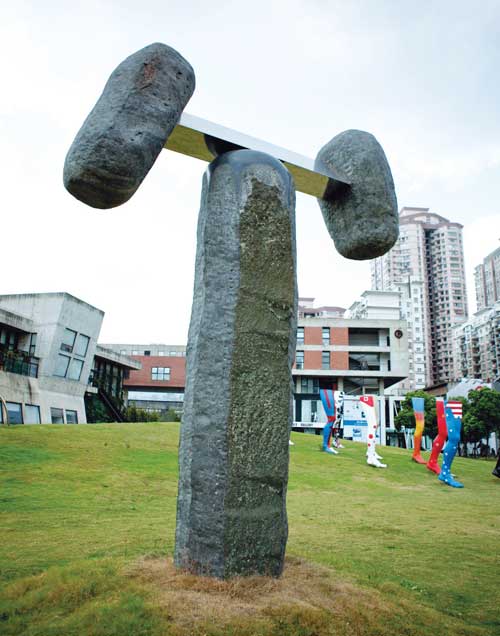
The Balance of the Sky , and The Ring of Landscape are Nobuo Sekine's two permanent works in Shanghai. Photos: Courtesy of Shanghai Sculpture Space
In October 1968, a 2.2-meter by 2.7-meter cylindrical hole appeared in the ground at the Suma Rikyu Park in Kobe, Japan. The removed earth from the park was then compacted into a 7-foot high cylindrical column and placed at the side of the open hole. This piece was recently listed by the UK Guardian newspaper as one of the "1,000 artworks to see before you die."
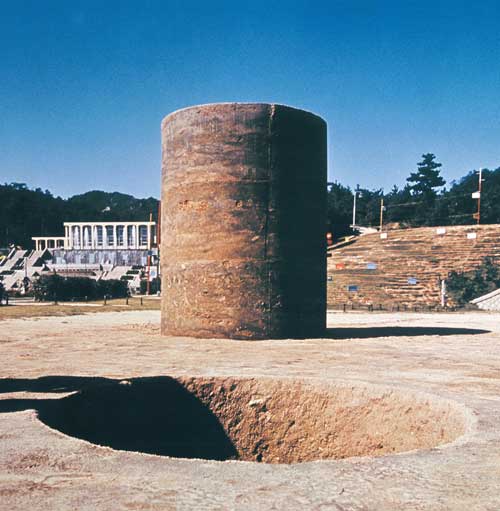
Phase-Mother Earth by Nobuo Sekine.
Land earth
Entitled Phase-Mother Earth, this work was seen as the birth of the Mono-ha movement in Japan, a movement similar to the "Land Earth" movement in the US in which landscapes and works of art became inextricably linked.
Phase-Mother Earth was created by Nobuo Sekine and catapulted him to international renown. He later staged exhibitions in many European countries including France, Germany, and the Netherlands.
The 69-year-old artist was in China recently to launch his latest exhibition which is on until the end of November at the Shanghai Sculpture Space on Huaihai Road West.
According to curator Xie Lin, the aim of Mono-ha artists was simply to bring "things" together, as far as possible in an unaltered state, allowing juxtaposed materials to speak for themselves. Mono-ha artworks are mainly made of materials such as iron, cotton, wood, mud, stone and paper.
"The Mono-ha artists seldom 'created;' rather they 'rearranged' materials into artworks because their essential principle was to respect the interdependent relationships between materials and the space around them," Xie said.
Sekine has entitled his Shanghai solo exhibition Monogatari, which means "telling a story." The works were all created between 1970 and 2011. Sekine told the Global Times that through his sculptures, graphic design pieces and original manuscripts among other materials, he wants to tell his own story about Mono-ha to Chinese audiences.
Xie explained that most Mono-ha artists create abstract art that is rarely figurative or recognizable in any conventional sense. "The very notion of Mono-ha is enlightening and significant in orientating current public concern towards the creation of environmental art."
Natural materials
All the sculpture works in the exhibition are made of bronze, black granite or stainless steel. Sekine said that he wanted to maintain the original color of the material as much as possible.
Xie said that it was after seeing Sekine's sculptures that he first got to know the artist. "They made a big impression on me because they are made from natural materials and look like they are in harmony with the environment."
As well as the temporary sculptures in the exhibition, Sekine has also created two permanent works for the Shanghai Sculpture Space by the names of The Balance of the Sky and The Ring of Landscape. They are made of stone, stainless steel and iron.
Besides the sculptures, another highlight of the exhibition is Sekine's "gold foil" works. "In Japan, gold foil is a very traditional material for artists to create many different kinds of art works," Sekine said.
Li Qiang, a local artist who was visiting the exhibition told the Global Times that he is very familiar with Sekine's works. "Sekine is still not so well-known in China, but as an artist with a unique philosophical world view, his artworks are an interesting contrast between the Eastern and Western ideas. He focuses on the universe, the world, nature, life and death, yin and yang, and Taoism," Li said.
Date: Until November 30, 10 am to 5:30 pm
Venue: Shanghai Sculpture Space
上海城市雕塑艺术中心
Address: 570 Huaihai Road West
淮海西路570号
Admission: Free
Call 6280-5629 for details