Distant relatives
Taipei 101
Years ago when I was a child, my mother told me that one of our neighbors earned a big fortune after welcoming a special relative from a faraway place - Taiwan. The neighbor used the money not only to build a big house but to buy a refrigerator, a luxury rare to a rural county in East China's Jiangxi Province in the 1990s.
Taiwan, an island only kilometers away from Fujian Province, has long been considered an inseparable part of China to mainlanders, although most Chinese have had little chance to visit.
Are they living a life like we are? Does their parliament really fight each other like cats and dogs? Are their students also burdened with heavy load of homework?
My head filled with these questions and more, I went with my husband on a tour of Taiwan this fall, in the context of various restrictions placed on mainlanders toward Taiwanese travel - not least of which is that only residents of four cities on the mainland are allowed to visit thus far.
In the 12 days of our tour, we traversed the island from North to South, and then back again via bus, train, ship and subway. Like every visitor from the mainland, we stopped at the National Palace Museum, the Chiang Kai-shek Memorial Hall and the National Dr. Sun Yat-Sen Memorial Hall, in addition to enjoying more sensual pleasures like a sunset near Kenting and dawn in Alishan, both nature preserves.
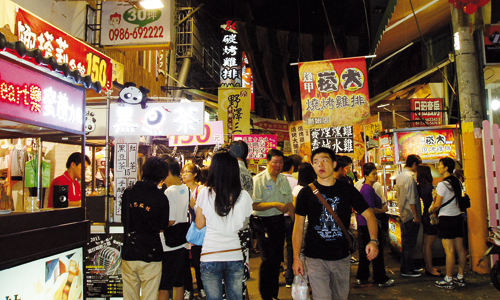
Taiwan's night markets sells all kinds of snacks, clothes and household wares. Photo: Tu Lei/GT
Japanese influence
When we got off the plane at the Taoyuan International Airport in Taipei, the first sight was the flag - a blue sky with a white sun amidst a sea of red, reminding me that we had arrived in a special region.
"The streets are so narrow and crowded with motorcycles," murmured Xia Jinbao, my husband. "But the girls are so pretty," he added thoughtfully.
To me, Taiwan bears a strong imprint from Japan, as evidenced from such details as womens' long naked legs being flaunted on every corner, or the cotton curtains hung at every shop entrance. Indeed, many natives told me that the region is quite similar to Japanese cities to some degree.
I was reminded of Cape No.7, a film which tells the love story between a local boy and a Japanese girl. When I first saw it, I couldn't understand why the Taiwanese were so reluctant to say goodbye to the Japanese at the end of their occupation after World War II and why the natives have such complicated feeling towards the Japanese.
As soon as I set foot on the island, however, I started sensing some of the answer.
Although the Japanese chopped down thousands of old trees in Alishan, some Taiwanese people think the infrastructure and educational system left by them benefited local people.
Culture of reading
Chinese mainland visitors might be surprised to discover a 24-hour bookstore in Taiwan called Eslite, a large chain store that dots every city on the island. Normally, the chain store is located near the subway stations in a high-rise building and stocks goods ranging from books to stationeries, record to discs.
Of course, all books published in Taiwan are in traditional Chinese characters, which rarely existed on the mainland since the founding of People's Republic of China in 1949, which adopted simplified characters as part of its refutal of China's feudal traditions.
We visited a Eslite store in nearly every city we dropped by, and what interested me most was the culture of reading at every one; each was filled with people treating the space like their own private studies and the bookstore was more than happy to accommodate them, providing comfortable reading conditions.
Upon laying his eyes on this sight, my husband - an avid bookworm - complained that mainland book stores rarely provide chairs for customers to sit on, presumably in a bid to prevent buyers from only reading without paying.
"Many of them also far too overstocked with books on how to earn money or gain success," Xia observed. "Here, on the other hand, the bookstore is more like a library."
It's become easy to spot mainlanders from the native Taiwanese in these huge bookstores, as the formers normally flock to the areas featuring banned books, such as those speculating on which politicians will assume leadership posts next year.
One intrepid reader bought dozens of such books and paid in cash, despite the fact that the editions were three times as expensive as found on the mainland.
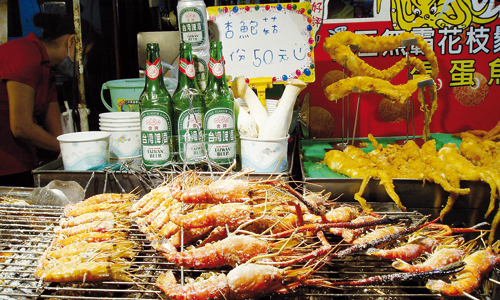
Taiwan's night markets sells all kinds of snacks, clothes and household wares. Photo: Tu Lei/GT
Trustworthy Taiwan
Two days before we finished our journey, we went to Chinkuashi, a place near Taipei once known as a gold-mining site.
However, after getting off the bus, Xia found his small bag had gone missing. After looking for some time, we decided to ask for help at the nearby police station - the first time we had to confront the authorities here, and a situation we never thought would transpire.
The station was not large and there was only one officer on duty. After listening carefully to our report, the policeman, surnamed Kuo, started to take some notes.
"The entire reporting procedure might take a while - do you have an hour or so to spare?" Kuo asked politely, to which we grudgingly acquiesced.
"We will post the report of your missing bag to all the stations in the area, so as to help you get your bag back earlier if possible."
Sitting in front of the computer, Kuo began inputting every last detail of all the items we'd lost, including where and when it happened, what items were in the bag, what color it was, what label, what brand - the contact details of hotel where we were staying, in case it was discovered.
The patient officer took nearly two hours to finish all this painstaking work. During that time, I noticed a local resident walk in to the police station's reception-watching TV and taking a nap on the couch - a site I couldn't imagine seeing in a police station on the mainland.
"It's amazing that the policeman could be so nice and the residents can be so casual here," Xia marveled.
Two hours later, we walked out. Back at the bus station, Xia decided to search our bus one last time. To his surprise, he saw the driver hold up his bag.
"The bag was handed over by a passenger," the driver explained.
Xia could hardly contain his excitement at encountering a situation of such trust and assurance, in contrast to the incidents he'd experienced back home.
In fact, such honesty is characteristic of Taiwanese everywhere. It is evident in their subway stations, which don't subject their passengers to safety checks.
It is apparent in the taxi driver who goes to the hotel to deliver the change you've left in the car. It is obvious in the key you leave at the unattended hotel desk after you check out.
And it was stunningly clear in the call I received after we got back home to Beijing, days after we'd left Taiwan, from the Keyman's Hotel in Taipei. The receptionist told me that they'd received a letter from the police, asking us if our loss had been recovered.
Markets disappointing
Of course, just as things exceed our expectations in so many great ways, so too did things take negative or strange turns - at the various night markets, for example.
Before we started our tour, we'd been informed from a variety of sources that the these were must-visit places in Taiwan. Among others, the Fengchia Night Market in Taichung City and Shihlin Night Market in Taipei City were singled out being as particularly exciting destinations for endless hours of shopping magic.
At first, we were pretty thrilled to encounter the long, colorful booths selling all kinds of snacks, clothes, household wares and other items.
The lively atmosphere was appealing, but after a while we started to get a sense of been-there, done-that, as though we were stumbling over the exact same booth over and over again.
Though we'd been expecting smashing deals on high-quality merchandise, we found most of the goods were no better than what we could find back home, say at Beijing's Zoo Market or other large mega-malls on the mainland.
In addition, my husband, who'd been anticipating eating his way through a sea of exotic snacks, only ended up tasting a bit of small pancake and a small plate of fruit, and nothing else.
"Nothing else looked clean to me," he said.
But in any case, our short 12-day journey was too short to truly get to know the region, especially considering all the walls that have been erected between the two areas.
But tourism is without a doubt one of the best ways to lower these barriers between Taiwan and the mainland, and we hope more people get the opportunity to visit and discover, as we did, a land of values, courtesy and culture.