Socrates, gifted but troubled Brazilian star
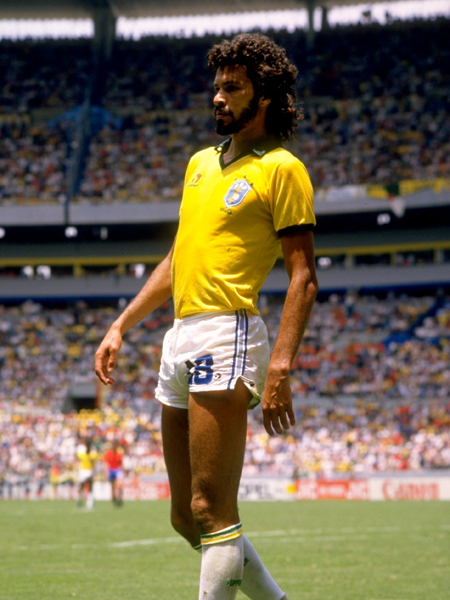
Socrates, who died on December 4, aged 57, was skipper of Brazil at the 1982 World Cup, a team widely-regarded as one of the finest never to have won the title.
Socrates was taken to Albert Einstein Hospital in Sao Paulo on late December 2 after suffering food poisoning. He went into septic shock, placed on a life support machine but passed way later.
Socrates, who played at the 1986 World Cup finals, was a flamboyant footballer who boasted a myriad of contradictions.
He was a qualified doctor who never gave up his enjoyment of a smoke and a drink; he was an outspoken political activist, regularly protesting against the Brazilian military junta of the 1970s and 1980s.
He once listed his heroes as Fidel Castro, Che Guevara and John Lennon, fathered six children and spent his retirement penning passionate articles on politics and economics as well as sport.
Socrates won 60 caps for Brazil, scored 22 goals and was a contemporary of the great Zico.
After officially ending his playing career in 1989, he bizarrely reappeared 15 years later, at the age of 50, with Garforth Town, an amateur side in the backwoods of northern England where he featured for just 10 minutes of action.
During his peak, Socrates embodied the romantic side of the beautiful game, Brazil's beloved national sport, which was being threatened by cynicism, pragmatism and creeping commercialism.
Distinguished career
Born on February 19, 1954, in Belem, Socrates started his career with Botafogo in 1974.
In 1978, he moved to Corinthians in San Paolo, where he spent six seasons, scoring 172 goals in 297 matches.
It was a record which brought three domestic titles in 1979, 1982 and 1983.
After his time with Corinthians, he had an unhappy sojourn in Italy with Fiorentina.
While at Corinthians he was one of the founders of a movement known as Corinthian Democracy.
Under its principles, all decisions made by soccer clubs, including the contracting of new players and training schedules, had to be approved by a vote of all members.
In 1982, the players had "I want to vote for my president" printed on the back of their shirts in a daring, public act of defiance during the first elections since the 1964 military coup.
His successful pursuit of a doctorate in medicine, as well as his growing political awareness, earned Socrates the nickname "Doctor Socrates."
After a brief spell in Fiorentina, Socrates returned to Brazil, playing at Santos and then Botafogo.
"The way of life is so correct and organized in Europe. It's not like that in Brazil, where things are more spontaneous," Socrates said in 2010. "I was in Florence for a year with Fiorentina and sometimes I didn't want to train, but to hang out with friends, party or have a smoke. There's more to life than football."
He ended his full-time playing career in 1989 before moving into the media, but his drinking was always a danger even if he did not think so.
"I never had many problems with alcohol because I was not addicted," he said last month. "All the time I interacted with alcohol as if it were a partner, but I never had withdrawal symptoms. I spent long periods without use."
Actually, Socrates had already been hospitalized twice in August and September this year with bleeding in his digestive tract, and recognized after these incidents that he had problems with alcohol, especially during his playing days.
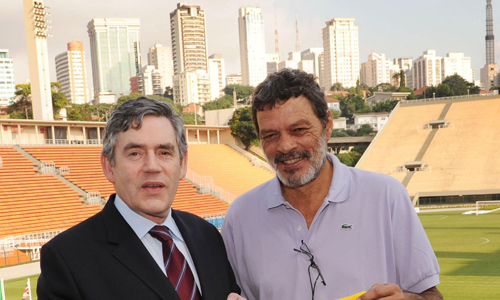
Former British Prime Minister Gordon Brown (left) meets with Socrates at the Museum of Football in Sao Paulo, Mexico on March 26, 2009. Photo: CFP
Respect paid
A report in the newspaper Folha de Sao Paulo claimed that Socrates had been buried later on December 5, in a private ceremony in the town of Ribeirao Preto, Botafogo, 300 kilometers outside Sao Paulo.
And according to the Brazilian Football Federation announcement, there had been a minute's silence before all December 5's matches in honor of "one of the most brilliant players in the history of the Brazilian national side."
Brazilian giants Corinthians, where he played for six years, paid a fulsome tribute to him.
"His faithful fans bid a sad farewell to the 'skinny one', we can also be thankful for having witnessed one of the best ever footballers. Thanks for the beautiful goals, the graceful touches, the skillful football that only Socrates possessed," Corinthians said on its club website.
Corinthians honored his memory in style by winning their fifth national league championship after a goalless draw against Sao Paulo rivals Palmeiras later on December 5.
Before the game, midfielder Alex said there would be no finer way to pay a fitting tribute to Socrates than for the club to get the draw they needed.
"The best way for us to celebrate his memory is the title," said Alex.
"We hope we can lift the title, to win it in the name of Socrates, for the great idol that he is."
Fans held up banners in the stands reading "Doctor Socrates, rest in peace" while a minute's silence was observed before the start.
Another former Corinthians and Brazil star Ronaldo also paid homage.
"The day has begun in sad fashion. Rest in peace Dr. Socrates," tweeted Ronaldo, who unlike Socrates did taste World Cup glory in 2002.
Simon Clifford, who was responsible in 2004 for persuading Socrates to play a game for his amateur Garforth Town team in the north of England, also paid his own tribute.
"Another sad weekend for football with the passing of our friend Socrates, wonderful player and principled man who stood by his values, rest in peace," tweeted Clifford.
Agencies