Pudong – the powerhouse for the city
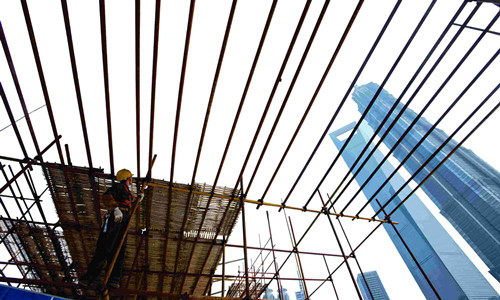
If Shanghai is hailed as the symbol of China's reform and opening-up, then Pudong New Area should be greeted as the perfect symbol of Shanghai's modernization and development over the past 20 years.
On the east bank of the Huangpu River, Pudong used to be an impoverished and uncultivated countryside that lagged behind economically. Shanghai residents used to say "people prefer a bed in Puxi rather than an apartment in Pudong."
But in 20 years Pudong stepped up its development and maintained a high-speed growth. In the next five years, it will achieve some even more impressive advancements.
Forested with scores of trophy skyscrapers, multinational company headquarters, billion-dollar IT plants and high-end housing, Pudong is not only a promising land for entrepreneurs, but nowadays the ideal place for a happy life.
"Pudong is no longer just an ordinary administrative district. Its GDP makes up nearly one third of the total GDP for Shanghai," said Han Kesheng, the director of the Pudong New Area press office.
New opportunities
Over the next five years, Pudong will build up the Lujiazui Financial City, inviting more businesses and company headquarters to open there. According to China's Central Television, of the 500 financial institutions in the Lujiazui Financial City, 96 are banks, including 17 foreign banks with aggregate assets that top 1 trillion yuan ($157.12 billion).
There are also 29 fund management companies that manage about 36 percent of China's total fund assets and 11 companies involved in factor markets for security, futures, diamonds, oil, financial futures, property rights, human resources and real estate.
Pudong will embrace a new opportunity for another wave of major development as it builds its shipping center in the next five years, a center that will surpass Singapore and Hong Kong in volumes of port traffic, Han said.
And the never ending Expo, the construction and opening of Disneyland will also boost economic development and tourism - it is expected to be completed by 2015. "The 24.50-billion-yuan investment in the Disneyland theme park will inject financial incentives that will transform Shanghai's economic development," said Dai Haibo, the deputy director of Shanghai's Pudong New Area. "And the energy the project brings will have an immediate effect on the district's development."
The site of the Expo Park will also attract the opening of 28 State-owned enterprise headquarters. Currently 13 central government enterprises with more than 50 billion yuan in registered capital have signed contracts to move their headquarters or offices to the area. Along with multinational companies and private enterprises, they will form a headquarters economic center with different levels in Pudong.
Over the next five years, the Zhangjiang Hi-tech Park will establish a concentrated plan for all the companies in the park to have initial public offerings (IPOs). The national-level park was established in 1992 and has been chosen to develop new and high technologies. It has become an incubator for many medium and small businesses. "The industry structures will gradually move from second to third levels," Han said.
As an international financial center, Pudong has attracted more than 160,000 skilled and experienced professionals. Though the number is still small compared with the 320,000 working in London and the 800,000 in New York, Pudong is expected to be home to between 220,000 and 250,000 professionals by 2015.
Following the rise of Shanghai's economic power, Pudong will undergo new challenges and advances in several areas.
The Jinqiao Export Processing Zone
Established in the 1990s and covering more than 27 square kilometers, the Jinqiao Export Processing Zone is an important example of Pudong's industrial development. It enjoys the same preferential policies as other State-level economic and technological development zones.
Over the past 21 years, it has achieved a total output worth 1.51 trillion yuan with 1.99 trillion yuan in sales volume. The zone has attracted more than 1,247 projects and the $18 billion in foreign investments yielded 115.20 billion yuan in tax to the government.
There are 62 Fortune 500 listed companies that have developed 107 projects in Jinqiao.
Boasting 85 major high-tech companies, the Jinqiao Export Processing Zone has made a significant contribution to driving the city's economic structure adjustment and economic development. In 2010, the gross industrial output value of the zone totaled 200 billion yuan, an annual increase of 29.20 percent and comprised 7 percent of the total output for Shanghai.
With the development of new industries, Information and Communication Technology (ICT) has become another emerging new field in the zone. "As part of our industry structure adjustment, we are in the process of applying for the establishment of a national ICT demonstration base," said Li Youlin, the deputy director of the Administrative Committee of the export zone.
Boasting the largest groups of ICT companies at the high technology level, Jinqiao ICT industry achieved a total output worth 54 billion yuan in 2010 - 10 percent of the IT industry in Shanghai. Its sales volume reached 6.90 billion yuan last year and more than 29,000 employees work there.
"This zone has become one of the most densely-populated areas for foreign talents in Shanghai. We have nearly 16,300 R&D professionals and offer great support facilities like the famous Biyun International Community to ensure they work and live happily in Pudong," Li said.
The home of China's aircraft industry
The China Commercial Aircraft Company assembly and manufacturing center, located at the south of Pudong International Airport, works on programs to develop the manufacture of large passenger aircraft and plans for regional jets. It is working to achieve the goal of a major civil aircraft manufacturing base in China.
Covering nearly 2.66 square kilometers, the center oversees the indigenous C919 passenger airplane program and will boost the aviation market in the Yangtze River Delta by manufacturing the 150-seat passenger aircraft.
More than 10 plants including workshops for research, manufacture, assembling components and painting are being established in this area that not so long ago was just rice paddies. With a budget of 19 billion yuan at its base, the passenger aircraft will have its maiden flight in 2014 and will be in full service in 2016.
Over the next 15 to 20 years, the center will become the biggest civil aviation manufacturing center in Asia with an annual turnover of at least 100 billion yuan as well as contributing 10 billion yuan in taxes.
"In setting up the C919 airplane assembly line, we aim to produce 20 homegrown C919 jets and 50 ARJ21 planes annually by 2016," said Lu Haiming, the director of the China Commercial Aircraft Company Pudong Center.
The aviation industry in Pudong grew 70 percent in the first 10 months of this year and it will generate the hiring of up to 30,000 professionals for the assembly stages along with 5,000 senior R&D specialists, according to Kang Jinghua, the vice director of Pudong Commission of Economy and Information.
"This is an important strategic investment that will largely boost China's civil aircraft industry," she said.
iPudong 2015
People queuing for buses in Pudong will no longer need to wonder how long before the next bus arrives - from next year, there will be electronic signboards at bus stops advising commuters of the time the next bus is due. This is one of the projects of iPudong, which aims to use advanced technology to make Pudong a clever place.
As well as telling the arrival times for buses, the electronic signboards will offer information on the last bus services for the day, traffic congestion problems and other details. If it is well received, the project will be extended throughout the city.
"iPudong will create a better life for residents by making the management departments more responsive and able to receive information more quickly. We'll set up advanced infrastructures for an advanced network," said Zhang Aiping, the vice director of the Pudong Commission of Economy and Information.
According to the draft outline for iPudong 2015, by the end of 2013 Pudong will offer 99.90 percent Internet coverage at 100 megabytes bandwidth for homes - two years earlier than the rest of the city. Pudong will have a wireless network established and there will be trials of specific "digital parks" in several areas. By then in these special areas, it will only take one minute for people to download a 500-megabyte movie.
"iPudong is closely concerned with the residents and all the applications are designed to make their lives and work easier," Zhang said. By 2015, government issues, city management and public services in Pudong New Area will be among the most efficient, convenient and favorable in Shanghai and its e-government will be highly advanced.
For example, 100 percent of administrative approvals will be able to be searched for and completed online, and 70 percent of the administrative projects will be capable of being processed online. People will be able to get things done or contact local government departments simply by clicking a mouse.