The big stories of 2011
As the year draws to a close the Global Times looks back at the top 10 news events that made the headlines in Shanghai.
No.1 A hit on housing
Shanghai authorities announced at the end of this January that they would impose a controversial and long-awaited property tax in an effort to cool the overheated housing market. Unlike Chongqing, where the property tax targets high-end properties, the Shanghai property tax applies to all second-home buyers or newly purchased properties.
The tax hits newly purchased second and extra houses of permanent residents in Shanghai if the average floor area per family member is more than 60 square meters, the government said. The city's housing market slumped after the introduction of the tax, which also contributed to a drop in house prices. In November hundreds of homeowners in Pudong and Jiading protested after their real estate developers offered discounts of up to 30 percent for units in unsold apartment complex.
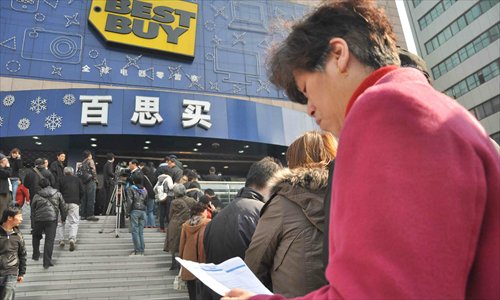
Electronics giant Best Buy called it quits in China on February 22. The US-based electronics retailer closed all nine outlets on the Chinese mainland as well as its regional retail headquarters in Shanghai, though it said it will consolidate its China business operations and merge with its wholly-owned subsidiary, the Nanjing-based Jiangsu Five Start Appliance Company.
While Best Buy said it was confident about this major change in its business strategy, market watchers said the closure was probably the result of the company's failure to adapt to the local market. Analysts said that the limited number of stores and weak relationships with suppliers were two of the factors contributing to Best Buy's retreat.
In 2009 sales at Best Buy's six stores in Shanghai totaled about 1 billion yuan ($151.93 million). In contrast, the net profit of Suning Appliances, a major domestic home appliance dealer, increased 56 percent to 2 billion yuan in the first half of 2010.
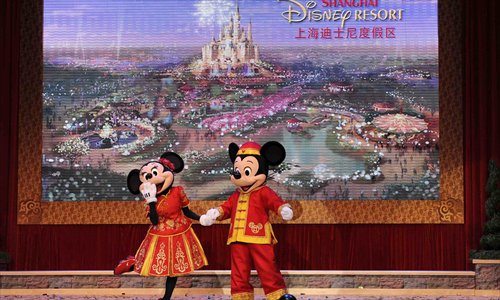
Construction of the Shanghai Disneyland project started on April 8. The groundbreaking ceremony at the site of the long-anticipated theme park and resort in Pudong New Area marked an important milestone after years of negotiations involving central and local government officials. The planned 3.9-square-kilometer theme park, Disney's first on the Chinese mainland and sixth in the world, is expected to be completed by 2015.
Having attracted an initial investment of 24.5 billion yuan, the project is expected to boost Shanghai's tourist industries and create more jobs. "The park will serve as one of the drivers of Shanghai's economic growth," Liu Zhengyi, the deputy head of the Administrative Commission of the Shanghai International Tourism and Resorts Zone, told the media.
More than 2,000 households and 300 companies were relocated to make way for the theme park project. Metro Line 2 and 11 will connect downtown with the park and resort which is expected to attract 7.30 million visitors every year.
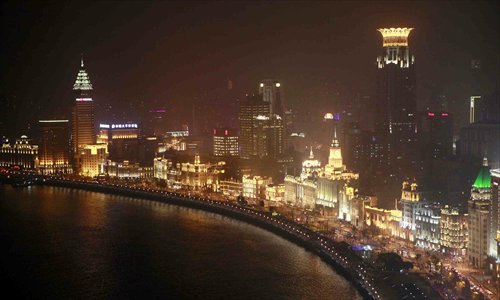
The merger of the downtown Huangpu and Luwan districts to become Huangpu district came into effect on July 1, after the State Council officially approved the move as part of the city's urban planning program. Covering 12.49 square kilometers and 8.03 square kilometers respectively, the former Huangpu and Luwan districts are home to several commercial centers, corporations, historic and tourism sites and many of the city's landmarks including the Bund, Nanjing Road, Xintiandi and Yuyuan Garden.
The merger is expected to benefit the 700,000 residents living there, with cultural and economic resources integrated under one administration. While some residents were left feeling nostalgic, experts say that such consolidations could be the trend for big cities. Luwan and Huangpu were the third district merger in Shanghai in the past decade - Nanshi was merged into Huangpu district in 2000 and Nanhui joined Pudong New Area in 2009.
No.5 Fast connections
The high-speed railway linking Beijing and Shanghai began service on July 1 after nearly two months of trials. Cutting traveling time to 4 hours and 48 minutes and reaching a top speed of 300 kilometers per hour, the new service improves the busy links between the cities and encourages economic development in the regions. Fares range from 410 yuan to 1,750 yuan.
The 1,318-kilometer link was plagued by glitches and delays. After a high-speed train crash in Wenzhou, Zhejiang Province at the end of July, which claimed 40 lives, China suspended all new railway construction projects and worked to improve operational safety on all high-speed trains. Authorities have instituted increased checks and supervision on the railway line.
No.6 Fare's fair
On July 8 the Shanghai Development and Reform Commission announced that the flag-fall fare for taxis downtown would rise from 12 yuan to 14 yuan including a 1-yuan fuel surcharge. The minimum fare after 11 pm increased from 16 yuan to 18 yuan, but the rate per kilometer remained unchanged. The increase followed discussions and public hearings, and the increases were said to be a response to higher petrol prices.
The city's 49,000 taxis had their meters adjusted within a month after the announcement. After the price increase took effect, there were concerns that business could slump and that life could be even tougher for the city's 100,000 taxi drivers. The government said it will continue to provide subsidies for taxi drivers and crack down on illegal cabs.

The 14th FINA World Championships opened at the 2-billion-yuan Shanghai Oriental Sports Center on July 16. Although it was the first time the city had hosted such an event, it attracted many Shanghai sports fans with most tickets sold prior to the games. The 16-day sports extravaganza saw the world's leading 5,724 athletes and coaches arrive to compete in open-water races, diving, water polo and synchronized swimming.
Chinese athletes claimed 15 gold medals (ranking second only to the US which won 17 gold medals), including all the 10 golds for diving. Sun Yang broke the men's 1,500 meters freestyle world record with a time of 14:43.14.
Also in July China's basketball icon Yao Ming announced his retirement from professional basketball after being plagued with a series of injuries. The 2.26-meter Shanghai native played eight seasons for Houston Rockets in the NBA, averaged 19 points and 9.2 rebounds and was named on the NBA All-Star team eight times. The 31-year-old began studying at Shanghai Jiao Tong University's Economics School in November.
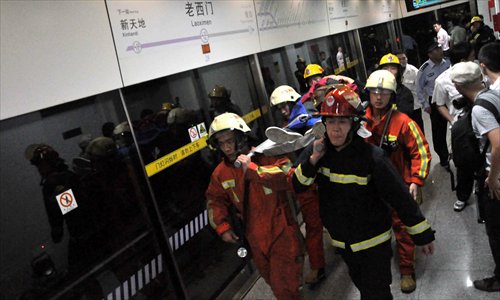
More than 200 people were injured on September 27 when two metro Line 10 trains rear-ended just two months after another accident caused by communication errors. Although none of the victims were seriously injured, the accidents severely dented public confidence in the city's transport safety systems. The subway operator Shentong called it "the darkest day in the history of the Shanghai subway." Authorities promised to increase safety measures but, for different reasons, there have consequently been several delays on the metro lines.
Meanwhile a new round of city subway construction work has started. According to the Oriental Morning Post, Shanghai now has the longest subway network in the world and this is expected to expand from the current 412 kilometers to 525 kilometers with four new lines opening across the city by 2014.
No.9 Counting up
Shanghai's population hit 23 million, the sixth National Census revealed. Figures released in September showed that nearly 1 percent of the people living and working in Shanghai came from abroad. The 2010 census was the first to include individuals from outside the Chinese mainland. Taiwanese comprise the largest overseas population with some 44,900 residing here, followed by 29,700 Japanese and 23,600 Americans.
Another study released by the Shanghai Municipal Statistics Bureau in December showed that Shanghai has the largest overseas population of any city on the Chinese mainland, with 20 percent of this group staying for 20 months on average. The city has become home for one in every four expats. Some 24 percent of the city's overseas population have married someone from the Chinese mainland, with 2,231 of the couples walking down the aisle last year.
A lack of suitable recruitment policies, tax incentives, simple and reliable foreign-friendly services and transparent government policies have been blamed for slowing the city's efforts to attract and retain more international talent.
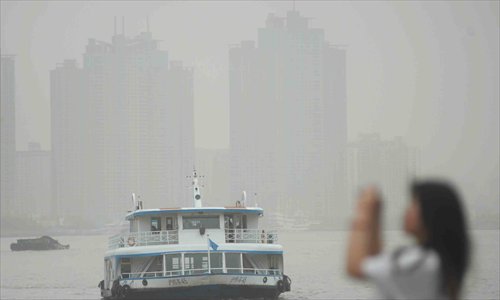
After a meteor shower could not be viewed in the city in early December because of air pollution, for the first time the Shanghai Environmental Monitoring Center released air pollution data that included PM 2.5 readings - the average annual density of particulate matter more than 2.5 micrometers in diameter. PM 2.5, primarily produced by the burning of fossil fuels, is one of the most dangerous type of particulate air pollution as the particles are small enough to penetrate human lungs.
The figures were released in response to public curiosity and concerns over the city's air pollution condition. According to data from the center, the annual PM 2.5 density in Shanghai over the past five years has been about 50 percent higher than the latest National Ambient Air Quality Standard. Shanghai experienced serious air pollution in May and November and has pledged to become one of the first cities to offer a daily PM 2.5 report and forecast.