String theory
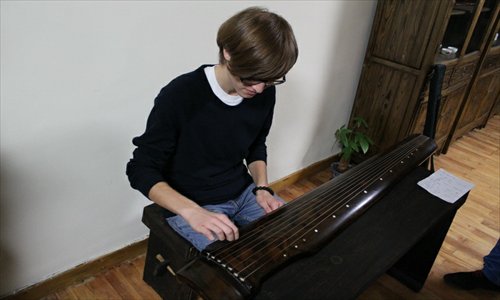
When Chinese people in ancient times described a person of refined taste, and who was well acquainted with literature, the phrase they would often use was being adept at qin, qi, shu, hua. In English this means the person was versed in the guqin, chess, calligraphy and painting.
Featuring seven strings and also known as the yaoqin or yuqin, the guqin can date its popularity back to the Spring and Autumn Period (770BC-476BC). It is also known that the Chinese philosopher and sage Confucius was a keen player. In 2003, UNESCO proclaimed that guqin music as one of the Masterpieces of the Oral and Intangible Heritage of Humanity.
It is one of the oldest plucked stringed musical instruments in China, and yet the guqin has largely fallen out of favor with Chinese people in recent decades. Thankfully a retro trend for the guqin is helping city dwellers re-discover the charms of this thousand-year-old instrument. Chinese media have reported that there are increasingly more and more young office workers in Shanghai going to Suzhou to learn guqin at weekends, as a way of winding down from the fast-paced life. And in Shanghai, there are also a number of guqin workshops springing up.
Shanghai Wenwan Guqin Studio
Every Friday night a non-profit-making class is held here for guqin lovers. Two professional guqin teachers and an assistant take charge of the two-hour class. The history of the guqin is explored as well as some basic skills of how to play the instrument. About 10 people attend the classes.
"There is no loudspeaker for when we are playing the guqin, so we cannot really have any more people in the class," said Sun Yucheng, who organizes the class. "We started the class to inform more people about this traditional Chinese instrument. It's more than just knowing how to play, it's also understanding the principles and culture behind guqin."
The workshop also teaches attendees how to tell the difference between the guqin and the guzheng, as well as how to classify an instrument depending on where and how it was made. This process is aided with the help of books about guqin. Since the workshops started a year ago, some 200 guqin lovers have attended.
According to Sun, about 60 percent of the attendees are office workers aged between 25 and 40. "The popularity of guqin may attribute to the trend of 'Sinology,' as well as it being a way to release stress. The guqin is easier to learn than other Chinese instruments. Our workshops have also attracted some foreigners," added Sun, while admitting there is no English-language service available at the class. After a free introductory class, people can decide if they want to sign up for the three-month guqin course.
Add: 204D, Bldg 3, Lane 977 Hongqiao Road 虹桥路977弄3号楼204D
Admission: Free
Tel: 3250-6829
Qingxian Guqin Studio
At 7 pm every Friday, similar free classes are available at Qingxian Guqin, which have been running for more than six months. "We attract many office workers to the class, and also some foreigners who want to know more about this ancient Chinese instrument," said Liu Chao, one of the three guqin teachers.
The class is divided into two parts: an introduction to the cultural background of guqin, and a Q&A section. After the Q&A section, teachers will perform some modified music pieces on both the guqin and other modern instruments such as the guitar. "Compared to other traditional Chinese instruments, guqin is both less known and less played. We want to make the guqin more accessible to people living in the 21st century, and the attendees seem quite interested in the combination of the guqin and other more modern instruments," Liu told the Global Times.
Knowledge of the instrument itself is also discussed at the class. According to Liu, there are two kinds of guqin according to the paint on the surface; either chemical paint or raw paint. And the type of paint will decide the sound the instrument produces. The chemical-paint model is normally mass-manufactured and not as expensive as the raw-paint varieties. These raw-paint designs are usually handmade and produce a stable, balanced and non-metallic sound. The price of a high-quality raw-paint guqin ranges from between 8,000 yuan ($1,266) and 20,000 yuan.
"But for the guqin beginners, you can pick up a 'chemical painted' guqin for around 2,000 yuan," Liu said.
Add: Room 2505, 188 Hongqiao Road 虹桥路188号2505室
Admission: Free
Tel: 136-2163-7924
Shishang Hongyue Guqin Studio
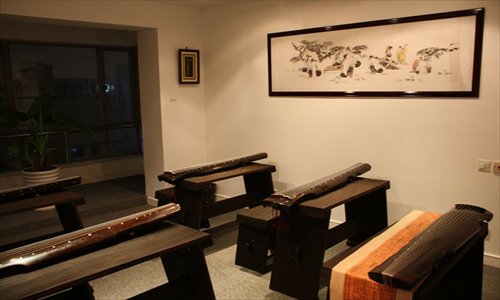
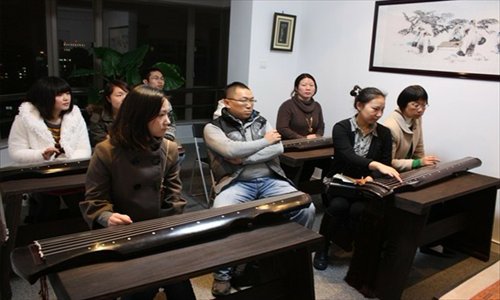
On Friday night every two weeks, the Shishang Hongyue Guqin Studio offers free guqin workshops for beginners. The studio aims to revive classic Chinese classic culture, particularly the aforementioned qin, qi, shu and hua, with the greatest emphasis on playing the guqin.
Along side the history and stories of guqin, famous guqin musical pieces are performed by teachers and students. The lead teacher, Ma Hongfei, started learning guqin from a very young age, and has performed in many countries.
Add: No.17, Lane 56 Yandang Road 雁荡路56弄17号
Admission: Free
Tel: 5306-6825