Costume couture
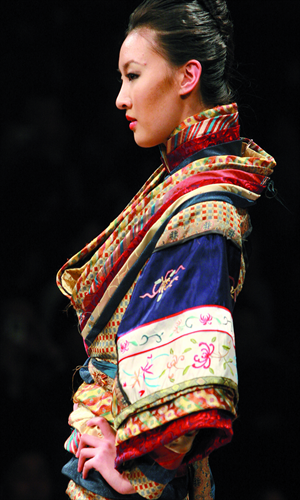
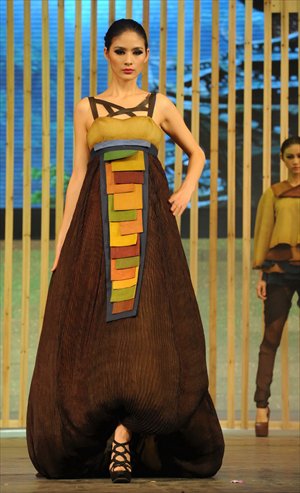
Ethnic minority designs are meeting with high fashion on China's catwalks.
Late last November, a woman, wearing a pleated skirt in the tradition of the Miao ethnic minority in China, walked down a fashion runway. The embroidery that typically runs down the length of the skirt was replaced by a spray of colorful ribbons and silver threads.
The clothing was designed by Lin Xuefei, a young Miao woman from Guizhou Province, as part of the National Costume Design Contest of China, held in Guiyang, Guizhou Province.
The organizers challenged designers to combine elements of traditional ethnic group costumes with looks from today's modern styles. The result was a chic and tasteful presentation of China's cultural diversity.
"In Guizhou Province, we have so many extremely gorgeous elements in our ethnic groups' costumes," said Lin, who won the gold award in the contest. "But they are hidden away in the remote mountains. In my designs, I try to bring these elements of traditional clothes into modern styles."
In preparation for this show, Lin drew on costume elements of five minority peoples among the 17 groups in Guizhou to create the five dresses she entered into the contest.
"People keep coming up to me saying they must go to Guizhou to have a look at the real thing," she laughed.
The costumes and traditions of China's ethnic minorities have recently caught the attention of China's fashion designers, as they offer a wide variety in terms of style, function and deeper cultural meaning.
A treasure trove of inspiration
China's 55 ethnic minorities are scattered across nearly 1,500 counties in every region of the country.
Due to the remote locations of some villages, many subgroups within a specific minority have developed unique cultures, forming separate costume traditions. For example, the subgroups of the Miao people, whose settlements span throughout several provinces in China including Guizhou, Hunan, Yunnan and Sichuan, are generally distinguished according to their costumes: White Miao, Big Flowery Miao, Red Miao, and Black Miao, to name a few.
In addition, vast as China is, the dress of ethnic minorities reflects a wide range of regional climates and resources. Peoples living in the cold north live on stock farming and favor warm clothes made with fur. Peoples in the south often wear cotton and hemp clothes, made from crops that grow in abundance, and their fabrics are often light and thin. Don't expect to see a girl from the Dai ethnic group (who mainly live in the tropical region of Yunnan Province) wearing the thick robes worn by Tibetans.
Thread trends
The contest in Guiyang was not the first design event to bring ethnic costumes to the fore. A fashion show at the Shanghai World Expo in 2010 featured a special presentation called Cloud Clothes with Extraordinary Splendor, which showcased Yunnan ethnic clothes and accessories.
"Many people view ethnic clothes as old-world, to be worn only by people from the countryside. We intend to break this concept, to present ethnic costumes in a fashionable way, putting them on the international stage," said Bai Jie, producer and director of the performance.
The designs in the show were fashioned from the traditional clothes of the 26 minority peoples in Yunnan Province, putting a modern spin on costumes worn by, for example, the Yi, Naxi and Hani peoples.
"We cannot just exclude the cultural force of these costumes because they are thought of as old," said Bai. "Ethnic clothes have developed along with time, just like everything else."
"It's our responsibility as designers to bring the cultures of our nation into people's daily lives, to spread them and put them into use," said Sun Xiuqin, a designer from the Xinjiang Uyghur Autonomous Region, who is a regular at China Fashion Week.
"We can promote these clothes as being part of the character of our time," he said. "And the customs will last longer by becoming more meaningful to mainstream Chinese."
Sun believes that such integration is appropriate, given the rich and unique traditions to be found throughout China's ethnic minority populations. "In doing so, we take our national culture out to the world and enchant people across the globe, making these traditions part of a wider living culture," he told the Global Times.
Application to the mainstream
Sun and Lin are among a growing number of minority clothing designers. Many companies, like WSFM and Liebo, go beyond simply putting intricate Miao embroidery on the cuff of a blouse: Rather, their designers are borrowing from the looks of ethnic costumes, creating something new to follow the fashions of the time.
While Sun believes that the original costumes should be revered in their unaltered states as an indispensable part of China's cultural heritage, he wants today's designers to feel encouraged to riff on them when creating modern designs.
Sun says he carefully considers his target demographic when sitting down to design a piece of clothing.
"If I'm designing clothes for a Uyghur person, then I would leave more Uyghur characteristics in my designs, fitting their customs," he told the Global Times.
Sun also enjoys the challenge of creating styles that will be embraced by fashionistas worldwide. "[The clothing] should be suitable for people all over the world, from Uyghur people to Han people to foreigners," he said, adding that he strives to create clothing that is "both national and international."