The downside of being champion
Seven-year-old Zou Zhixiang has been training as a gymnast for three years in Fuyang, Anhui Province, photographed on September 25, 2011. Photo: CFP
For every Chinese Olympic champion like diver Guo Jingjing, who found a Hong Kong billionaire as boyfriend, there are former athletes like Zou Chunlan, who scrubs clients' bodies in a bathhouse, now that her weight-lifting career is over.
For every success story like gymnast Li Ning, who built an international sports clothing empire after winning multiple Olympic gold medals, there is a Zhang Shangwu who was discovered offering to show passers-by on a Beijing street his pommel horse routine if they dropped a few yuan in a hat.
Zhang won a gymnastic gold medal at the 2001 World Universiade in Beijing, but a serious ankle injury cut his promising athletic career short. He told reporters he was trying to raise money to help treat his ailing grandfather. Within hours, Zhang's story shot around the Internet and was reposted 17,000 times.
To raise bit of cash Ai Dongmei, a former marathoner sold her gold medal for 1,000 yuan ($15.83), and let her lesser medals go for 100 yuan. She had won 19 medals over a competitive running career that spanned 10 years.
The shocking tales of destitute former athletes like Zhang, Ai and Zou have raised questions about the treatment of retired athletes who had been groomed since childhood to bring glory to the motherland.
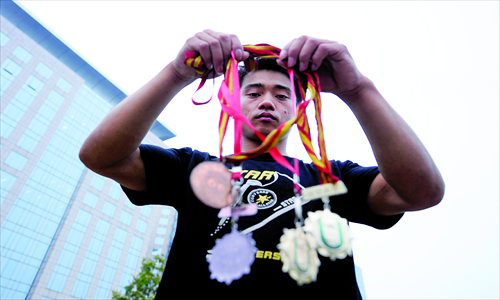
In the hope of helping those who have fallen from the podium to the underclass, the Champions Foundation was established last May. It was initiated by Olympic speed skating champion Yang Yang and the Chinese Red Cross Foundation and has so far provided five career counseling training courses.
Yang said it can be very difficult for Chinese athletes to adjust to civilian life after spending most of their early lives in a regimented training program.
Told when to eat, sleep and train
"Athletes are passive players under the traditional way of teaching and training. They are usually told what to eat, when to sleep and how to train. Their only goal is to achieve a better performance and finally become champions," said Yang.
When athletes retire they not only find themselves out of the limelight, they are also forced to care for themselves and make decisions on their own. Yang said this leaves many athletes feeling "abandoned" and with few real-life skills.
The career counseling offered by the Champions Foundation includes giving the former champs 40 cards representing different professions. The former athletes are told to discard the cards that they are not interested in pursuing as careers. So far about 40 athletes have attended each of the courses.
Even Yang, who is a member of the International Olympic Committee, said it took her several years to determine a career path after she won China's first Winter Olympics gold in 2002 in Salt Lake City.
"My personal value should not only be reflected in skating rink, it had to also make me proud and give me a sense of achievement," said Yang.
According to research by IOC, the average retirement age of athletes who have participated in the Olympic Games is 28.
"Twenty-eight years old is when most young people are chasing their dreams and progressing towards a prosperous future. For athletes this is the age they have to make the kinds of decisions most people make when they are 60," said Yang.
Athletes are offered three options when they leave the sports institute where many had trained since they were small children.
They can choose to attend a university or vocational school without having to pass admittance exams but will have to pay tuition themselves, or they can accept a resettlement fee which averages between 60,000 and 70,000 yuan. A third option for those who have achieved outstanding results, and no less than a top eight at an Olympic Games, retired athletes can attempt to pursue a coaching career.
Zhao Yanyan, 25, left her family when she was 8 years old to train in track and field. She eventually became a competitive cyclist until a tailbone fracture ended her career in 2007. She chose to go to college after leaving her sport, even though her early schooling had all but been ignored.
Ill prepared for academics
"In primary school I was very proud that I didn't have to study as hard as other pupils, and I had much more time to play," said Zhao, who recalls spending most of her childhood at the track.
Zhao says most athletes' parents and coaches don't realize the importance of studying and make promises they can't keep. "My coach once told me if I become a champion, I would get everything," said Zhao.
Zhao had only finished primary school before being admitted to Beijing Sport University after she left competitive athletics.
Zhao says her classmates, who were also former athletes, had trouble in writing Chinese characters and she was one of the few who finished the course.
"In my class almost everyone studied hard the first year, but in the second year only three or four of us kept studying," said Zhao, adding that most of her 27 classmates lost confidence after achieving only low grades despite their determined effort.
Yang, from the Champions Foundation, wants to see coaches, tutors and caregivers be given the tools and the proper thinking to make sure their young athletes have a better, well-rounded upbringing when they are taken to attend sports institutions.
"Attention should not only be focused on athletes, but also on people around them, because of the special roles they play," said Yang.
According to a survey of more than 900 Chinese athletes during the 2010 Guangzhou Asian Games, Yang's foundation found that 54 percent of athletes hope they can further their studies after retirement.
"If I had a chance to do it over again, I would definitely choose to study harder," said cyclist Zhao regretfully.
"Even after graduating from college, I still don't know what I can or should do," said the 25-year-old, who repeatedly mentioned her low self-esteem.
No longer guaranteed jobs
In past decades, retired athletes who had grown up as a star of a State-sponsored athletic team were often guaranteed jobs at the end of their days as competitors. Over the past decade, however, State-owned institutions and enterprises appear to be no longer willing to employ people with few skills they need.
"My past athletic performance is now useless and it didn't guarantee me a job," said Zhao, who earns 60 yuan for a 45-minute cycling class. Her fee will double if she can become a recognized "formal" coach, she said.
"The State-sponsored sports system values athletic performance too much, while neglecting the education of athletes, and not paying much attention to athletes as individuals," said Yan Qiang, vice-president of the newspaper Titan Sports.
Yan agrees that athletes were better taken care of under the old system, but even then were often thrown into unsuitable jobs they had little interest in.
"The State-sponsored sports system is all about training champions and performance is the standard against which everything is measured," said Yan.
In 2007, six ministries agreed to provisional regulations to guarantee the training, study and employment after athletes retire.
Liu Guangtao, a director with the Human Resources Development Center, attached to General Administration of Sport of China, said new policies have been introduced to help athletes secure a better future. These include year-long internships and training courses to prepare them for a future job.
Retired athletes can get help
"Athletes can get suggestions and help from NGOs like Champions Foundation, and from the government," said Liu.
Chinese athletes are not the only ones facing difficulty after their days as competitors are done. The employment of retired athletes was raised at an IOC conference in 2002.
In 2005 the IOC Athlete Career Program was launched to help "Olympic athletes making the transition from the field of play to the labor market." The program was renewed in 2008.
Yet the problems facing Chinese athletes, who train from a young age and compete solely for the glory of their country in a sport with little opportunity for them to use their talent to make money as professionals, remains a serious issue.
Certainly, some Chinese athletes also become superstars in the "real" world, like table tennis legend Deng Yaping. After retiring in 1997 she attended Tsinghua University and Nottingham University and earned a doctorate degree from Cambridge University in 2008.
She realized early during her playing days that an education was as important as winning.
"No athlete can do a sport for a lifetime. They all have to retire someday, so they need to prepare for this from the day when they become athletes," said Deng, adding that the IOC also suggests all athletes prepare for retirement while they are still competing. Deng is now Deputy Secretary-General of People's Daily.
"Nowadays, adjustments are being made to counter the problem. Rigid standards are being changed and new policies are being implemented in sports training schools and organizations," said Yang.
Yang wants coaches to realize that early education of athletes before their retirement will not affect their training, and will help them build a better future life giving them reason to cherish their sports career and encourage them to work even harder at it.