Soft power on airwaves
"This is Africa Live from CCTV News," said news anchor Beatrice Marshall as she launched China's State broadcaster's latest international program from Kenya on January 11.
Broadcasting from her hometown of Nairobi, Marshall's words were whipped by undersea fiber-optic cable 10,000 kilometers to the headquarters of China Central Television in Beijing and then broadcast live around the world by satellite on its English channel.
"The CCTV Africa News Production Center is considered a vital step in expanding CCTV's global news coverage capabilities, it is also regarded as a crucial measure toward the completion of CCTV's global news gathering network to enhance the competitiveness of the TV station," states CCTV's official website.
In addition to the Nairobi center, CCTV plans to set up 14 news bureaus across the African continent by the end of this year.
CCTV's Africa production center is just the beginning of the State broadcaster's massive overseas expansion. It plans to officially launch its North America production center based in Washington D.C., on February 1. It has already hired around 60 local employees.
The Washington center will mainly report on breaking news in the US and produce programs tailored to local audiences, but with a global eye.
Production centers in Europe, Asia-Pacific and the Middle East are scheduled to be established by the end of 2015.
Meanwhile, CCTV declined interview requests from the Global Times.
The expansion of China's official television has garnered worldwide attention, especially since the Chinese government stated its aim to preserve China's "culture security" by strengthening its "soft power" aimed at bolstering the country's international status.
At last October's plenary session of the Central Committee of the Communist Party of China (CPC), enhancing China's soft power was seen as an important way of promoting the country's development and the prosperity of socialist culture.
"To some degree, whoever owns the commanding heights of cultural development, and soft power, will enjoy a competitive edge internationally," declared a communique that was adopted at the conference.
Since Chinese President and General Secretary of CPC Central Committee Hu Jintao first used the term "cultural soft power" in his political report to the last National Party Congress in 2007, China has been spending heavily to promote Chinese culture in the hope of grasping a greater share of global influence.
China has tried to spearhead its drive for greater cultural prominence on several fronts. In 2004 it launched an international network of Confucius Institutes to teach Chinese language and culture. More than 300 Confucius Institutes have been set up around the world.
The government also invested heavily in pushing other Chinese media overseas, including the launch of its 24-hour English news channel under the Xinhua News Agency called CNC World, which began broadcasting on July 1, 2010.
CCTV's global push is seen as the country's most ambitious push into English news coverage in the hope of making China's "voice" heard in the international arena.
"Although our economy has been developing very fast, our voice is very weak around the world, which always leads to a wrong interpretation of China by Western media," said Zhong Xin, a journalism professor at Renmin University of China. He noted that a series of incidents in 2008 and 2009, including protests during the Olympic torch relay in Paris and riots in Tibet and Xinjiang, contributed to the Chinese government's determination to push its message through its own media overseas.
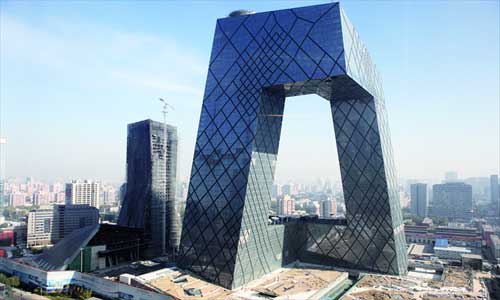
Though experts agree that it's important for the Chinese media to go global, they also admit it will take a long time for CCTV News to become a mainstream media outlet overseas.
Media analysts both at home and abroad agree the biggest challenge for CCTV's overseas expansion lies in winning the trust of foreign audiences. Hu Zhengrong, the vice president of the Communication University of China, told the Global Times that the key to China's credibility is to deliver content that is acceptable to foreign audiences, and in a manner to which they are accustomed.
CCTV's English channel has been attempting to go international since being revamped in 2004. The change started with the hiring of native English speakers as news anchors and increasing its coverage of international news.
Seven years later, the English Channel, which changed its name to CCTV News following another re-launch in April 2009, now has numerous native English news anchors who read the news from a well-equipped studio in Beijing. Viewers are now often treated to reports by locally-hired correspondents wherever breaking news occurs around the world.
"Sometimes, a first glance at our news program on TV creates the illusion that we were watching BBC, instead of CCTV," said an editor with the CCTV News who talked to the Global Times on condition of anonymity.
Since Edwin Maher, who was hired by CCTV in 2004 as the first foreign news anchor, the State broadcaster's stable of foreign talent has now grown to at least 15 native English-speaking news anchors delivering its 24-7 news programming in Beijing.
In order to improve its reporting of world news, which had once relied heavily on the wire copy from AP or Reuters, CCTV has hired 45 freelance foreign correspondents from more than 30 countries around the world.
"Of course, news stories need to be approved by the editors in Beijing, and there are discussions and debates in terms of news angle and the use of some specific expressions, but we are trying our best to present the facts," said a producer from the CCTV News who also declined to be identified.
Experienced locals hired
While the production centers both in Africa and Washington D.C. are headed by Chinese personnel, most of the staff is locally hired including senior producers, hosts or reporters.
Some analysts say CCTV's overseas production centers will offer the audience a new angle to the same events that are also covered by CNN and BBC.
"Audiences in those countries and regions will be able to see and hear a new perspective on developments in their countries, including developments that affect China's interests in those countries and regions," said John Jirik, a long-time observer on CCTV with Lehigh University, in Pennsylvania, US.
Jirik believes the Chinese government should not expect CCTV to instantly gain a trusted position among global media.
Many China watchers suggest the biggest obstacle facing CCTV's global push is its identity as a State-run media institution and trying to win over an audience from a very different cultural background.
"CCTV's identity as part of the State media, or the mouthpiece of the Chinese government, creates a kind of resistance from foreign audiences especially from the West, where most people won't trust it and believe it's all about propaganda," said Hu with the Communication University of China.
Renmin University's journalism Professor Zhong agrees it won't be easy to change long-held perceptions of Western audiences, and believes the launching of these overseas production centers is a chance for CCTV to play down its official identity by reporting news and stories in a smart manner.
"We should take a more open attitude in managing these overseas bureaus so as to win the hearts and minds of local people, by fully engaging the local communities in the shows and providing more direct interactions with local people, or opening the overseas centers for local people to visit," said Zhong.
That appears to be CCTV's Africa Production Center's intent. During the first 60-minute episode of Africa Live, three native African news anchors reported on African politics, economy, culture and sports. The program also included reports from a number of African journalists who filed stories from around the continent. Meanwhile, Kenyan Vice President Kalonzo Musyoka was the first guest on CCTV's new talk show from its base in Kenya, called Talk Africa.
Presenting a Chinese perspective
Many media watchers agree that Africa, where the information industry is not well developed, provides CCTV with a better environment for growth. In the US and other Western countries, CCTV will be competing against media titans, all of which have built reputations as strong, independent news-gathering organizations.
While it will no doubt be years before CCTV's overseas expansion can be seen as having helped increase China's soft power, analysts say the international success of CCTV News and other Chinese media will largely depend on the frank delivery of news from a Chinese perspective in the context of global developments.
"China's soft power will benefit if overseas audiences can see and hear a vibrant discussion about China's place in the world, and a well-informed and globally engaged media that is not afraid to tackle tough subject is key to developing that kind of discussion," said Jirik.