Hot pottery
Galleries specializing in contemporary ceramics have weathered the Chinese art market downturn better than most. Photo: CFP
2011 was a year that saw unexpected stagnation in the Chinese auction market, with paintings by famous artists selling for much less than predicted under the hammer and many auction houses closing their autumn seasons with lackluster sales. However, amid this tough environment, sales of Chinese contemporary ceramics soared, tempting some critics to deem the art genre the hottest pick in 2012.
The numbers are astounding. A decorative quiver by young ceramist Bai Ming, which was appraised between 800,000 and 900,000 yuan ($126,880 to $142,740), fetched 1.265 million yuan at Beijing's China Guardian Auction Company's autumn auction last year, winning the highest amount for any of Bai's work to date.
A blue and white vase by Zhou Guozhen, another ceramist, valued between 250,000 and 350,000 yuan, sold for 1.15 million yuan at last autumn's auction at Beijing-based Poly International Auction Company, which was also the highest auction price among Zhou's works.
All signs point to a new era for Chinese contemporary ceramics. In fact, this trend has been steadily building momentum for quite some time.
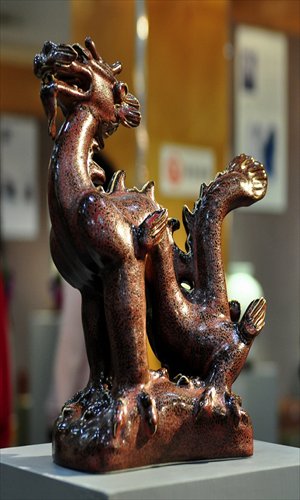
Galleries specializing in contemporary ceramics have weathered the Chinese art market downturn better than most. Photo: CFP
Market growth
As more and more people have come to appreciate contemporary ceramics, the prices of such works have risen sharply in recent decades. Let's take the works of ceramists who Province, as an example. In the late 1980s, an average piece would sell for less than 1,000 yuan. By the end of the 1990s, a typical price tag was about 20,000 yuan. And in 2009, the average price had reached 200, 000 yuan.
The ceramics market on the Chinese mainland saw a decline between the founding of the People's Republic of China and the end of the Cultural Revolution (1966-76). It wasn't until the mid-1970s that Jingdezhen drew foreign ceramics lovers, and demand for ceramics also increased in neighboring countries and regions, like Japan, Singapore, Hong Kong and Taiwan.
Contemporary ceramics began to draw greater attention from mainland art buyers in the 1990s.
Several shops that specialize in contemporary ceramics opened in Hong Kong at the beginning of the 1990s. This prompted mainland markets, especially those in the neighboring Guangdong Province, to grow interested in the art form, and over the years, similar shops began to show up on the mainland.
"Even though the number is still small at the moment, it is still growing," said Han Xiaoying, owner of a Beijing-based ceramics shop.
In 2008, China Guardian Auction Company seized on this burgeoning market by organizing auctions especially for contemporary ceramics. Year-end sales reached 10 million yuan that year. After the company's autumn auction in 2011, the amount went beyond 60 million yuan.
Aesthetic over function
The ballooning market is certainly partially due to recent economic development, but Yang Yu, an art critic, believes "it is the campus ceramists that ushered in Chinese contemporary ceramics."
Yang said over the past few years, ceramists of the older generation, such as Zhong Liansheng, Wang Xiliang, Zhu Danian, and Zhou Guozhen, and a group of young and middle-aged ceramists, like Xiong Gangru, Zhang Jinghui, Bai Ming, and Bai Lei, carved out new innovations, riffing on traditional ceramics styles. Most of them are professors of colleges and universities, and were greatly influenced by traditional ceramics.
By blending different genres and techniques, together they created contemporary ceramics.
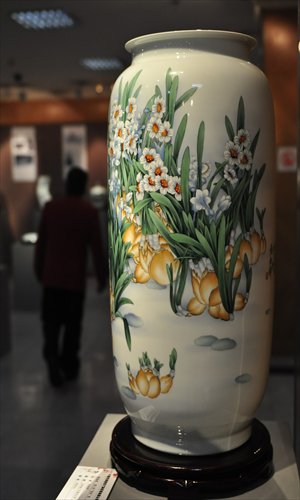
Defining the genre
The Chinese art market has undergone rapid development over the last few years. But today, many people still have only a vague grasp of the genre.
What are the differences between a traditional work and a contemporary one? According to Yang, the answer lies in two aspects: outlook and purpose.
Yang explained that first, the concepts explored in a contemporary ceramics piece go beyond traditional themes. Traditional glazes have been set aside while new visual qualities can be seen from contemporary color glazes. In addition, "techniques like antique glazing, China ink printing, and relief have been innovated, offering new inspiration," he said.
Second, under the traditional aesthetic, the practical use of a ceramics piece was the first concern, and beauty was second.
However, this largely constrained the development of ceramics, because creativity was always limited by the hierarchy of these two fields.
Today, contemporary styles allow ceramists to challenge traditional ceramists can take advantage of other techniques, like sculpture and contemporary installations, in their designs.
Moreover, contemporary ceramics draws on a combination of various values of art, culture and practical use.
"It is a new type of work of art today, but it will be a valued antique tomorrow," said Zhang Haiguo, a senior collector.
"Contemporary ceramics do have very high value for collectors," he continued, adding that some contemporary ceramics are becoming as valuable as antique ones.
Global Times