The temple con
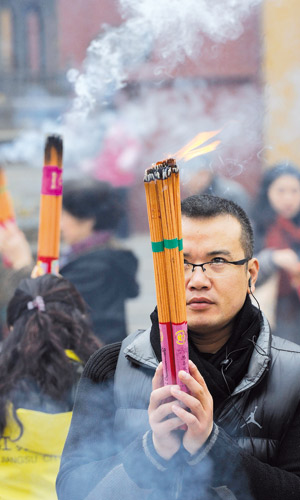
Thousands gather to burn joss sticks at the Nanshan Temple in Sanya, Hainan Pronvince on January 23, 2012. Photo: CFP
The modus operandi of the con artists has also been reported at other places of worship and point to deeply ingrained superstition in the minds of those who are marked. The criminals appear to be taking advantage of a wave of modernization of ancient temples that have opened doors to tens of thousands of visitors and numerous nefarious money-making schemes.
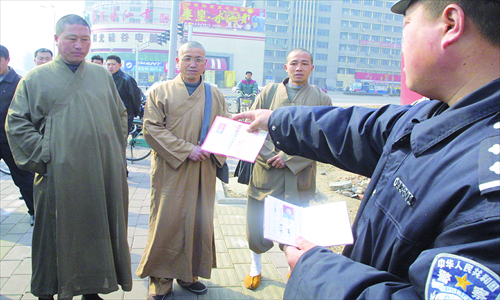
Before Qiu even got through the recently renovated gate of the Yanquan Temple he would have been approached by men posing as monks. They asked him for 2,000 yuan for a bundle of joss stick, likely promising him that he would be endowed with exceptional good luck.
Once Qiu was hooked the bogus monks started to reel him in. This time they would have pressed his fear-of-bad-luck buttons. Somehow they convinced him that the only way to avoid disaster befalling his family was to contribute 15,000 yuan to help build a golden statue of Buddha.
If Qiu balked at the price the imposter monks would heap on the warnings of impending doom. If he tried to avoid making the payment by pleading that he didn't have the money, the monks would scold him for lying in a temple to Buddha.
It's not known what finally twigged Qiu into realizing he was the victim of an elaborate con, but he reported the incident to the police station in Yiliang county, where the Yanquan Temple is located.
On December 21, the police finally acted and arrested two imposter monks and questioned six others who were operating their bad-luck-prevention scam at the temple. A leading Yunnan Province website reported Qiu's case and the arrest of the monks in early January.
Many imposters
A follow-up investigation led by authorities from the provincial capital Kunming and Yiliang county showed that the temple was home to only one authentic, registered Buddhist monk. Subsequent investigations showed that the imposters had done so well they bought spacious homes and were driving luxury cars.
Yanquan Temple was tapped as a potential revenue-generating tourist site more than a decade ago. In 2001 the village, which has jurisdiction over the historic site, signed a contract with Kunming South International Travel Agency to develop the temple's tourism business.
The agency reportedly spent 12 million yuan to expand the surrounding area into a 13-hectare tourist area. In its first year of operation more than 200,000 tourists flocked to the temple, generating over 2 million yuan in profit.
Two years ago the village turned the lease over to a Hunan man, surnamed Long, who offered 7.2 million yuan a year for the lucrative property.
A study by Liu Yuanchun, a researcher at the Institute for Religious Studies with the Shanghai Academy of Social Sciences, found that bogus monks were bilking visitors to religious sites with promises of salvation from superstition.
Liu who had visited places of worship around the country found that religious impostors used the same routine and tricks and were often in cahoots with tour guides.
He said many temples in Northwest China have been contracted by a travel agency from Sichuan Province that taught tour guides and impostor monks how to trap and trick tourists.
"They use psychology to trick people," said Li Xiangping, a professor with department of Sociology, East China Normal University in Shanghai explaining how some tourists can be talked into paying money, even huge amounts in return for a special blessing that includes a promise of future prosperity.
Li is upset with people who worship Buddha in the hope of achieving some materialistic gain, rather than spiritual enlightenment.
"People have been deluded into thinking that Buddha only blesses the rich, which not only goes against the teachings of Buddhism, it also harms the image of Chinese culture," said Li.
"Chinese people have a different belief system when it comes to religion. We usually put self interest and materialism into our religious beliefs," said Qiao Xinsheng, a professor with Zhongnan University of Economics and Law in Wuhan, Hubei Province.
Some people who have been conned say the religious department will pass them on to the tourism bureau which will then pass them on to some other department of the local government, all of which refuse to take responsibility for the con games happening under their noses.
"The problem lies in the management committee or the commercial organization. They do everything for money and in turn harm the interests of tourists and worshippers," said researcher Qiao.
The committees, which are supervised by the government's religious management department, often include religious people and authentic monks but they have little sway or interest when it comes to making profits from religious tourist sites.
"When tourists are charged too much it's the local government that should take action, not the monks," said Qiao, who believes local governments often put profit first and see religion as a business.
"The key problem is how to build a scientific and effective governance structure," said Qiao.
Even residential property developers are tapping into the Chinese belief in the granting of prosperity by otherworld forces by constructing a temple within their apartment complex.
"Without the support of a local government, it is impossible for those temples to be built," said Li, suggesting that local governments are allowing developers to prey on potential buyers' superstitious beliefs.
In some places, the government built temples and then invited monks to set up a monastery. The monks are required to return "profits" to the government to cover their investment and provide revenue to their coffers.
"The government should not be involved in profit-gaining activities, and it is totally improper for it to take advantage of religion to earn money," said Li, adding that the practice of using temples and people's religious beliefs to make money has been going on for decades.
Li blames the con games being played on tourists at religious sites on this hunger for money.
"The religious management committee has tremendous autonomy," said Xiao Yaohui, a researcher with the Yunnan Academy of Social Sciences.
Xiao says the governance of religious sites is complicated because the government's social management department both controls religious activities and benefits financially when a site attracts many worshippers. He thinks government should stick to making rules and not be involved in religion as a money-making enterprise.
Jiang Jianyong, deputy director with State Administration for Religious Affairs, says the country's larger religious sites follow acceptable accounting practices and many issue financial statements prepared by their own accountants.
Jiang told Xinhua that smaller temples still need to implement much better financial accountability.
Ou Peng says he hopes some government agency or institute will clamp down on the con artists who took him and his family for a ride.
Last October he also visited Yanquan Temple after a tour guide recommended it.
Ou was introduced to a "master monk" who suggested he purchase incense worth 10,800 yuan, to prevent pending danger to his family. The master even let him use his bank card to pay.
As soon as he burned the incense the master warned him that his son was headed for danger and he need another special bundle of incense worth 12,600 yuan to ward off the pending trauma. Ou again handed over his bank card.
"They suddenly became tough and uncompromising. I was scared and submissive as I am always looking to make a fortune," said Ou, adding that he soon realized he was being conned by a gang of extortionists.
China News Week reported that Ou got his money back after he complained to the Kunming Tourism Bureau.