A Gaudí tour

What if you were allowed only half a day to take a whirlwind trip through Barcelona, a jewel case of the Mediterranean with so many gems to dazzle visitors? I had to think hard for a solution even before leaving China, as my business trip had been fully scheduled with interviews and meetings. After a lot of pondering and researching, I made a decision which now proved most correct and sensible: a Gaudí tour.
As an Olympic host and Expo pioneer, Barcelona has accomplished what both Beijing and Shanghai boast of, and impressed the Chinese people with its shining stadiums in 1992 as shown on satellite TV. However, my colleagues and I were stricken with the city's diversity of styles when we traipsed through the shadowy alleys in Barri Gotic (the Gothic quarter) to meet city council officials working in a medieval building where gargoyles of the millennium-old cathedral serve as a backdrop through their windows.
Nothing, however, possesses the same status as Antonio Gaudí, Barcelona's favorite son. Take a walk along the city's most famous street Las Ramblas, and look around, the name you most frequently see is perhaps not the city's name itself, but the name of Gaudí. Postcards, calendars, and souvenirs are stamped with either his name or his work. Tourist agencies promote all kinds of Gaudí tours and sightseeing bus lines all lead to his architectural creations.
To view the complete works of Gaudí in Barcelona, you need at least one day even in Chinese tourists' notorious snap'n'go style, since it's commonly known that Gaudí finished, or failed to finish, nine buildings within the city and its suburbs. Luckily, we had Gustavo Contepomi, an architect friend working both in Barcelona and Beijing, known through the Spanish embassy in Beijing, as our guide.
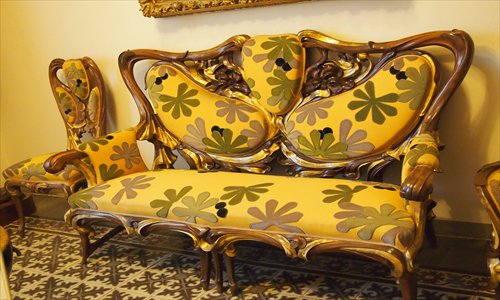
Furniture in Casa Milà. Photo: Li Hongwei/GT
Our first stop was Gaudí's magnum opus, Sagrada Família, otherwise known as The Sacred Family Church.
Many people have probably seen it in the background from well-known films such as Woody Allen's Vicky Cristina Barcelona and Pedro Almodovar's All about My Mother. But Sagrada Família is more than a backdrop; it has a character that embodies the city's beauty and sensibility along with its creator's deep pessimism and spirituality.
We saw the church's towers from afar in the taxi. They were like tropical plants shooting from the ground and striving painfully to touch the sky. Getting out of the car in front of the Nativity facade, I couldn't help but stand in awe of the other-worldly carvings and sculptures. The exterior shapes and columns looked so heavy with their elaborate designs, overall they gave me a feeling they could fall on my head at any minute.
We spent quite some time at the Nativity facade since it was truly the work of Gaudí. The architect started working on the church in late 1883, and the Nativity piece was finished in 1900. A glimpse of the scale and intricacy of the work tells how labor-intensive the construction was. The subjects of the facade are divided to gates of faith, hope and love, representing three cardinal Christian virtues, each illustrated with life-size sculptures of the Holy Family, apostles, angels, shepherds, babies, chickens, and owls.
While the Catalonian love for nature is apparent in the sculptures, the bizarrely growing stone lumps and their darkish color also gave me a sense of pessimism and the heaviness of life.
"No wonder," said Gustavo after I told him how I felt, "Gaudí was very pessimistic." According to Gustavo, the official name "Expiatory Temple of the Sacred Family" implies Gaudí's deep sense of Catholic guilt. "Expiatory means atonement. Gaudí was very religious…fervent, to a fanatic degree," said Gustavo, "He died after being run over by a tram on his way to daily confession."
Sagrada Familia triggered controversy even when Gaudí was alive. When Spanish King Alfonso XIII visited the church in 1904, someone from his entourage asked the king whether the facade was "overdone." "You should look at the whole structure," the king was recorded as tersely saying.
Gustavo also reminded me to appreciate what he called "the explosion of space" about the church. It is indeed explosive, especially given that there was no computer in Gaudí's time to develop 3-D models.
Inside the church, the explosion of space is accentuated by the skylight penetrating from the windows and vaults, creating a spatial hallucination and an atmosphere of seclusion and prayer.
The interior of the church stands apart from others which contribute to its organic characteristics. The columns look like plants thickly growing upward, the vaults expanding at the top like branches and the ceiling transformed to sunflowers. Even the holy water font is seashell-shaped, highlighting Catalonia's Mediterranean feature. "Gaudí's work defies the industrial era," commented Gustavo, "by adopting a gothic style, Gaudí wasn't going back in history; he also defied the ugliness of industrialization."
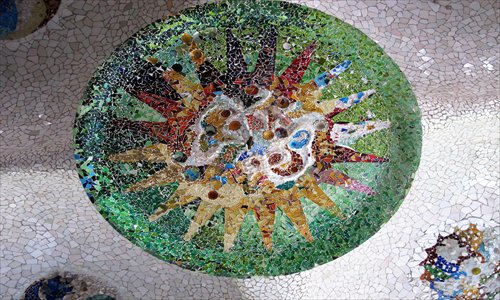
Bits of glazed ceramic tile called trencadis in Güell Park. Photo: CFP
A lot of graphic documentation was burned during a fire in the church's crypt, which led many to speculate what Gaudí's original idea was for the other two facades: Passion and Gloria. Now the Passion facade is the controversial work of local sculptor Josep M. Subirachs, which seems very different from the rest of the work and therefore is the focus of controversy.
To some, including Gustavo, the church won't be called Gaudí's when it's finished. "Can you imagine someone else finishing Picasso's unfinished painting and still calling it a Picasso?"
But even if all the graphics were preserved, Sagrada Família wouldn't be the same. "Gaudí was a very intuitive person," said Gustavo, "he changed his ideas constantly as the construction developed."
Furthermore, parts of Gaudí's plan will never be accomplished due to other reasons. The planned plaza in front of the main entrance, for example, perhaps will never come into being. A block of buildings has occupied the land and perhaps only in China could they be demolished efficiently to be loyal to the genius's original plan.
The construction of the church won't be finished until 2030. In China, rumor has it that a Chinese construction company has taken over the project because the local people can no longer wait. When I jokingly repeated the rumor to Francesc Gamús, director general of external affairs of the Catalonia regional government, he laughed hard and then said, "Why the rush? The ground stone of our cathedral was laid in the first millennium, and the facade was finished in the 19th century." I guess God has the patience.
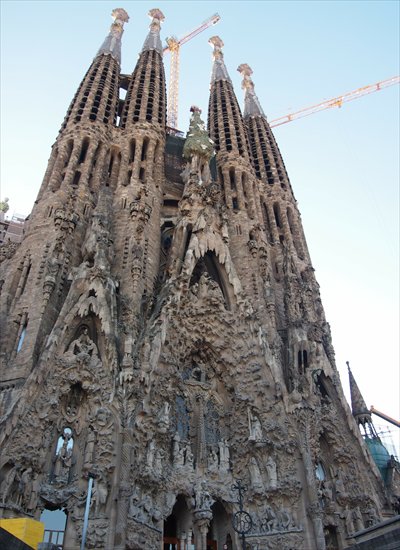
The Nativity facade of the Sagrada Família. Photo: Li Hongwei/GT
Under Gustavo's guidance, I decided to visit Gaudí's two other works: Casa Milà and Park Güell. "They are Gaudí's later works, and unlike his earlier works, of which Gaudí only designed parts and portions, his later pieces are almost all his ideas, from the tile to the interior decorations."
Casa Milà, better known as La Pedrera (the quarry) in Barcelona, is located in the Eixample district where streets are broader than the old town. The rich Milà family assigned the work to Gaudí in 1905 when he was less busy because the construction of Sagrada Família was at a standstill due to lack of funding.
Neo-gothic, rococo or baroque, none of those words or their combination, can define Casa Milà. Different from other modernista buildings in the same district, Casa Milà is located at the corner of two streets with an imposing area of 1,600 square meters. But I almost didn't realize there was a corner there because of the organic and natural curves. It looks like a big rock in the sea, with lines composed by balconies flowing like waves intertwined with the seaweed of ironwork.
Defying the boredom of functionality of the industrial era, Casa Milà renders endless surprises. On the exterior, each of the wrought irons is different. Inside, rooms are all irregular and each has its distinctive style. Gaudí also designed furniture for the dwellers. The couches look quirky but make one wonder whether they're comfortable to sit in. Bizarrely-shaped mirrors perhaps reflected the designer's mysterious heart more than the owner's luxurious lifestyle.
The rooftop is the wonderland of the house. All the chimneys have an exotic and primitive form, with some looking like Spanish conquistadors. If you need a picture with Gaudí as the backdrop, this is the ideal place. Thanks to the absence of high-rises in the city, the towers of Sagrada Família can be seen clearly on the roof and one snap of the camera can capture both Casa Milà and the church towers in the same picture.
An exhibition on the top floor deserves a visit even if you're short of time, since it helps you discover where Gaudí's inspirations came from. For example, in one display, joined metal chains hang on the ceilings like a chandelier, with a mirror under it. Without any explanation, you know the shape of Sagrada Família towers are a mimic of the reflection of the chains in the mirror. Take a 10-minute walk around Casa Milà, you will find more modernista buildings, including another Gaudí creation, Casa Batlló, and some of his rivals' work. The area around Casa Milà is called the District of Discordance, due to the many different styles of architecture mixed together. Don't overlook the tiles of the pavement and the lampposts here; they are all Gaudí's children.
Located in the city's hilly area, Güell Park is where you can enjoy a panoramic view of the beautiful city. The park is named after Barcelona's prominent industrialist Eusebi Güell, who to Gaudí was like the Medici of Florentine artists. Along the main staircase you will see the beautiful trencadis - broken bits of glazed ceramic tile. On top of the Salon of the Hundred Columns is a public square where serpentine benches adorned with brightly colored trencadis attract many visitors to sit down.
Güell's original plan was to build 60 houses in the park; however, only two have been finished. One of the two has been converted to a museum and is worth visiting. Gaudí lived here from 1906 to 1926.
Finally we got a glimpse of how the genius spent his last years: only a bed, a chair, a bed stand, and a crucifix on the wall. The crucifix is exactly in the same style of what appears at the altar of Sagrada Família, with the head of Jesus lifting skyward and legs bending at a painful angle, perhaps depicting the artist's deep yearning and unspeakable sorrow.